


KEY POINTS
- “Peace” was chosen as 2025’s top word by children.
- Mentions of “peace” in children’s creative writing have surged by 60%.
- Slang term “six-seven” won overwhelmingly, valued by kids for friendship and fun.
- For the second year, “AI” was the runner-up.
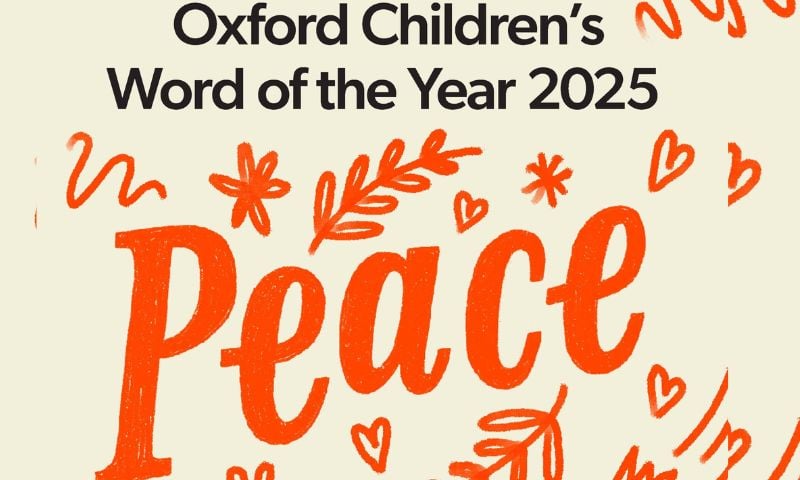
ISLAMABAD: In a poignant reflection of contemporary childhood, “peace” has been declared the Oxford Children’s Word of the Year for 2025 by Oxford University Press (OUP).
ISLAMABAD: Peace has been chosen the Oxford Children’s Word of the Year 2025, reflecting growing awareness among children of global conflict and instability.
The selection, announced by Oxford University Press (OUP), is based on research involving nearly 5,000 children aged six to 14 in the UK and ranked ahead of words such as AI and resilience, highlighting how world events are shaping young people’s perspectives.
Child’s-eye view of troubled world
The selection of “peace” was directly linked by children to current affairs, with one in ten specifically mentioning “war” when explaining their choice.
Conflicts in Ukraine and Gaza were cited, with words like “need,” “want,” and “should” frequently framing their calls for global harmony.
This consciousness is echoed in children’s own writing; analysis of the Oxford Children’s Corpus shows a 60% increase in mentions of peace in stories submitted to the BBC 500 Words competition since 2015.
“This year’s research demonstrates just how attuned children are to current affairs,” said Andrea Quincey, Director of Early Years and Primary Publishing at OUP.
“Whether that’s calling for peace in response to current conflicts or highlighting how AI has permeated daily life.”
AI’s presence and slang of connection
For the second year running, “AI” was the runner-up, chosen by 33% of children.
A significant 29% of six- to eight-year-olds selected it, confirming its ubiquitous presence in even young children’s lives.
Responses like “excited” highlighted their positive association with the technology.
In the realm of slang, the term “six-seven” dominated, chosen by 47% of children as their word of the year, followed by “aura” and “delulu.”
Research revealed its role in fostering social bonds, with children linking it to “friends,” “popular,” “fun,” and “laugh.”
Notably, 72% of children emphasised the importance of having words they use exclusively with friends.
“Perhaps it’s no surprise that ‘six-seven’ is voted, overwhelmingly, as their slang word of the year,” Quincey noted.
“A word which brings them laughter and joy and connection with friends.”
Celebration of language
To build on these insights, OUP is calling for UK schools to participate in the 2026 research, aiming to capture more regional voices and colloquial language.
An accompanying activity pack has been developed to support vocabulary and oracy skills through “word of the year” conversations.
The annual research, part of a decade-long project by OUP’s Children’s Language department, culminated in the Oxford Children’s Word of the Year 2025 report, published on January 21, 2026.
It paints a picture of a generation deeply conscious of global strife, immersed in technological change, and creatively building their own linguistic worlds of connection and joy.