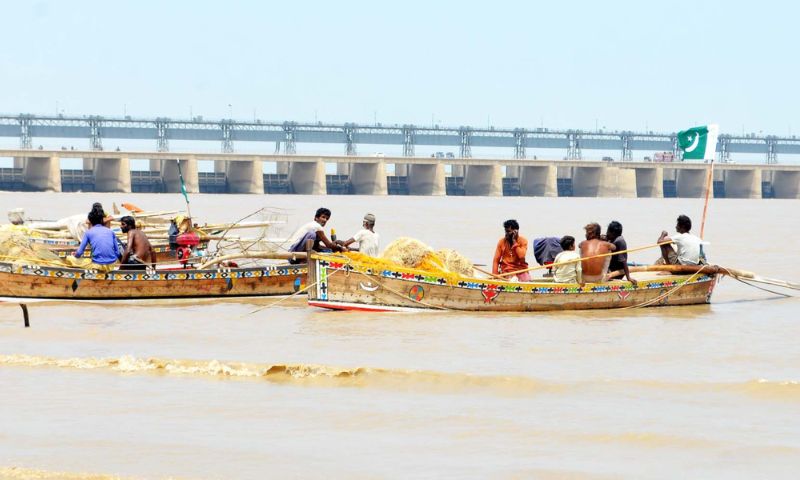



HYDERABAD, Pakistan: Thirty-something Allah Dino Mallah and his fellows wait for another round of their turn downstream of the Kotri Barrage on the right bank of the Indus River to catch palla—a unique species of fish celebrated for its rich aroma and taste.
Unlike other fish, it has countless spines, making it somewhat difficult to eat, especially for first-timers. Spicy palla is sold in hotels in the Jamshoro district, mostly at a much higher price compared to other Indus fish like rohu (Labeo rohita) locally called rau, or even common sea species. Fried palla is priced between Rs. 6,000 to Rs. 7,000 per piece in hotels located near the barrage in Jamshoro.
Chasing the bigger catch
“It depends on your luck”, says Dino, hoping for a better catch as he prepares to enter the river for his second round. Dino and his friend, Mumtaz Mallah, make up to five rounds a day in the river in their bid to catch palla, which offers them better income prospects. These rounds are taken by different fishermen in turns to ensure fairness.
On average, a fisherman catches five to six palla a day, sold at Rs. 500 to Rs. 6,000 depending on size.
Palla is expensive because of its taste and its limited availability during this particular season, Mumtaz adds, continuing the conversation on the right bank of the Indus River inside the riverbed downstream of the barrage, where flows have somewhat increased.
Mumtaz and his fellow fishermen’s daylong activity sometimes continues late into the night. For them, time and tide wait for none, and every round in the river counts. “Since economic returns are relatively better, everyone aims to catch as much palla as possible,” he says. He, so far, has been able to get 10 to 12 pieces of palla, but not of the preferred size that buyers usually demand.
“A piece weighing hardly half a kilogram sells for Rs. 500 or more, but if it weighs over a kilogram and is egg bearing, it can easily fetch the fisherman thousands of rupees apiece,” Mumtaz adds.
Our elders used to tell us how they regularly caught plenty of palla when Indus River used to have sufficient flows downstream of the Kotri Barrage. These flows were always a sign of euphoria for all of us.” – Allah Dino Mallah, a fisherman
“Now we crave for few pieces of this fish. In the past 45 days, since the below-Kotri flows resumed, I have only managed to catch four to five pieces a day,“ he regrets.
For Dino, fishing has become a game of chance, where effort is plenty but reward is uncertain.
It has been 45 days since we started struggling to catch palla, Mumtaz says. Fishermen like him and his friends sell their catch directly to buyers as well as retail fish vendors. Many of their boats remain anchored on the riverbank. “Some of us take up to nine rounds in 24 hours, especially during the monsoon season. The number of fish caught in each round varies,” he says.
For fishermen like Dino and Mumtaz, the struggle to find palla is deeply linked with the river’s unpredictable flows, which are shaped by Kotri Barrage.
Kotri Barrage’s critical role
The Indus River has been meeting the Arabian Sea in the Kharrochhan area of coastal Thatta district for the last two months—thanks to the seasonal flood flows reaching the Indus River System.
Before entering the ocean, the river crosses Kotri Barrage—the last barrage over Indus Basin Irrigation system (IBIS) that is the world’s most contiguous irrigation network—constructed soon after the country’s independence in 1947.
Recent rainfall in the upper reaches suggests that water will reach Kotri in the coming days, given that the Guddu Barrage again touched low-flood level on August 18 after having passed a peak flood on July 29 this year.
Adequate Indus flows are directly tied to palla’s growth and unique breeding pattern, which is reported mainly between the river stretch below Kotri Barrage and deltaic region of Sujawal and Thatta. But sustainable post-Kotri flows have been a serious issue for the past three decades, driven both by climate change and upstream water storage projects.
Mumtaz notes that Kotri Barrage authorities have opened gates to allow flows downstream. The gates are usually opened during the flood season once the demands of off-taking canals are met. The surplus water is then released downstream, also helping to meet Hyderabad city’s drinking water needs. The civic agency lifts water at a designated point below Kotri Barrage. These flows, while ensuring urban supply, also contribute to the fishermen’s economic survival.

The story of Kotri is also the story of recurring floods that have reshaped both the river’s ecology and the fortunes of its fishermen.
Floods fuel fisheries
It was 15 years ago that Kotri Barrage witnessed super floods, when one-fourth of Pakistan was hit by flash floods in 2010. At that time, a flow of 939,442 cusecs passed downstream Kotri on August 27, 2010. This was followed by a medium flood of 344,866 cusecs on August 31, 2013; a high flood of 603,084 cusecs on August 19, 2015; another high flood of 600,018 cusecs on September 11, 2022; and a medium flood exceeding 300,000 cusecs in August 2024. Earlier, Kotri experienced a very high flood of 710,739 cusecs on August 27, 1978; 793,522 cusecs on August 13, 1994; a super flood of 817,749 cusecs on August 26, 1994; and a very high flood of 771,365 cusecs on August 19, 1995.
Since 2010, we’ve seen regular rainfall, which helped revive palla production – Moazzam Khan, ex-Director General of Marine Fisheries, Karachi
Seventy-six-year-old Karachi-based Muhammad Moazzam Khan, who once served as Director General of Marine Fisheries in Karachi, believes that palla production has improved since the 2010 super floods that devastated the country. “Since 2010, we’ve seen regular rainfall, which helped revive palla production,” he notes. Palla production, which had dropped to 254 tons production in 2011, rebounded to 1,506 in 2020; 1,540 in 2023 and 1,472 tons in 2024.
Beyond floods and flows, palla’s own breeding cycle reveals why uninterrupted river connectivity is vital for its survival.
Palla’s breeding journey
Moazzam Khan calls palla a native of the sea. “It migrates to the river for breeding and spawning, a process that continues from the monsoon to winter. Grown-up palla are caught either while returning to the sea or moving further upstream,” he explains.
Memoirs of Mughal emperor Zahiruddin Muhammad Babar, he remarks, mention palla’s presence as far upstream as Attock, a city at the junction of Punjab and Khyber Pakhtunkhwa. Citing one of the most credible studies on palla production by American scientist GBI Talbot and his Bangladeshi counterpart, NI Bhuyian, Moazzam argues that modern barrages and water diversion structures over the Indus have indeed hampered pala production.
His research shows that “past evidence indicates its availability even in Multan, but now it is hardly found between Sukkur and Kotri [barrages].”
Yet, even when nature favours the fishermen, human practices like destructive nets continue to endanger palla’s future.
Moazzam warns that the use of nets such as bolo—Estuarine Set Bag Net or ESBN—and other fixed gillnets poses a major threat to palla’s survival and migration. Yet these are frequently used by fishing communities between Kotri Barrage and the delta. “These nets allow the capture of palla as small as six inches,” he regrets. Under the Sindh Fisheries Ordinance, 1980, ESBN is banned, but enforcement remains elusive.