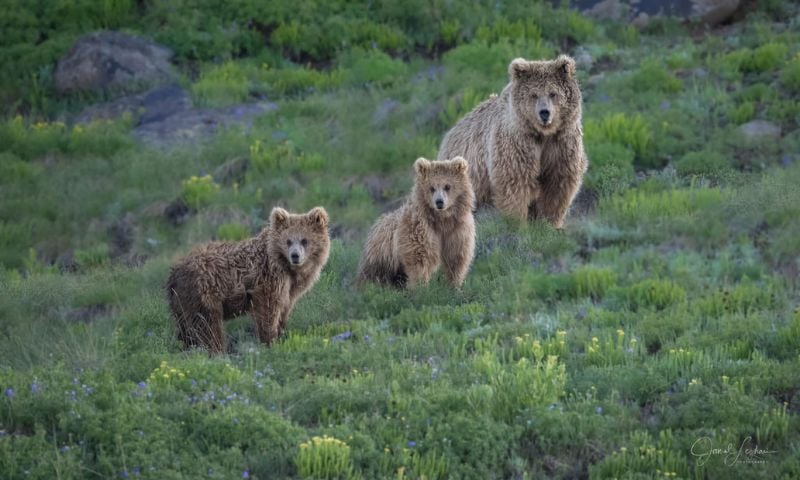



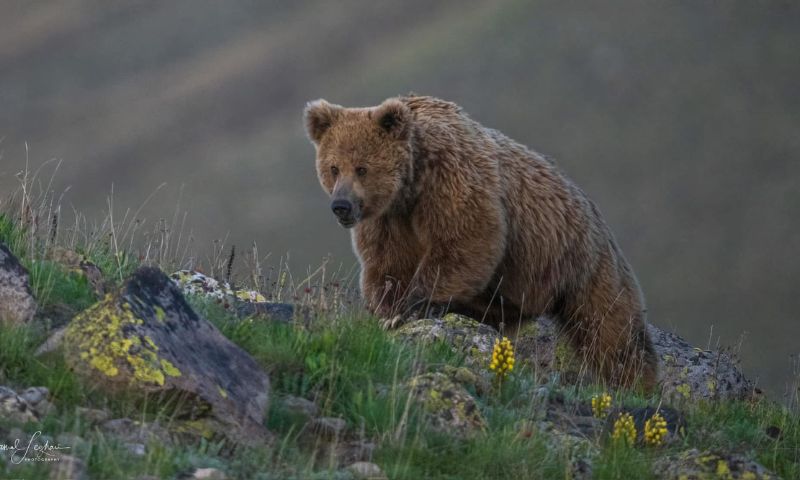
SKARDU, Pakistan: High atop the alpine plateaus of Gilgit-Baltistan, the Himalayan brown bear reigns as the undisputed, yet fragile, monarch of the mountains.
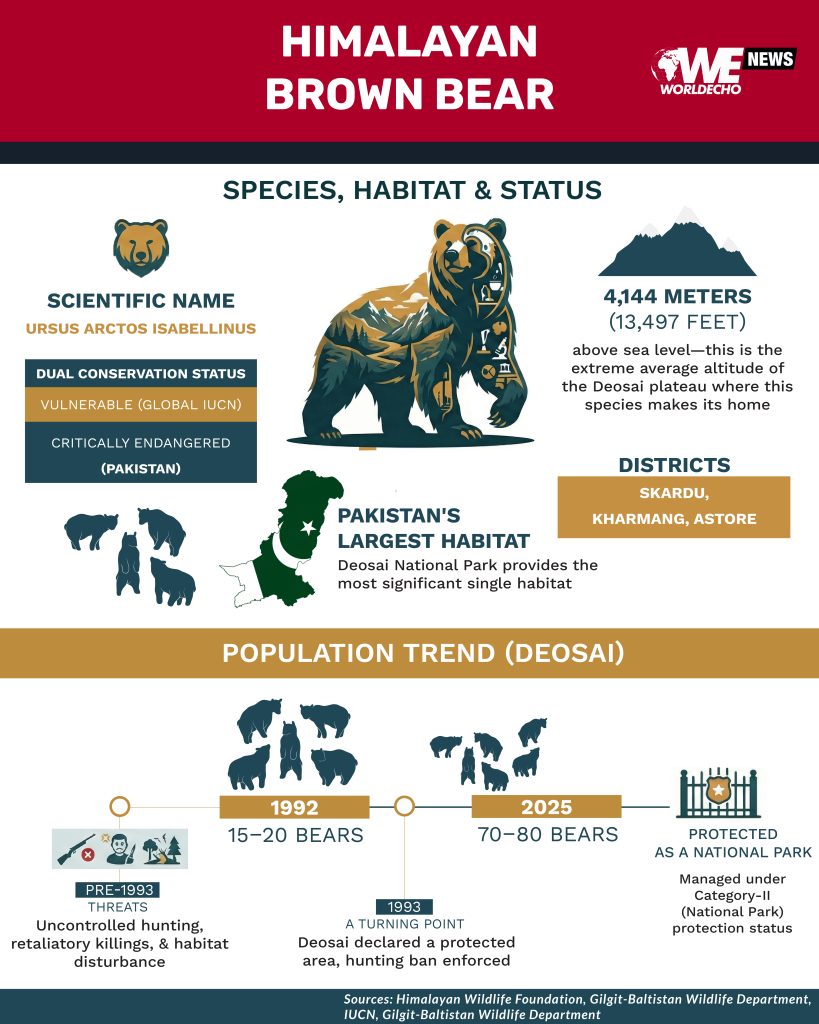
Known scientifically as Ursus arctos isabellinus, this majestic creature is listed as Vulnerable on the International Union for Conservation of Nature (IUCN) Red List.
At the national level in Pakistan, however, it is considered Critically Endangered — its population fragmented, its range restricted, and its survival historically hanging by a thread.
Deosai National Park, often called the “Roof of the World,” stretches across the Skardu, Kharmang, and Astore districts.
At an average altitude of 13,497 feet (4,144 metres), it provides Pakistan’s largest single habitat for Himalayan brown bears.
From brink to revival
According to the Gilgit-Baltistan Wildlife Department, nearly 80 Himalayan brown bears currently inhabit Deosai National Park.
Their numbers tell a story of resilience, a testament to the saying that ‘where there’s life, there’s hope.
The survey conducted by the Himalayan Wildlife Foundation (HWF) reveals that the species plummeted to a perilous low of 15–20 bears by 1992.
The causes were many and varied — from uncontrolled hunting and retaliatory killings following livestock depredation to lack of legal protection and mounting habitat disturbance.
The tide began to turn in 1993, when Deosai was declared a National Park. Strict hunting bans were enforced, and a series of conservation measures — community engagement, livestock compensation schemes, wildlife monitoring, and awareness campaigns — were rolled out.
The bear was found dead early in the morning by our staff. We immediately ordered a medical examination to determine the cause of death. If it was killed illegally, we would pursue strict legal action. If natural, we would confirm that officially.” – Naeem Abbas, Wildlife Department official
Today, Deosai remains the bear’s stronghold, its laws providing the strongest legal shield for these creatures in Pakistan.
Sustainable ecotourism is permitted, but the park continues to uphold strict conservation protocols, ensuring the brown bear remains an emblem of Deosai’s natural wealth.
Current population
Deosai currently supports an estimated population of around 70–80 Himalayan brown bears, making it the largest single habitat for the species in Pakistan.
Hunting has been strictly prohibited since the government of Gilgit-Baltistan declared Deosai a protected area in 1993, initially granting it the highest level of legal protection under Category-I (strict natural reserve).
The designation was later revised to Category-II (National Park), allowing for sustainable use and limited ecotourism while maintaining strong conservation safeguards.
Tragedy in Minimarg
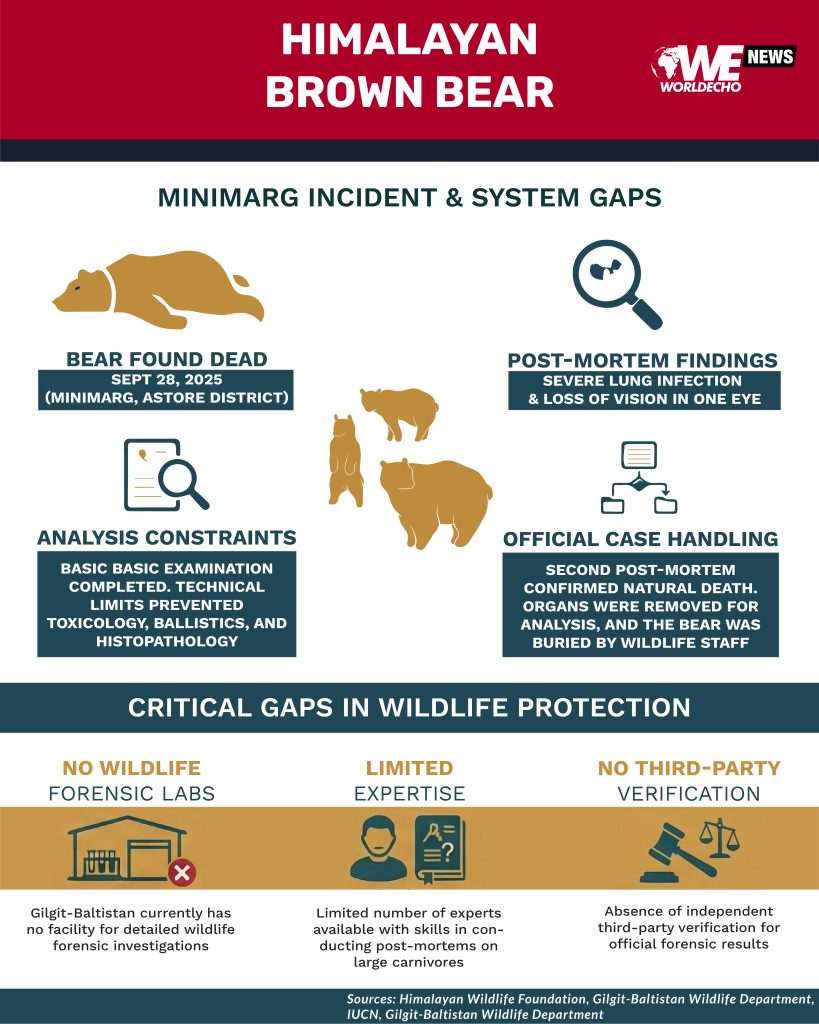
Despite these safeguards, the bear’s death in Minimarg on 28 September 2025 has reignited concern.
Minimarg — a remote, sparsely populated area of Astore district, some 35–40 kilometres east of Astore city — became the scene of distressing images circulated on social media: a Himalayan brown bear, lifeless and covered in blood. Conservationists feared the worst — illegal hunting.
Naeem Abbas, Divisional Forest Officer (DFO) of the Astore Wildlife Department, confirms the discovery.
“The bear was found dead early in the morning by our staff. We immediately ordered a medical examination to determine the cause of death. If it was killed illegally, we would pursue strict legal action. If natural, we would confirm that officially,” Abbas said.
The initial postmortem conducted by a local veterinary doctor revealed a severe lung infection as the cause of death.
However, wildlife experts and conservation practitioners in Gilgit-Baltistan stress that local wildlife postmortems are rudimentary, constrained by the lack of specialised forensic facilities and expertise.
Most veterinary professionals are trained primarily in livestock care, not wildlife forensics — leaving complex cases vulnerable to misinterpretation.
When we first saw this news on social media, we were deeply worried. This species is globally rare, and its largest population survives only in Gilgit-Baltistan. If this was an illegal hunt, there must be a transparent inquiry conducted by a person of integrity and good reputation.” – Wazir Muzaffar, Human Rights Commission of Pakistan
Postmortems are generally restricted to visual and pathological examinations conducted under field conditions, lacking advanced toxicology, ballistic, or histopathological analyses.
Experts caution that while such assessments can identify obvious causes, complex cases require specialised wildlife forensic facilities, which currently do not exist in the region. Notably, the bear had lost vision in one eye prior to its death.
Responding to speculation on social media that the bear’s internal organs were missing, Abbas clarifies: “The organs were removed as part of the official medical investigation. We later conducted a second postmortem, which again confirmed that the death was natural. The bear was eventually buried by our staff, and no taxidermy was carried out.”
Experts, however, believe that veterinary staff are generally not trained to conduct postmortems on large carnivores, which contributes to public mistrust and uncertainty over official findings.
System under question
The incident has sparked a broader debate among conservationists, experts, and civil society, highlighting the need for a robust framework, which includes:
- independent and transparent investigations into wildlife deaths.
- third-party verification for endangered species.
- development of wildlife forensic capacity.
- establishment of a regional wildlife pathology laboratory.
- long-term monitoring using GPS collars and camera traps.
- combating misinformation on social media
- improving. communication between authorities and the public.
- reaffirming zero tolerance for illegal hunting.
- prioritising capacity building for wildlife management and conservation in the region.
Wazir Muzaffar, a well-known social activist and office-bearer of the Human Rights Commission of Pakistan, has consistently raised his voice on environmental and wildlife conservation issues alongside his human rights work.
Speaking to WE News English, he remarks: “When we first saw this news on social media, we were deeply worried.
This species is globally rare, and its largest population survives only in Gilgit-Baltistan. If this was an illegal hunt, there must be a transparent inquiry conducted by a person of integrity and good reputation.”