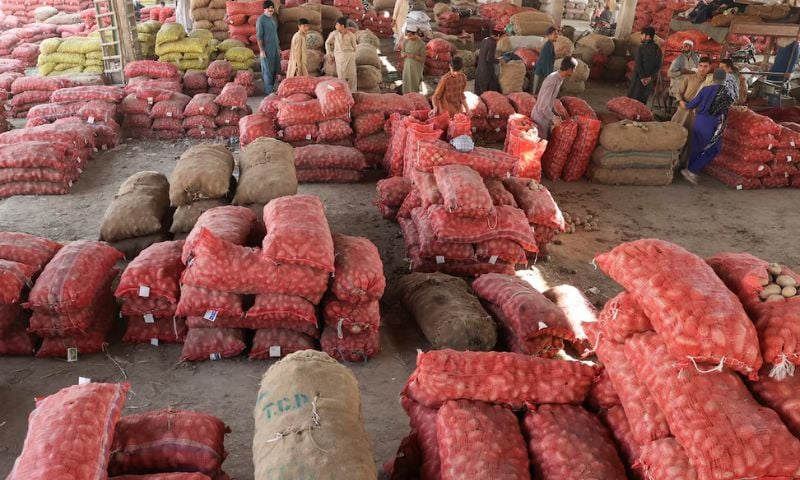



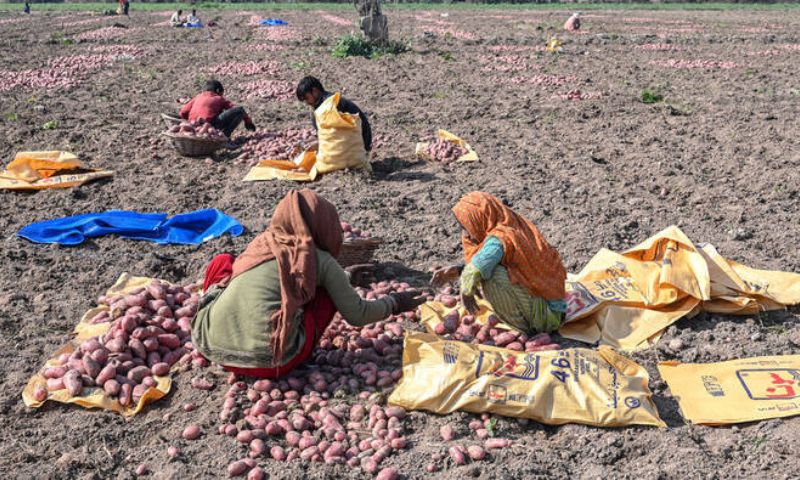
MARDAN, Pakistan: Under the winter sun in Gujar Garhi, Mardan, 35-year-old farmer Suleman Khan bends over his field, pulling fresh potatoes from the soil with the help of labourers.
What should have been a moment of relief after months of hard work has instead turned into deep worry.
Like many farmers across Khyber Pakhtunkhwa, this year’s harvest is selling at prices even lower than cost of seeds and fertilisers, labour wages, and other farming-related expenditures.
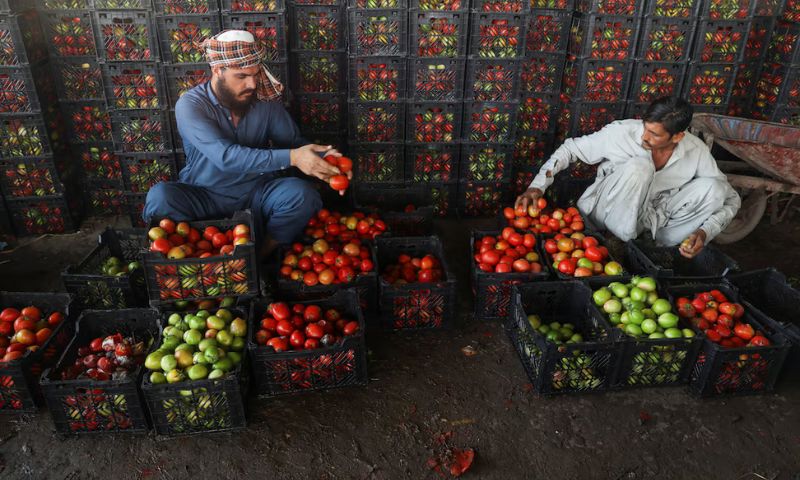
Along with potatoes, prices of other vegetables — including tomatoes, cucumbers, apple gourd (tinda), onions, and seasonal produce — have fallen sharply.
Farmers blame the ongoing closure of the Pakistan-Afghanistan border, which has severely disrupted exports and flooded local markets with surplus produce, leaving them high and dry.
Rising costs, falling returns
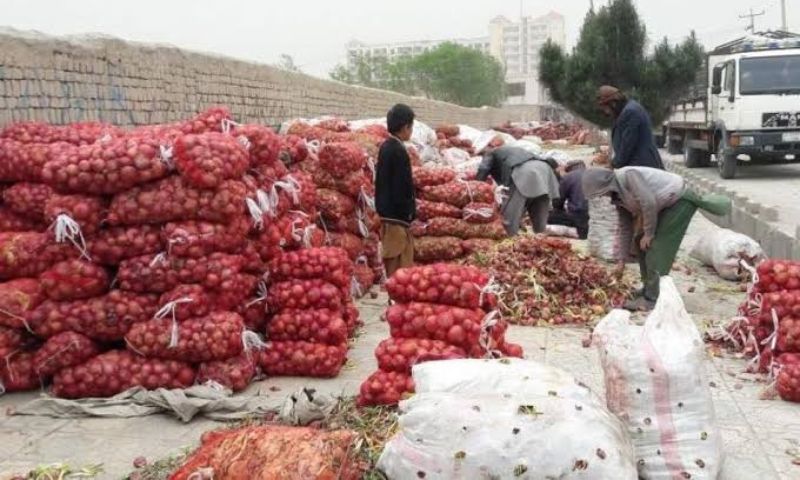
Farmers say their losses are biting deeper because production costs have increased significantly. Fertilisers, diesel, seeds, and labour have all become more expensive.
“The prices are so low that we cannot even recover our costs,” Suleman tells WE News English. “We spent hundreds of thousands of rupees on potato crops, but there is no profit left for us.”
According to the farmers interviewed by WE News English, the annual cost per acre ranges from Rs280,000 to Rs300,000, covering all expenses from potato seeds to transportation of the produce to the market.
Local farmers complain that vegetables are being sold at throwaway prices, pushing many small growers to the brink of financial ruin.
Trade comes to halt
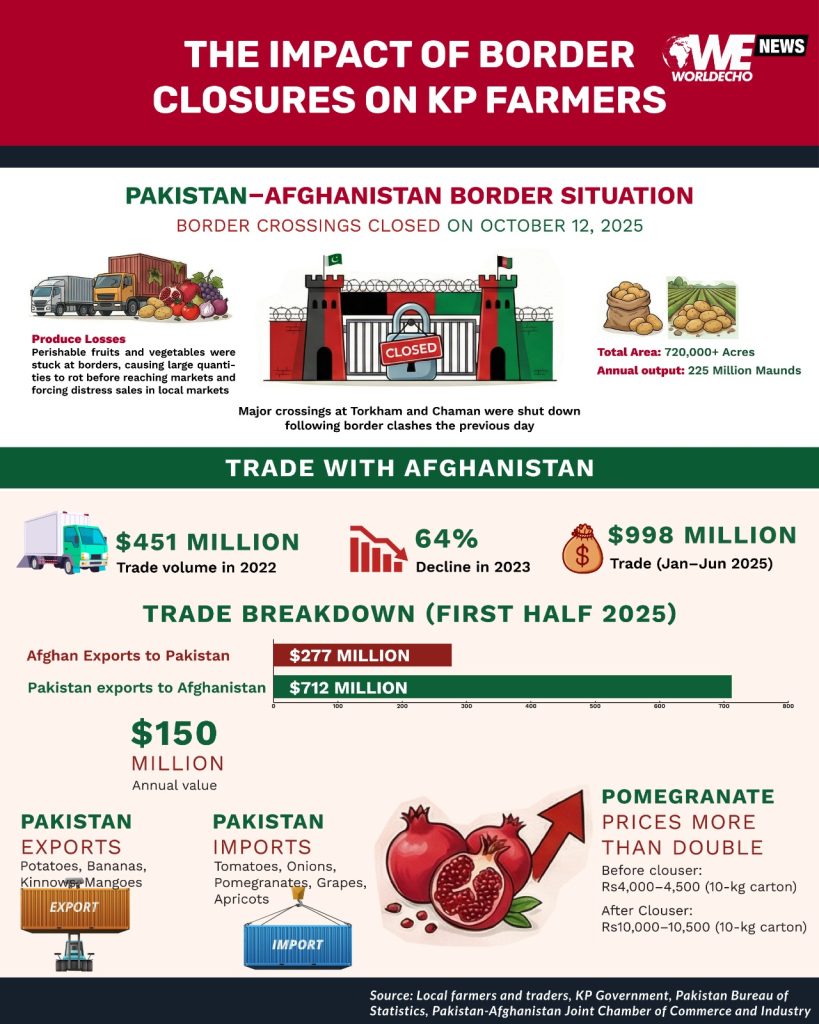
The data of Pakistan’s Ministry of Commerce reveals that the total trade between Pakistan and Afghanistan stood at $451 million in 2022, but declined by 64 per cent in 2023 due to political tensions, security issues, and repeated border restrictions.
On October 11, 2025, clashes erupted between Pakistani security forces and Afghan Taliban fighters near the border areas of Balochistan and Khyber Pakhtunkhwa, resulting in casualties on both sides.
Following the incident, major border crossings — including Torkham and Chaman — were closed on October 12 and remain shut.
The prices are so low that we cannot even recover our costs. We spent hundreds of thousands of rupees on potato crops, but there is no profit left for us.” – Suleman Khan, local farmer
The closures have brought cross-border trade and movement to a standstill, leaving farmers and traders caught between a rock and a hard place.
Produce rotting at borders
Vegetable and fruit traders in Mardan say exports to Afghanistan have been almost completely halted. Large quantities of perishable produce remained stuck near border areas, where they got rotten.
As a result, farmers are forced to sell vegetables in local markets at extremely low prices or discard them altogether.
Sahibzada Khan, President of the Mardan Fruit and Vegetable Market Association, says repeated border closures are squeezing livelihoods dry.
“Both governments must find a permanent solution,” he tells We News English. “Farmers and traders on both sides are suffering every time the border is closed.”
Pakistani farmers say they neither have the financial capacity to store produce in cold storage facilities nor alternative routes or mechanisms to export their crops to other countries.
Most of their trade was linked to Afghanistan and Central Asian states, which was only possible through Afghan transit routes.
Shoppers gain, farmers lose
Official data shows a mixed picture for consumers. According to the Pakistan Bureau of Statistics, overall inflation stood at 6.1 per cent in November, higher than the Ministry of Finance’s projected range of 5–6 per cent.
However, some residents say vegetable prices have become unusually low.
“For the first time, vegetables are affordable in Khyber Pakhtunkhwa,” says Manzoor Khan, a resident of Mardan. “But this bargain comes at the farmers’ expense.”
Local vegetable prices have taken a sharp dive following the suspension of trade at the Afghan border. With export routes closed, an oversupply in domestic markets has slashed prices by more than half.
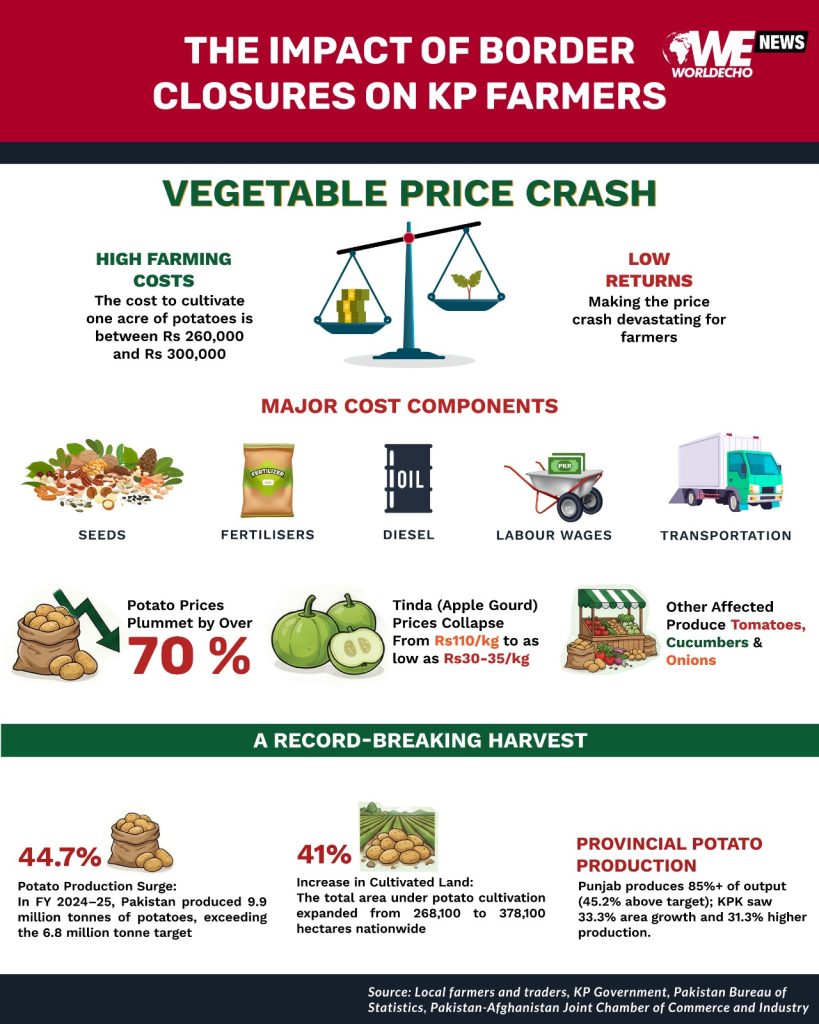
Consumers who previously paid up to Rs 250-300 per kg for certain vegetables are now seeing rates as low as Rs 50–100 per kg.
Potatoes, which previously sold at Rs200 per kg, have dropped to Rs50–60, while apple gourd has fallen from Rs110 per kg to Rs30–35.
Market flooded with potatoes
Farmers and market experts say the price crash has been further intensified this year by a significant expansion in potato cultivation across Khyber Pakhtunkhwa and other provinces, leading to record production levels.
With export routes blocked and domestic supply rising sharply, markets have been overwhelmed by excess produce, pushing prices down well below production costs.
Both governments must find a permanent solution. Farmers and traders on both sides are suffering every time the border is closed.” – Sahibzada Khan, traders’ representative
According to the Pakistan Bureau of Statistics (2024), over 720,000 acres are dedicated to potato farming, yielding more than 225 million maunds annually.
Punjab province leads with over 85 per cent of the production, while Sindh and Khyber Pakhtunkhwa are rapidly expanding due to improved seed access and changing dietary preferences.
Government data shows Pakistan’s potato production exceeded targets by a wide margin. During fiscal year 2024–25, the country produced 9.9 million tonnes of potatoes against a target of 6.8 million tonnes, an increase of 44.7 per cent.
The total area under potato cultivation expanded by 41 per cent, rising from 268,100 hectares to 378,100 hectares, with Punjab leading production. Punjab’s output remained 45.2 per cent above target, while yield per hectare also improved.
Khyber Pakhtunkhwa recorded notable growth as well, with cultivated area increasing by 33.3 per cent and production rising by 31.3 per cent.
This sharp rise in output has created a supply glut in the market, pushing further pressure on prices. With production outpacing domestic demand, farmers are struggling to recover even their basic costs.
Export routes blocked
Sahibzada Khan says that during the season Pakistan exports bananas, potatoes, kinnows, and mangoes to Afghanistan, while Afghan transit routes are also used to reach Central Asian countries.
He describes the situation as alarming, adding that several Pakistani drivers have been stranded in Afghanistan for weeks. Some vehicles have come under attack, while drivers face shortages of food, money, and accommodation.
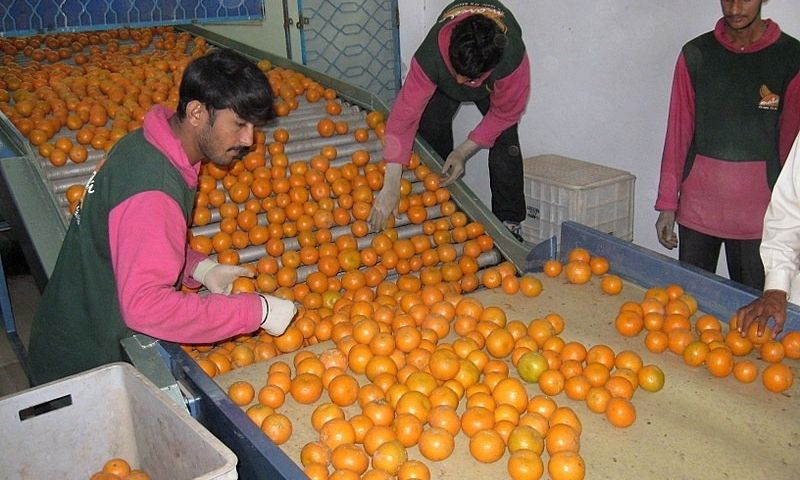
Pakistan’s annual exports of fruits and vegetables to Afghanistan and Central Asian countries are worth around $150 million, while Pakistan imports tomatoes, onions, pomegranates, grapes, and apricots from Afghanistan.
Following the suspension of trade, exporters were forced to sell perishable goods at throwaway prices or discard them due to spoilage.
Exporters say the alternative Iran route is difficult to use because banks are not issuing the required financial guarantees.
According to the official website of Pakistan-Afghanistan Joint Chamber of Commerce and Industry (PAJCCI), the State Bank of Pakistan rejected on November 19, 2025, a request to waive financial guarantees for exports to Iran and Central Asian countries via Iran.
Most pomegranates are now being imported to Pakistan via Iran instead of Afghanistan, and many trucks of fruits waiting for border opening on the Afghan side have gone to rot in the meantime.” – Munnawar Khan, Afghan exporter
Meanwhile, Munnawar Khan,35, an Afghan exporter, says that most pomegranates are now being imported to Pakistan via Iran instead of Afghanistan. Many trucks of fruits waiting at the Pak-Afghan border have rotten in the meantime.
As a result, prices have surged from Rs4,000–4,500 to Rs10,000–10,500 per 10-kg carton, while supplies from Quetta and other parts of Balochistan have almost stopped.
Long-term trade at risk
Despite recent disruptions, trade figures show the long-term importance of bilateral commerce. According to Afghanistan’s Ministry of Industry and Commerce, trade between Afghanistan and Pakistan reached nearly $998 million in the first six months of 2025.
The sharp increase marked a turnaround driven by diplomatic and policy shifts. In April 2025, Pakistan’s Foreign Minister Ishaq Dar led a high-level delegation to Kabul — the first such visit in over two years — resulting in a mutual commitment to delink trade from political tensions.
This was followed by Pakistan’s decision to ease the 10 per cent processing fee on Afghan transit goods that had been imposed in late 2023, significantly lowering trade costs and improving cross-border movement.
During this period, Afghanistan exported $277 million worth of goods to Pakistan, while imports from Pakistan stood at $712 million.
These trade disruptions are not just numbers on a ledger — the immediate losses borne by farmers, especially smallholders, are a direct fallout of unstable cross-border commerce.
Without consistent policies and open routes, growers continue to struggle season after season, unable to plan or recover from repeated shocks.