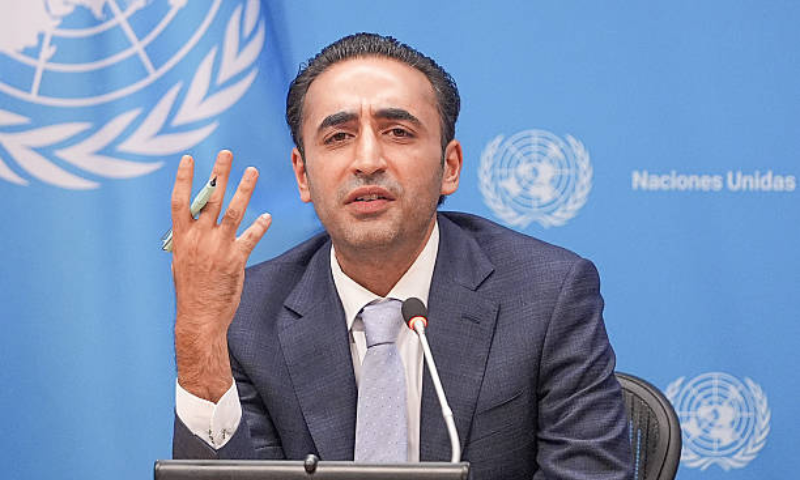



ISLAMABAD: Pakistan Peoples Party (PPP) Chairman Bilawal Bhutto Zardari has called for devolving major tax-collection powers from the federal government to provinces, arguing that decentralisation is key to strengthening Pakistan’s fragile economy and restoring business confidence.
Bilawal Bhutto Zardari is the son of the assassinated former Prime Minister Benazir Bhutto. His party currently governs the southern Sindh province and is a coalition partner in the federal government with Pakistan Muslim League‑Nawaz (PML-N).
Speaking to business leaders in Karachi, Bilawal said Pakistan must “move away from force-based revenue policies” and instead adopt a cooperative approach that encourages compliance.
“Wherever you need our help at the level of the president of Pakistan, our governors, we are ready to do so for your district-wise economic uplift plan,” the PPP chief said.
“The prime minister also desires to work for this, but the difference between their approach and ours is that they believe in centralisation and we focus on decentralisation,” he added.
Bilawal acknowledged the business community’s concerns about high tax rates, but maintained that his party believes in collecting more taxes to strengthen the economy.
“Though the goal is the same, the problem is that the sitting and previous governments wanted to run the economy by force. We think that the economy cannot be run by force, but through a soft attitude,” he added.
Bilawal said provinces should be authorised to collect sales taxes directly, citing independent assessments of large revenue leakages. He recalled that after Pakistan’s 18th Constitutional Amendment in 2010, provinces took over taxation on services, with Sindh outperforming the federal revenue authority. Bilawal suggested that any excess revenue collected by provinces could be returned to Islamabad, easing the federal government’s financial pressures.
He told business representatives that his party supports a broader tax base and competitive tax rates to encourage investment rather than coercion. According to Bilawal, “an economy cannot be run by force,” and taxpayers must be treated as partners rather than targets.
“You can attract more bees with honey than vinegar. Therefore, if we make our tax rates competitive and give respect to taxpayers, instead of snubbing them or bringing them into the tax net by force, we can get better results,” Bilawal argued.
Role of business community and foreign partners
Discussing trade, he highlighted the importance of Pakistan’s GSP+ status with the European Union, which he said significantly boosted exports. He also pointed to China’s growing interest in promoting Pakistani products, noting the PPP’s role in launching the China-Pakistan Economic Corridor (CPEC). Bilawal assured the business sector of full cooperation, saying the PPP would continue working with federal authorities to address structural challenges, including the creation of industrial zones and export diversification.
Responding to renewed debate about forming new administrative provinces, Bilawal urged the government to first implement existing parliamentary consensus—particularly on a proposed South Punjab province—before considering wider territorial reforms. He cautioned that discussions about dividing Pakistan’s largest provinces should be based on political agreement rather than competition between regional parties.
Calling reconciliation “the only way forward,” Bilawal warned that political polarisation is putting Pakistan’s democratic system under strain and said sustained dialogue between parties is necessary for stability.