


KEY POIINTS
- Bangladesh’s Ministry of Foreign Affairs summoned India’s High Commissioner, urging New Delhi to hand over the suspects.
- Police believe the suspected killers fled illegally to India.
- Protests spread nationwide, with attacks on Indian diplomatic facilities.
- Protesters accused newspapers of promoting Indian interests and blamed India for Hadi’s killing.
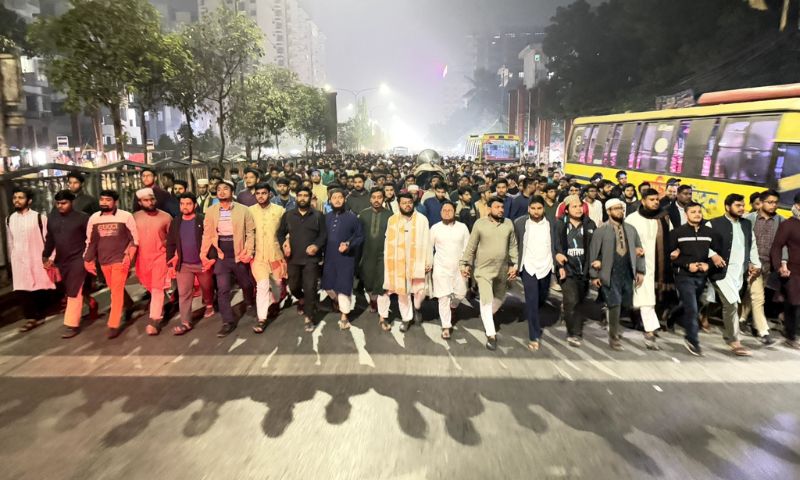
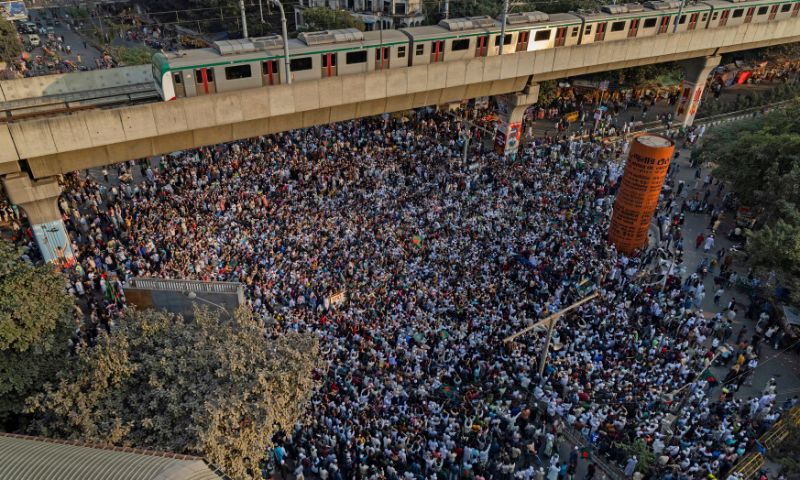
DHAKA, Bangladesh: Thousands of protesters rallied across Bangladesh on Friday for a second straight day, calling for the arrest of the gunmen who shot and killed a prominent anti-India leader, Sharif Osman Hadi.
Hadi died in a Singapore hospital on Thursday, days after being shot outside a mosque in Dhaka.
As news spread that 32-year-old pro-democracy and anti-India leader Sharif Osman Hadi died in a hospital in Singapore on Thursday, crowds took to the streets in an outpouring of mourning and anger.
Several buildings were vandalised, including the offices of media outlets deemed to favour India — an old ally of Bangladesh’s ousted prime minister, Sheikh Hasina. Hasina is reportedly hiding in India following her ouster in the student-led uprising.
Hadi, a staunch critic of India, was shot by masked gunmen while leaving a mosque in the capital Dhaka, last week. He was initially wounded and flown to Singapore for treatment, but eventually succumbed to his wounds on Thursday.
Bangladeshi police said Faisal Karim Masud, identified as the gunman in the shooting of Hadi, fled to neighbouring India shortly after the attack. Investigators believe his alleged accomplice, motorcycle driver Alamgir Sheikh, also crossed into India.
According to police sources cited by the Dhaka Tribune, the two men are suspected to have crossed the border illegally through the Haluaghat area of Mymensingh on Friday, just days after the December 12 shooting.
Bangladesh demands India hand over killers
In response, Bangladesh’s Ministry of Foreign Affairs summoned India’s High Commissioner to Dhaka, Pranay Verma, urging New Delhi to arrest and hand over the suspects if they are found on Indian soil.
Bangladeshi police say they have identified both suspects in Sharif Osman Hadi’s killing and believe they fled illegally to India, offering a reward of five million taka for information leading to their arrest.
Hadi’s killing has ignited a fierce public backlash, sharpening already fraught debates over India’s influence in Bangladesh.
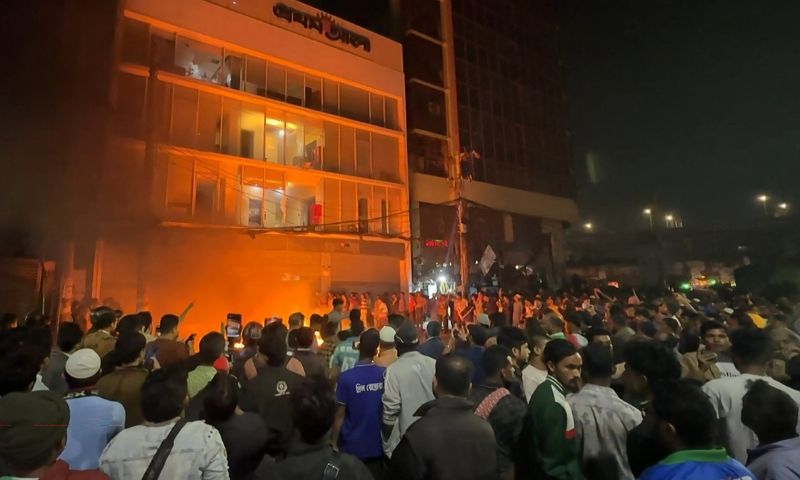
Groups of protesters stormed the offices of two of newspapers on Friday, setting fire to the Bengali-language Prothom Alo and the English-language Daily Star, as anger over the death of Hadi spilt further onto the streets.
‘Foreign political influence’
Hadi had been an outspoken critic of India, where the former prime minister, Sheikh Hasina, remains in self-imposed exile.
Protesters accused both newspapers of promoting Indian interests in the Muslim-majority country, branding them complicit in what they described as “foreign political influence”.
Witnesses, cited by local media, said crowds torched the two newspaper buildings, trapping journalists and other staff inside.
Firefighters were forced to use ladders to rescue several people from the burning premises. Army units were later deployed outside the offices as unrest continued to spread across the capital.
Protesters surround India’s deputy ambassador’s residence
On Friday, hundreds of protesters surrounded the residence of India’s deputy ambassador to Bangladesh, attempting to stage a sit-in protest. Police fired tear gas shells to disperse the crowd, local media reported.
Elsewhere, protesters used a bulldozer to demolish a regional office of the Awami League, the party led by Hasina, in the northern city of Rajshahi, according to footage aired by private broadcaster Jamuna TV.
Similar scenes of unrest were reported in the port city of Chattogram and in the southern city of Khulna, underscoring the nationwide scale of the protests following Hadi’s death.
Following the death of Hadi, multiple incidents of violence were reported across Bangladesh overnight, with attacks targeting diplomatic, political, historical and cultural sites in several cities, according to local media.
Clashes outside Indian High Commission
In the port city of Chattogram, clashes broke out outside the Assistant High Commission of India after a group of protesters gathered near the premises.
Police said stones and bricks were thrown during the confrontation, leaving at least four people injured, including two officers, before law enforcement dispersed the crowd.
Separately, homes of several Awami League figures were attacked in different parts of the country.
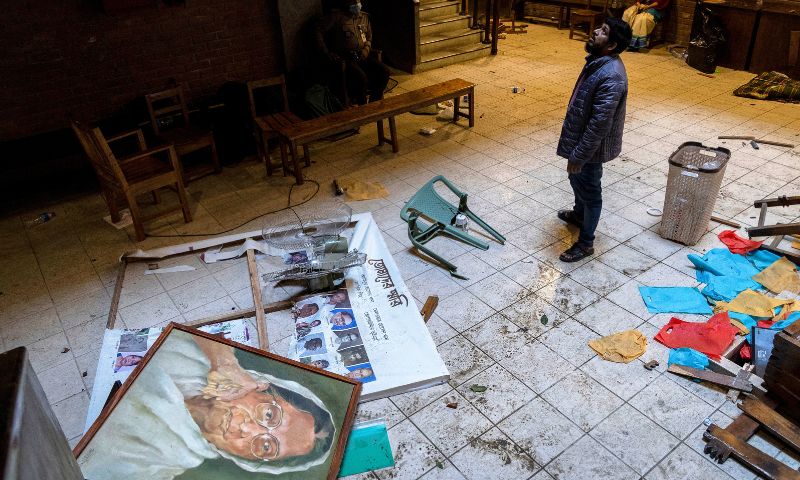
Local media reported vandalism and arson at the Chattogram residence of former minister Mohibul Hasan, the Bandarban home of former minister Bir Bahadur, and the Dhaka residence of a relative of former MP Habib Hasan.
Anti-India rhetoric
Within hours of news of Hadi’s death, the protestors denounced what they described as India’s political interference in Bangladesh and accused New Delhi of backing destabilising forces in the country.
Protesters gathered outside Indian diplomatic facilities for a second consecutive day, with slogans rejecting “Indian dominance” and warning against external meddling.
According to local media reports, the intensity of protests forced the closure of visa services at the Indian High Commission, with India’s Deccan Herald reporting that the visa centre remained shut due to security concerns.
Some demonstrations turned violent. During overnight unrest, protesters set fire to a historic residence linked to Sheikh Mujibur Rahman, Bangladesh’s founding leader, reflecting the depth of public anger and the volatile political mood.
India’s ‘hegemonic role’
Supporters of Hadi allege that he had received death threats from Indian phone numbers before the attack.
Bangladeshi officials had earlier raised the issue diplomatically, demanding cooperation over individuals suspected of involvement in the assassination attempt.
Rashid Pradhan, a political leader aligned with Hadi’s movement, warned on Friday that Bangladesh would no longer tolerate what he called India’s “hegemonic role”, warning that future demonstrations could escalate further if demands for accountability are ignored.
Several protest leaders also cautioned that continued interference could trigger resistance extending beyond Bangladesh’s borders, framing the crisis as a regional flashpoint rather than a purely domestic issue.
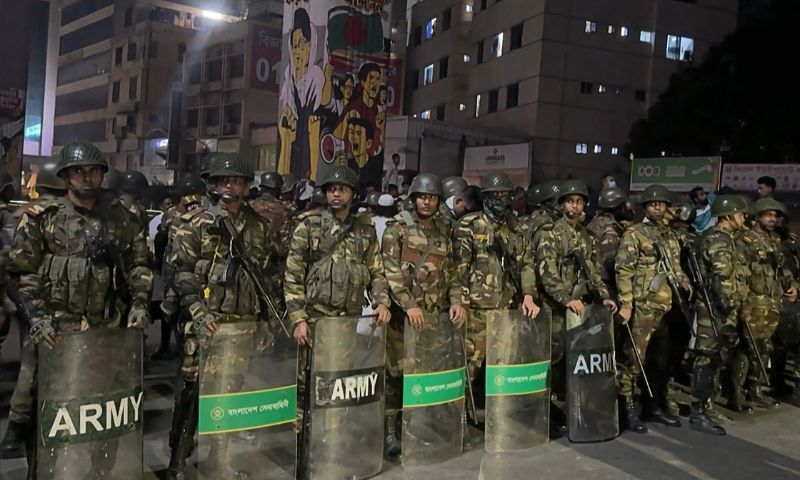
Hadi had risen rapidly as a fiery critic of Bangladesh’s political establishment and New Delhi’s influence over Dhaka.
His decision to enter electoral politics was seen as a turning point for Inqilab Moncho, transforming it from a protest movement into a direct political challenger.
UN urges ‘Transparent’ investigation
UN rights chief Volker Turk called on Friday for a “prompt, impartial, thorough and transparent” investigation.
In Dhaka, protester Sajid Al Adeeb told AFP that “people have gathered here demanding the swift arrest of those who killed Hadi.”
Bangladeshi police said the killers of Hadi fled to India after the attack.
Police said they have identified both the killers in Hadi’s killing and believe they fled illegally to India.
Interim leader Muhammad Yunus has described the shooting as a premeditated attempt to derail February’s election, noting that Hadi had reported repeated death threats in the weeks before the attack.
Protests were also held in the cities of Gazipur, Sylhet and Chattogram on Friday.
Hadi’s remains were brought to Dhaka on Friday evening ahead of a funeral planned for Saturday.
The funeral prayer will be performed on Saturday in front of the parliament building, the government said.
Hadi’s body will then be placed at the central mosque of Dhaka University to allow people to pay their last respects before his burial there.
The UN’s Turk said in a statement that “he was deeply troubled” by Hadi’s killing.
“Retaliation and revenge will only deepen divisions and undermine the rights of all,” he said.
“I urge the authorities to conduct a prompt, impartial, thorough and transparent investigation into the attack that led to Hadi’s death, and to ensure due process and accountability for those responsible.”
Violent protests in Bangladesh against Indian hegemony after the assassination of a political leader allegedly by Indian agencies.#BangladeshCrisispic.twitter.com/pXFoAQuj4J
— Sarah DuMontior (@dumontior) December 19, 2025
Security beefed up in Dhaka
Ahead of the funeral, security has been beefed up in the capital with strict restrictions on flying drones around the parliament building.
The US embassy in Dhaka urged its citizens to remain vigilant and “remember that gatherings intended to be peaceful can turn confrontational and escalate into violence”.
Late Thursday, people set fire to several buildings in Dhaka, including the offices of leading newspapers Prothom Alo and the Daily Star.
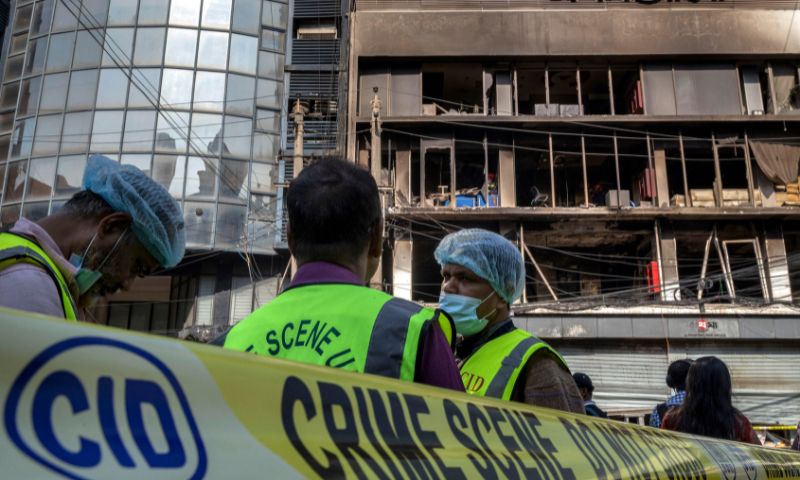
Critics accuse the publications of favouring neighbouring India, where Hasina has taken refuge since fleeing Dhaka in the wake of the 2024 uprising.
Government urges restraint
The government urged citizens to resist all forms of violence.
“This is a critical moment in our nation’s history when we are making a historic democratic transition,” a government statement said.
On Wednesday, before Hadi’s death, protesters demanding Hasina be returned to Bangladesh marched toward the Indian High Commission in Dhaka, in the latest sign of strained ties between the neighbours since the fall of her autocratic government.
Hadi, a leader of the student protest group, was running for a parliament seat in the February 2026 national election.
In a televised address to the nation, Muhammad Yunus, head of Bangladesh’s interim administration, announced special prayers at mosques on Friday and declared Saturday a national day of mourning. He appealed to demonstrators to exercise restraint and avoid further violence.
“Hadi’s demise is an irreparable loss for the nation,” Yunus said, urging calm as authorities sought to restore order amid the growing political turmoil.