


KEY POINTS
- Bangladesh police say the killers of Sharif Osman Hadi fled to India after the attack.
- Police identified the suspects as Faisal Karim Masud and Alamgir Sheikh, who crossed into India via the Haluaghat border.
- Hadi’s killing had intensified anti-India sentiment across Bangladesh.
- Dhaka had summoned India’s High Commissioner and suspended consular services in New Delhi.
- Ties between the two countries remain strained since Sheikh Hasina fled to India after the 2024 uprising.
DHAKA, Bangladesh: Bangladesh police said on Sunday that the suspected killers of anti-India youth leader Sharif Osman Hadi had fled to India after the attack, a development likely to further strain already tense relations between the two neighbours.
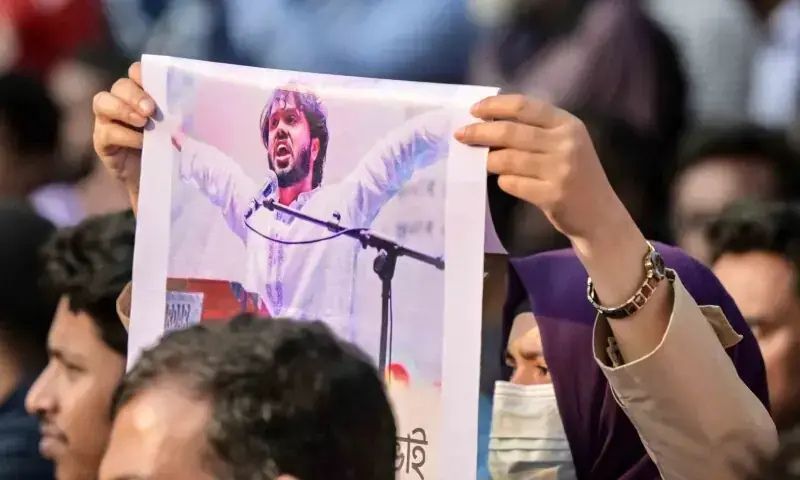
Hadi, a vocal critic of India who took part in last year’s mass uprising, was shot by masked assailants in Dhaka earlier this month and later succumbed to his injuries at a hospital in Singapore.
“The killing was premeditated. Those behind it have been identified,” SN Nazrul Islam, a senior Dhaka Metropolitan Police officer, said at a news conference.
Suspected killers, Faisal Karim Masud and Alamgir Sheikh, left Bangladesh through the Haluaghat border with India shortly after attacking Hadi on December 12, Islam said.
They were received at the border by two Indian citizens, who escorted them into the northeastern state of Meghalaya before handing them over to two accomplices.
Bangladeshi investigators were in contact with their Indian counterparts, who had arrested the two suspected accomplices, Islam said.
“We are communicating with Meghalaya police, who have confirmed the arrest of two Indian nationals,” he added.
The Indian foreign ministry had earlier said it rejects “false narratives” about New Delhi’s involvement in Hadi’s killing.
Hadi’s killing fuelled anti-India anger
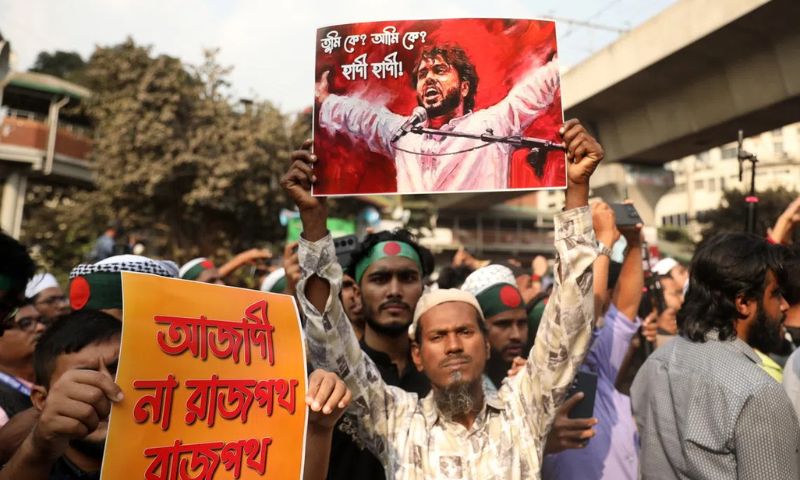
Sharif Osman Hadi, 32, was a spokesperson for the Inquilab Mancha, or Platform for Revolution, and participated in the student-led protests that overthrew the government of prime minister Sheikh Hasina last year.
He was shot in the head by masked assailants in Dhaka while launching his campaign for the elections.
His death set off violent protests and further fuelled anger among Bangladeshi youth against India. The angry protesters also torched several buildings, including two major newspapers deemed to favour India, as well as a prominent cultural institution.
With protests being held across the country almost daily, pressure has been growing on Bangladesh’s interim government to arrest the killers of Hadi, who was set to contest the general elections in February next year.
Ties between the neighbours have deteriorated since the ousted prime minister, Sheikh Hasina, fled the pro-democracy uprising and sought refuge in India.
India says it is still considering Dhaka’s requests to extradite Hasina, who was sentenced to death in absentia for orchestrating a deadly crackdown on the uprising.
Diplomatic tensions
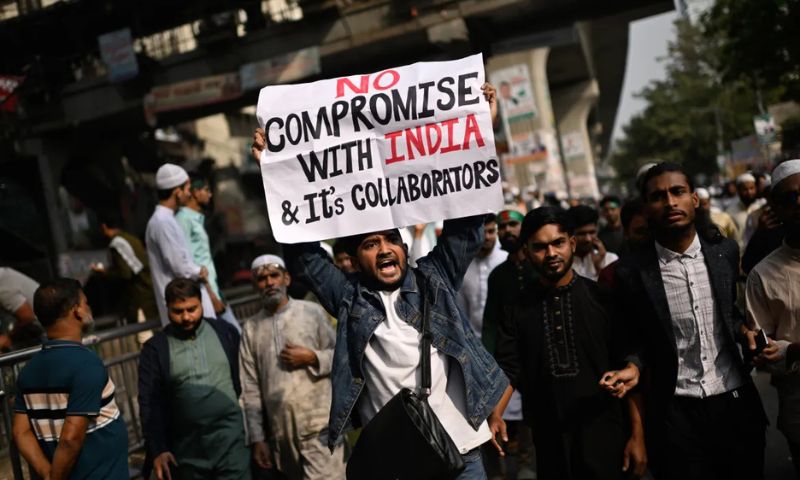
On Tuesday, Bangladesh summoned India’s High Commissioner in Dhaka to protest what it described as “violent and premeditated attacks” on its diplomatic facilities in India.
On Tuesday, hundreds of protesters gathered near the Bangladesh High Commission in New Delhi to protest the killing of a Hindu man in Bangladesh.
Protesters burned pictures of Bangladesh’s Chief Adviser Professor Muhammad Yunus and chanted slogans calling for a boycott of Bangladesh.
Amid rising security concerns, Bangladesh has suspended all consular and visa services at its High Commission in New Delhi.
The foreign ministry alleged that the protests were carried out by “extremist elements”.
Bangladesh condemned what it termed “acts of intimidation against its diplomatic establishments”, saying they endangered diplomatic personnel and violated international norms.
“Such incidents undermine the principles of mutual respect and the values of peace and tolerance,” the ministry said in a statement.
Dhaka called on New Delhi to conduct a proper investigation and to fulfil its obligations under international diplomatic conventions.
“Bangladesh expects the Government of India to immediately take appropriate steps in accordance with its international and diplomatic obligations to safeguard the dignity and security of diplomatic personnel and establishments,” the statement said.
India’s Ministry of External Affairs said last Sunday that the protest outside the Bangladesh High Commission in New Delhi involved “20–25 youths” and was dispersed by police.
Accusations against New Delhi
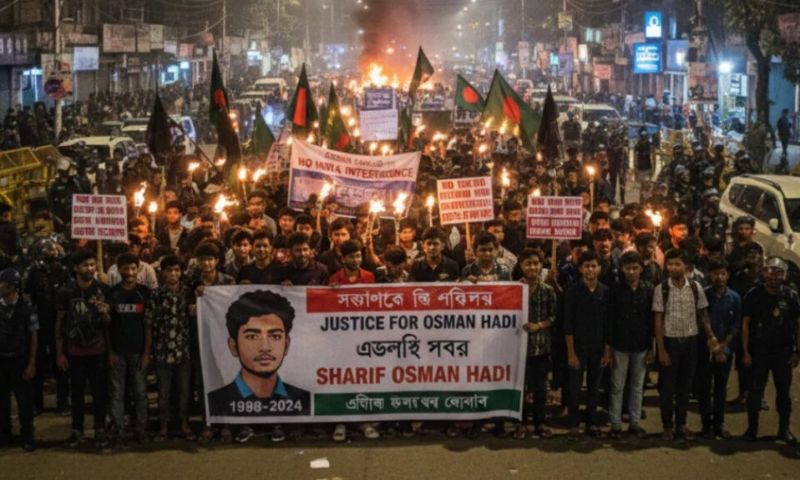
The diplomatic fallout comes amid widespread protests in Bangladesh and anti-India anger.
Protesters have accused New Delhi of sheltering both the perpetrators of Hadi’s killing and Sheikh Hasina.
Political tensions intensified further on Monday when another anti-India student leader was shot in the southern city of Khulna.
Muhammad Md Motaleb Sikder, 42, a senior leader of the student-led National Citizen Party (NCP), was targeted by unidentified gunmen in the Sonadanga area, according to local media.
Hospital officials later said the bullet had grazed his skull without penetrating it and that his condition had stabilized. Doctors confirmed he was now out of danger.
Relations between the two countries have remained strained since the 2024 uprising in Bangladesh that ended Sheikh Hasina’s 15-year rule.
Hasina has been living in India since fleeing the country last August.
The United Nations estimates that around 1,400 people were killed during the protests that led to her ouster.