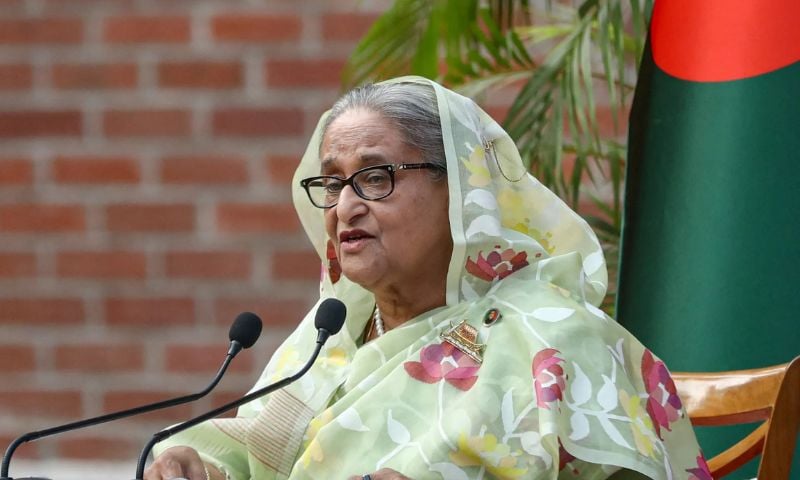



DHAKA, Bangladesh: Bangladesh said on Sunday it was “surprised” and “shocked” that India had allowed fugitive former prime minister Sheikh Hasina to make a public address in New Delhi.
Hasina, 78, fled to neighbouring India in August 2024 after a student-led uprising ended her iron-fisted 15-year rule.
She made her first public speech since then in an audio address to a packed press club in Delhi on Friday.
She was found guilty in absentia by a Dhaka court in November of incitement, issuing an order to kill and inaction to prevent atrocities and was sentenced to be hanged.
“The government and the people of Bangladesh are surprised and shocked,” Bangladesh’s foreign ministry said in a statement.
“Allowing the event to take place in the Indian capital and letting mass murderer Hasina openly deliver her hate speech… constitutes a clear affront to the people and the Government of Bangladesh.”
It said allowing Hasina to make the speech set “a dangerous precedent” that could “seriously impair bilateral relations”.
Bangladesh voters go to the polls on February 12 to choose new leaders after a period of turmoil that followed the overthrow of Hasina’s autocratic government.
Hasina said in her audio address that “Bangladesh will never experience free and fair elections” under the interim administration.
Bangladesh has asked India to extradite Hasina, but New Delhi has yet to comment on the request.
India’s past support for Hasina has frayed relations between the South Asian neighbours since her overthrow.
The relationship between India and Bangladesh has entered a period of unprecedented turbulence. This breakdown is not merely a diplomatic disagreement. It is a profound realignment driven by internal politics, security fears, and a growing trust deficit.
The current escalation reached a breaking point in mid-December 2025. The catalyst was the assassination of Sharif Osman Hadi, a prominent leader of the 2024 student uprising. Hadi was shot in Dhaka on December 12 and died in Singapore on December 18.
Public anger in Bangladesh exploded when reports suggested the attacker had fled across the border into India.
This sparked massive anti-India protests and a “long march” toward the Indian High Commission in Dhaka.
In a rare and alarming move, both nations suspended regular visa services on December 22. This has effectively cut off the people-to-people ties that are the backbone of the relationship.
At the heart of the friction is the presence of former Prime Minister Sheikh Hasina in India. Since her ouster in August 2024, Hasina has remained in Indian “hospitality.” This fact deeply irritates the interim government led by Muhammad Yunus.
Bangladesh has officially requested her extradition to face trial for alleged crimes during the 2024 protests.
India’s refusal to hand her over is viewed by many in Dhaka as an interference in their sovereign legal process. Conversely, New Delhi views Hasina’s safety as a matter of historical loyalty.