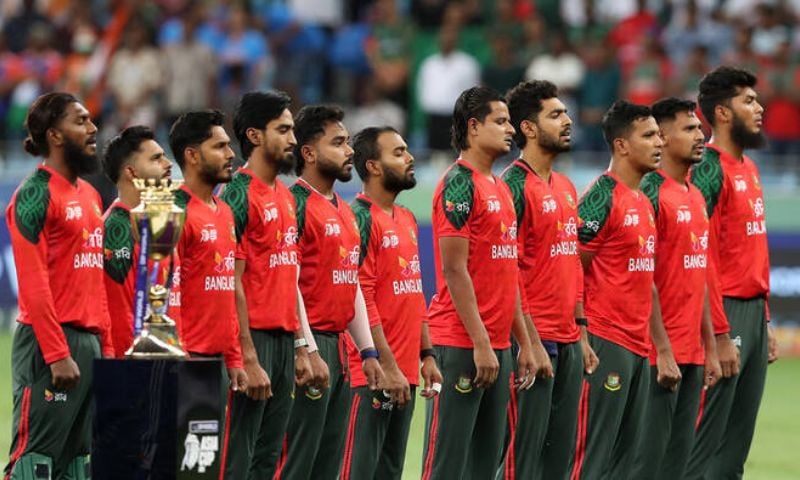



NEW DELHI: The absence of Bangladesh from next month’s ICC Men’s T20 World Cup is a “sad moment” for the game and highlights deepening divisions in international cricket, the World Cricketers’ Association (WCA) said on Sunday.
Bangladesh were replaced by Scotland in the 20-team tournament after refusing to tour India because of security concerns linked to strained political relations between the two neighbours.
The International Cricket Council (ICC) rejected Bangladesh’s request to move their matches to co-host Sri Lanka, saying it was not feasible to alter the schedule so close to the February 7 start of the tournament.
“The withdrawal of Bangladesh from the T20 World Cup, and the resulting absence of a valued cricketing nation from cricket’s pinnacle international T20 event, is a sad moment for our sport,” WCA chief executive Tom Moffat said in a statement.
He said the decision was painful for Bangladesh players and fans and should prompt reflection by cricket’s leadership.
“Rather than allowing division or exclusion to take hold, we call on the game’s leaders to work with all stakeholders, including governing bodies, leagues and players, to unite the sport, not divide it,” Moffat said.
WCA Statement on Withdrawal of Bangladesh from Men’s T20 World Cup
▶️ https://t.co/4cz7bF1Ef3 pic.twitter.com/BmFgS2K7R4
— World Cricketers' Association (@WCA_Players) January 24, 2026
ICC confirms Scotland replacement
On Saturday, the ICC confirmed that Scotland would replace Bangladesh in the Men’s T20 World Cup 2026.
The ICC said the decision followed more than three weeks of dialogue with the Bangladesh Cricket Board (BCB), including video and in-person meetings to address security concerns about playing in India.
According to the ICC, internal and external security assessments found no threat to the Bangladesh team, officials or supporters.
The ICC said it shared detailed operational and security plans with the BCB at multiple stages.
After a final 24-hour deadline passed without a response from Bangladesh, the ICC said it followed established governance and qualification procedures to select a replacement team.
Scotland, ranked 14th in the T20I rankings, were chosen based on recent performances and their standing in ICC events.
They will join Group C alongside England, Italy, Nepal and the West Indies.
The updated fixtures list for the Men’s #T20WorldCup 2026 📋
More details ➡️ https://t.co/M61nOzx2fF pic.twitter.com/deynITDuV3
— ICC (@ICC) January 24, 2026
Tensions in South Asian cricket
The episode has underlined ongoing political tensions affecting South Asian cricket.
India’s strained relations with Pakistan previously led the ICC to adopt a “hybrid model” for major tournaments.
Under that arrangement, India played its matches at neutral venues when Pakistan hosted global events.
As part of a similar compromise, Pakistan are scheduled to play all their matches at the upcoming T20 World Cup in Sri Lanka.
However, Pakistan Cricket Board (PCB) chairman Mohsin Naqvi said participation was still not confirmed.
“The prime minister is not in Pakistan right now. When he returns, I’ll be able to give you our final decision,” Naqvi told reporters. Naqvi also serves as Pakistan’s interior minister.
Criticism of ICC consistency
Moffat said the WCA was increasingly concerned about agreements not being honoured and about a lack of meaningful consultation with players.
“It also highlights significant issues with the game’s existing operating model at the global level,” he said.
“If left unaddressed, these issues will weaken trust, unity, and ultimately the future of the game.”
Former Pakistan captain Shahid Afridi criticised what he described as inconsistency by the ICC.
He said the ICC had accepted India’s security concerns about touring Pakistan in 2025 but appeared unwilling to show the same flexibility to Bangladesh.
“Consistency and fairness are the foundation of global cricket governance,” Afridi said in a post on X.
“Bangladesh’s players and millions of fans deserve respect — not mixed standards.”
As a former international cricketer who has played in Bangladesh and in ICC events, I’m deeply disappointed by today's ICC’s inconsistency. It accepted India’s security concerns for not touring Pakistan in 2025, yet appears unwilling to apply the same understanding to Bangladesh.…
— Shahid Afridi (@SAfridiOfficial) January 24, 2026
Former Pakistan batsman Mohammad Yousaf said neutral venues had been approved in the past for similar concerns.
“Standards cannot change from country to country,” Yousaf said. “The ICC must act as the International Cricket Council, not appear to serve the interests of any single board.”
Very sad to see a cricket-loving nation like Bangladesh being deprived of cricket due to security concerns not being addressed.
When similar concerns were raised earlier, a neutral venue was approved. Standards cannot change from country to country.
ICC must act as the…— Mohammad Yousaf (@yousaf1788) January 25, 2026
The Bangladesh withdrawal and Pakistan’s pending decision have added uncertainty ahead of the tournament, which begins on February 7.