
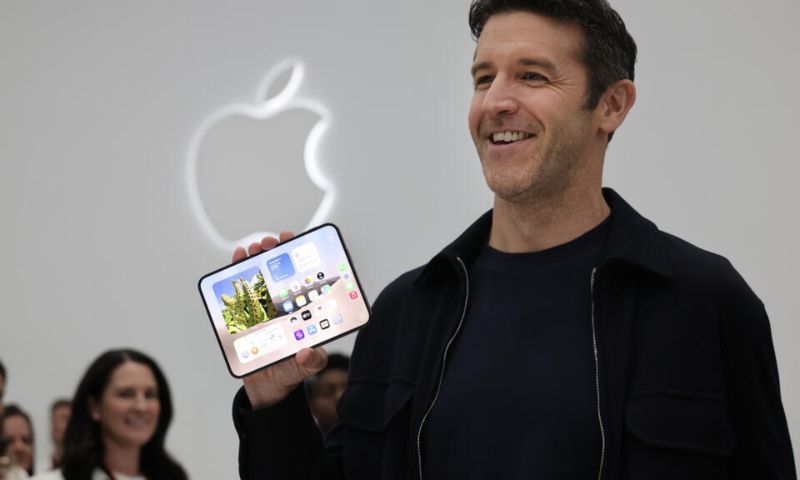
CUPERTINO: Apple unveiled its first foldable smartphone, the iPhone Duo, on Wednesday, marking the first major product launch under new chief executive John Ternus.
The $1,999 device represents an important test for Apple as it enters a foldable smartphone market already occupied by Samsung and Chinese rivals Huawei and Xiaomi.
JUST IN: Apple unveils its first foldable phone, iPhone Duo.
When opened, it is the thinnest iPhone ever.
The phone is 50% larger than the iPhone 18 Pro Max. pic.twitter.com/Wby0jQVLkr
— Collin Rugg (@CollinRugg) September 9, 2026
Wednesday’s event was the first under Ternus, 51, who succeeded Tim Cook on September 1 after more than two decades at Apple.
Apple Enters Foldable Phone Market
Roughly the size of a passport when folded, the iPhone Duo combines a conventional smartphone with a larger tablet-like display.
It features a full external screen when closed, a larger internal display when opened and multiple camera lenses. Apple said it had also reduced the visible crease running through the folding screen, a longstanding criticism of foldable devices.
ALSO READ: China’s AI Robochefs Are Taking Over Restaurant Kitchens
The Duo starts at $1,999, slightly above Samsung’s Galaxy Z Fold8.
Apple also introduced the iPhone 18 Pro and iPhone 18 Pro Max, priced at $1,199 and $1,299 respectively. Both are $100 more expensive than their predecessors at launch and include an upgraded camera system allowing users to adjust lens aperture.
No standard iPhone 18 was announced.
Seven Years After Samsung
Apple enters the foldable market seven years after Samsung introduced its Galaxy Fold in 2019.
Huawei this week unveiled its three-panel Mate XT 2 for around $2,800, while Xiaomi introduced the 18 Fold at approximately $1,540.
Foldables still account for less than two per cent of global smartphone shipments, but research firm IDC expects Apple to capture about one-third of demand following its entry.
The launch comes as the artificial intelligence boom increases demand for advanced chips, contributing to component shortages and higher electronics prices.
Apple also announced updated AirPods and smartwatches with improved heart-rate sensors.