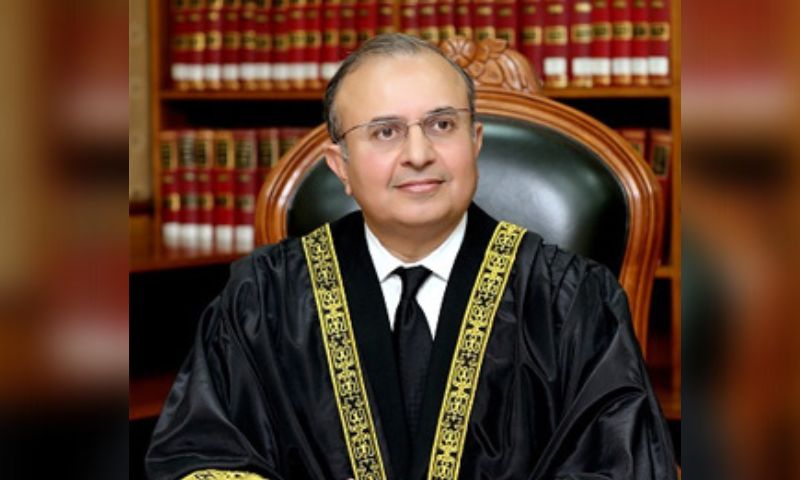



ISLAMABAD: Justice Mansoor Ali Shah, a member of the Supreme Court bench that on Friday restored accountability cases against public office holders, in his dissenting note, maintained that the majority verdict violated the trichotomy of power and undermined the supremacy of the parliament.
The Supreme Court, in a majority 2-1 verdict, approved the Pakistan Tehreek-e-Insaf (PTI) chief’s petition against amendments made to the country’s accountability laws by the previous Pakistan Democratic Movement (PDM)-led government.
The Honorable Judge observed that the basic question in the case was not about the alleged amendments in the NAB law by the Parliament but about the superiority of the Parliament, a house of elected members of over 240 million people of Pakistan.
“It is about the constitutional importance of parliamentary democracy and the separation of powers between three organs of the State. It is about the limits of the jurisdiction of the Court comprising unelected judges, second judging the purpose and policy of an enactment passed by the Parliament, without any clear violation beyond a reasonable doubt, of any of the fundamental rights guaranteed under the Constitution or of any other constitutional provision,” he maintained.
Justice Mansoor Ali Shah said that the majority verdict had fallen short of recognizing the constitutional command that ‘the State shall exercise its power and authority through the chosen representatives of the people’ and to recognize the principle of trichotomy of powers that is the foundation of parliamentary democracy.
“The majority has fallen prey to the unconstitutional objective of a parliamentarian, of transferring a political debate on the purpose and policy of an enactment from the Houses of the Parliament to the courthouse of the Supreme Court,” he observed.
He maintained without setting out a clear and objective test for determining how the claimed right to have accountability of the lawmakers is a significant part of any of the fundamental rights ensured under the Constitution, the majority verdict through a long winding conjectural path of far-fetched “in turn” effects has tried hard to reach an obvious violation of the basic fundamental rights.
Justice Mansoor viewed the majority judgment fell short to acknowledge that the legislative power of the Parliament is never exhausted.
On September 5, the three-member of the top court concluded the hearing in the Pakistan Tehreek-e-Insaf (PTI) Chairman’s petition against the National Accountability (Amendment) Act, 2022, saying the court would announce a “short and sweet” verdict soon.