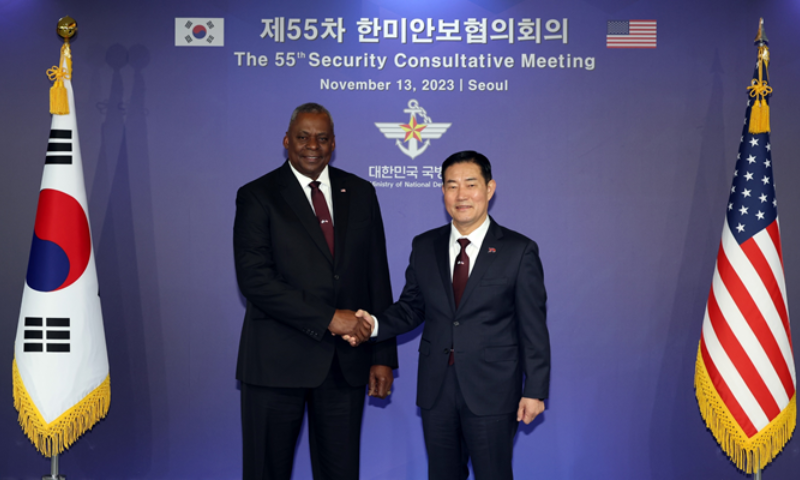



SEOUL: In a pivotal meeting in Seoul, South Korean Defence Minister Shin Won-sik and US Secretary of Defence Lloyd Austin underscored the resolute commitment of Washington to leverage its entire military arsenal in defence of South Korea.
The focus of the discussions revolved around the recalibration of their joint nuclear deterrence strategies to effectively counter the ever-evolving threats emanating from North Korea.
During the annual Security Consultative Meeting (SCM), both nations marked a significant milestone by updating their Tailored Deterrence Strategy (TDS), representing the first overhaul in a decade. Minister Shin Won-sik emphasized the metamorphosis of the ROK-U.S. alliance, placing a strong emphasis on collaborative planning and execution of conventional support from South Korea to U.S. nuclear operations.
This shift signifies the evolution of extended deterrence into a seamlessly executed strategy jointly orchestrated by both nations.
“The ROK-U.S. alliance, now grounded in the Washington Declaration announced by the presidents of the Republic of Korea and the United States, will collaboratively plan and execute conventional support from the ROK to U.S. nuclear operations. The extended deterrence will transform into a collective effort executed jointly by the ROK and the U.S.”
“Our commitment to deterrence for the ROK remains steadfast, encompassing the entire spectrum of our nuclear, conventional, and missile defence capabilities. During today’s security consultative meeting, Minister Shin and I explored shared opportunities to further fortify the alliance.”
The urgency behind these strategic adjustments is propelled by the swiftly changing threats posed by North Korea. A government source elucidated that the updated strategy facilitates joint planning and execution of a nuclear operation, leveraging South Korea’s conventional capabilities. This marks a departure from the preceding model, which predominantly focused on the U.S. military’s singular nuclear operation.
In April, the leaders of both nations concurred on establishing a bilateral nuclear consultative group, amplifying South Korea’s active involvement in U.S. strategic operations on the Korean Peninsula. The discussions at the SCM align seamlessly with Austin’s prior meeting with South Korean President Yoon Suk Yeol, where the focus remained on addressing the evolving threats from North Korea. The imperative for preparedness against any potential provocation, including a “Hamas-style surprise attack,” underscored the importance of these strategic deliberations.