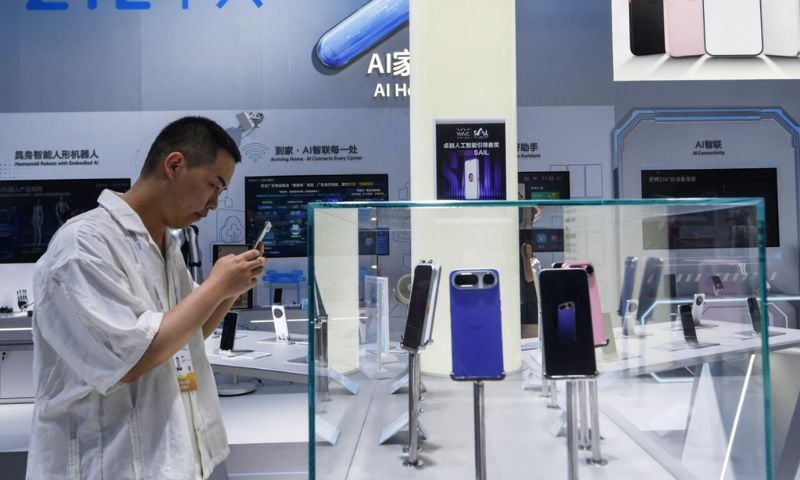
SHANGHAI: Artificial intelligence-powered smartphones capable of completing complex tasks through simple voice commands emerged as one of the biggest attractions at the World Artificial Intelligence Conference (WAIC) in Shanghai, signalling a major shift in the future of mobile technology.
Several Chinese technology companies unveiled next-generation “agentic” smartphones designed to function as personal AI assistants, enabling users to order food, book services, compare prices, draft messages and perform a range of digital tasks without manually navigating individual applications.
Industry experts believe such devices could redefine the smartphone experience by replacing conventional app-based interactions with AI agents that carry out tasks autonomously. However, they also caution that the technology faces significant commercial and technical barriers, particularly resistance from app developers unwilling to surrender direct access to their users.
Chinese smartphone manufacturer Nubia introduced its NaviX Ultra, an AI-powered handset driven by Doubao, the widely used chatbot developed by ByteDance, the parent company of TikTok. Promoting the launch, Nubia described the device as the beginning of “a new era of AI agent smartphones”.
The company follows the earlier release of the experimental Doubao Phone, which attracted strong consumer interest when a limited batch sold out shortly after its launch in December.
The prototype enabled users to issue voice commands for tasks such as ordering meals, searching for the best online shopping deals and navigating multiple applications without switching between them.
Despite its promising debut, the phone soon encountered major obstacles after several leading Chinese technology companies, including Alibaba, Tencent and JD.com, restricted the AI assistant’s access to their platforms.
The restrictions significantly reduced the device’s capabilities, forcing ByteDance to disable certain advanced functions, particularly those involving financial transactions and digital payments.
Technology analysts say the episode underlines one of the biggest challenges facing AI agent smartphones.
Kiranjeet Kaur, Associate Research Director at market intelligence firm IDC, said major digital platforms are reluctant to give third-party AI systems unrestricted access because doing so weakens their relationship with users.
She noted that while AI agents represent an important long-term goal for the industry, the technology remains in its early stages and still struggles to deliver consistently reliable performance.
Unlike its predecessor, reports suggest the NaviX Ultra is designed to work alongside third-party applications rather than attempting to access them independently, an approach intended to avoid conflicts with major platform operators.
Another Chinese smartphone maker, Honor, also showcased its vision of AI-driven mobile technology with its futuristic Robot Phone.
The device features a movable camera mounted on a compact robotic arm that can recognise gestures, automatically frame photographs, stabilise video recordings and even respond to music through animated movements.
Honor said the handset will include an AI agent powered by multiple language models, some developed jointly with Alibaba, when it becomes commercially available later this year.
Meanwhile, Shanghai-based AI company StepFun introduced the STEPX Neo, describing it as an AI agent-native smartphone built around intelligent digital assistance rather than traditional app usage.
According to the company, the device has established partnerships with several leading Chinese digital platforms, including Alipay and ride-hailing service Didi, allowing users to complete travel bookings, shopping, office tasks, local services and video editing through a single AI-powered interface.
The push towards AI-first smartphones is not limited to China. Global technology companies, including Google, are rapidly expanding AI capabilities across their mobile devices, adding features such as automated appointment scheduling and intelligent digital assistants capable of handling increasingly complex requests.
In Japan, US-based Brain Technologies launched its Natural AI Phone earlier this year in collaboration with SoftBank. During demonstrations, the device successfully completed tasks such as sending apology messages through voice instructions, although it also struggled with more demanding commands.
Marc Einstein, an analyst at Counterpoint Research, said the industry has yet to identify a dominant player in the AI smartphone race, making it one of the most closely watched areas in consumer technology.
He predicted that within the next five to ten years, smartphones would rely far less on traditional applications, with AI agents increasingly acting as the primary interface between users and digital services.
According to industry observers, such a transformation could fundamentally reshape the digital economy by altering how consumers interact with online platforms and forcing technology companies to rethink their existing business models.