
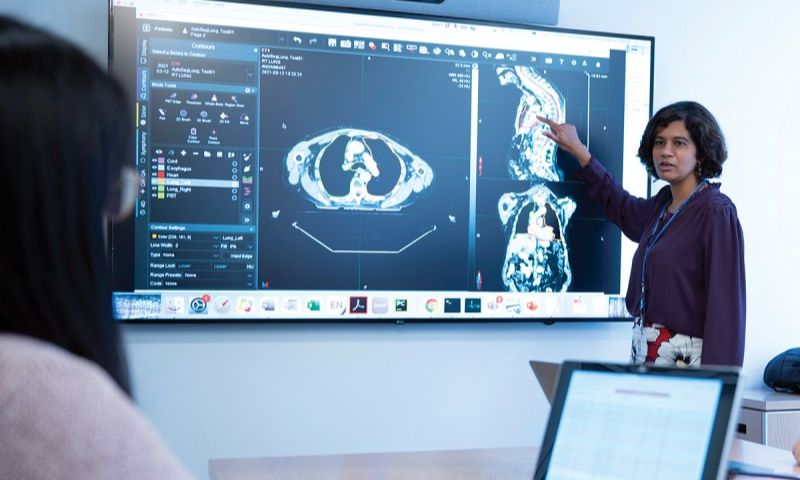
LONDON: Artificial intelligence has successfully designed high-quality cancer radiotherapy treatment plans in a major international clinical trial, marking what researchers say could become a breakthrough in global cancer care.
The study, known as the ARCHERY trial, involved more than 1,000 cancer patients across hospitals in India, South Africa, Jordan and Malaysia. Researchers found the AI system produced treatment plans matching international standards in more than 95 per cent of cervical cancer cases and 85 per cent of prostate cancer cases.
Scientists said the technology could dramatically reduce waiting times for cancer treatment and help address shortages of specialised medical staff, particularly in low- and middle-income countries.
The trial was led by researchers from University College London and London School of Hygiene & Tropical Medicine.
Faster cancer treatment planning
Radiotherapy planning is traditionally a complex and time-consuming process involving oncologists and medical physicists. Specialists normally spend many hours — and sometimes weeks — outlining tumours, protecting healthy tissue and determining the safest radiation beam positions.
The AI-based system automates much of that work by identifying tumour structures and calculating optimal radiation delivery patterns.
Researchers said the technology reduced planning time to just over an hour.
Professor Ajay Aggarwal of the London School of Hygiene & Tropical Medicine said the results showed the technology could support routine hospital use globally, particularly for cervical cancer treatment.
Addressing global healthcare gaps
According to researchers, nearly 94 per cent of cervical cancer deaths occur in low- and middle-income countries. Although radiotherapy remains one of the main curative treatments, access remains severely limited because of equipment shortages and lack of trained staff.
Researchers said only around 10 per cent of patients requiring radiotherapy in low-income countries currently receive it.
Professor Mahesh Parmar, Director of UCL’s Institute of Clinical Trials, said radiotherapy helps cure around 40 per cent of cancer cases worldwide, yet millions still lack access to treatment.
He added that the ARCHERY trial also addressed a major gap in testing AI healthcare technologies, noting that many previous AI studies were small-scale or limited to wealthy countries.
AI and future cancer care
The AI technology, known as the Radiotherapy Planning Assistant, was developed by the University of Texas MD Anderson Cancer Center.
Experts believe the technology could improve cancer care efficiency worldwide, including in advanced healthcare systems.
Professor Matthias Guckenberger, President of the European Society for Radiotherapy and Oncology, said the trial demonstrated that AI could help hospitals treat more patients while saving time and resources.
Results for head and neck cancer cases are expected later this year.