
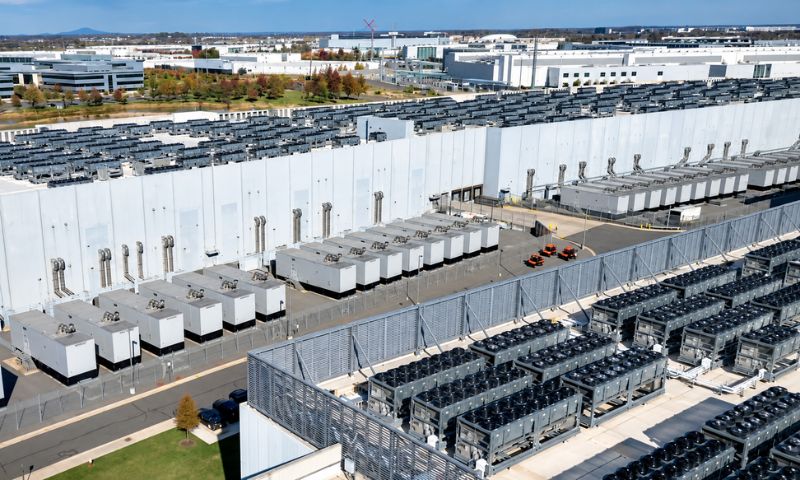
NEW YORK: AI data centres are becoming less dependent on water as technology companies deploy advanced cooling systems designed to keep increasingly powerful computer servers from overheating, even as the artificial intelligence boom drives construction of massive new facilities.
Data centres consumed an estimated 222 billion litres of water worldwide for cooling in 2025, according to consultancy Rystad Energy. Without measures to reduce consumption, that figure could nearly triple to 644 billion litres by 2030.
Growing demand has fuelled public concern in the United States, particularly as data centres require huge amounts of both water and electricity.
Why AI Data Centres Need Less Water
Nvidia says its latest DSX system can virtually eliminate water consumption for cooling at some AI data centres.
The technology uses a closed-loop cooling system, circulating liquid directly through servers and close to chips that can reach temperatures above 80 degrees Celsius.
ALSO READ: Saudi Arabia Expands Use of AI to Enhance Services for Hajj and Umrah Pilgrims
Instead of constantly replacing evaporated water, the liquid circulates repeatedly through sealed pipes.
Nvidia also allows cooling liquid to enter servers at around 45C, considerably warmer than conventional systems. This reduces the need for energy-intensive chilled air, with simple fans often sufficient to remove heat.
Microsoft, Amazon Web Services and Meta have also told the media they use closed-loop cooling systems involving no net water loss.
Tech Giants Improve Water Efficiency
Despite expanding their data-centre footprints, Microsoft and AWS reported improvements in water-use efficiency between 2022 and 2025.
Microsoft improved efficiency by 25 per cent, while AWS recorded a 37 per cent improvement, according to their latest sustainability reports.
However, reducing direct water consumption can create another challenge: higher electricity demand.
Independent researcher Andy Masley said there is a direct trade-off between water and energy use in cooling systems. Even closed-loop liquid eventually needs to be cooled, often using electricity-powered fans.
The environmental impact also extends beyond water consumed directly at data centres. Water is required to generate electricity and manufacture chips and servers.
In the United States, this indirect water footprint can be twice as large as the amount consumed directly by a data centre, highlighting the broader challenge facing the rapidly expanding AI industry.