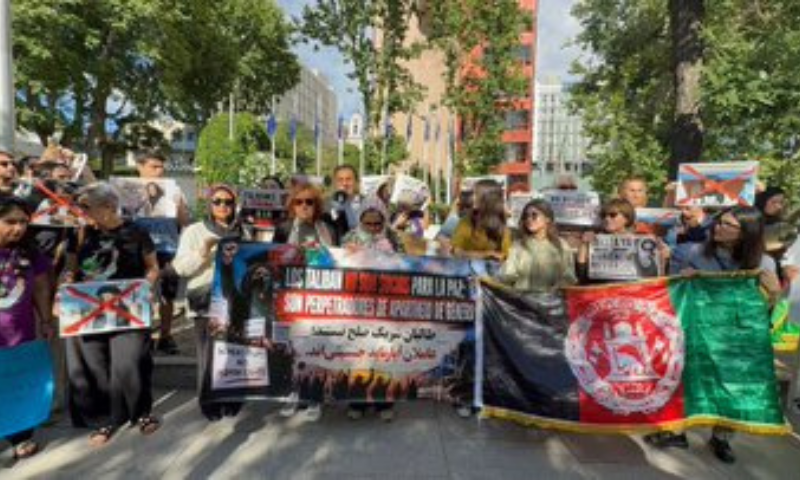
MADRID: Afghan activists and former politicians urged European governments not to legitimise the Taliban during a protest held alongside a major international conference on feminist foreign policy in Spain, where delegates from around 60 countries discussed the situation of women under Taliban rule.
The demonstration was organised by Mohammad Asif Siddiqi, a former deputy speaker of Afghanistan’s parliament.
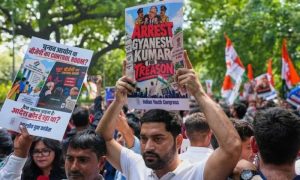
Protesters carried anti-Taliban banners and chanted slogans condemning what they described as the group’s repression of women, restrictions on civil liberties and broader human rights violations since returning to power in August 2021.
Participants included Afghan expatriates, human rights activists, Afghan women and Spanish supporters.
شماری از شهروندان افغانستان و فعالان حقوق بشر اسپانیایی و ایرانی در برابر دفتر پارلمان اروپا در مادرید تجمع کردند و مخالفت خود را با مشروعیتبخشی به طالبان اعلام نمودند.
معترضان تأکید کردند که طالبان نماینده مردم افغانستان نیستند و جای این گروه در دادگاه است.#AfghanWomen pic.twitter.com/knD2rHx1V3— Afghanistan Women’s Light of Freedom Movement (@AWLFMovement) June 4, 2026
They called on the European Union and its member states to avoid any official recognition of the Taliban administration and instead strengthen support for Afghan women, civil society groups and human rights defenders.
At the end of the protest, organisers submitted a resolution to Spanish and European authorities urging them not to invite Taliban representatives to the European Parliament or establish formal relations with the movement.
Afghanistan #women and human rights activists gathered today in Madrid to protest any engagement with the Taliban in Europe.
The Taliban do not represent the people of Afghanistan.
Granting them legitimacy ignores the suffering of millions of #Afghanistan women and girls.The… pic.twitter.com/3XaDnQCJzK
— Women’s Justice Movement (@wjmglobal) June 4, 2026
The resolution also called for Afghan embassies abroad not to be transferred to Taliban control and urged the international community to withhold political legitimacy from the current authorities in Kabul.
Demonstrators argued that Afghan women and girls have faced severe restrictions over the past four years, including limitations on education, employment, freedom of movement and participation in public life.
Concerns were also raised about forced and child marriages.
Speaking to media representatives, Mr Siddiqi called for Taliban leaders to be investigated by the International Criminal Court (ICC) in The Hague for alleged crimes against humanity. He also accused the Taliban of supporting extremist groups operating in the region.
Participants warned that continued support for militant organisations and restrictive domestic policies could pose wider security risks beyond Afghanistan if left unchallenged.
Mr Siddiqi said anti-Taliban demonstrations would continue and called on Afghan communities and human rights advocates around the world to organise similar events. He also urged the international community to review financial assistance reaching the Taliban administration.
The fifth meeting of European foreign ministers on feminist foreign policy was attended by representatives of around 140 civil society organisations and feminist groups, as well as women’s rights advocates and civil society representatives from approximately 60 countries.
The conference focused on advancing gender equality, supporting peace initiatives and strengthening democratic values. On the sidelines of the event, participants discussed the situation in Afghanistan, the concept of “gender apartheid”, and the role women could play in any future peace process.
Among the speakers was former Afghan parliamentarian Fawzia Koofi, who highlighted the challenges facing Afghans under Taliban rule and argued that policies of engagement and accommodation by some countries had strengthened the group’s ability to suppress women.
She said Afghan women and men were living under increasingly difficult conditions and stressed that lasting peace could not be achieved without women’s participation in political and social life.
Participants at the conference echoed those concerns, arguing that sustainable peace and democratic development in Afghanistan require the meaningful inclusion of women in governance and peacebuilding efforts.
Since regaining power in August 2021, the Taliban have imposed sweeping restrictions on women and girls, effectively excluding them from secondary and higher education, many forms of employment and much of public life.
Women are also subject to strict dress requirements and face restrictions on travel without a male guardian.
United Nations experts, human rights organisations and campaigners have described these measures as a form of “gender apartheid”, arguing that they systematically discriminate against women and girls.
They have repeatedly called for such policies to be recognised under international law as a crime against humanity, although no formal legal proceedings have yet been launched.