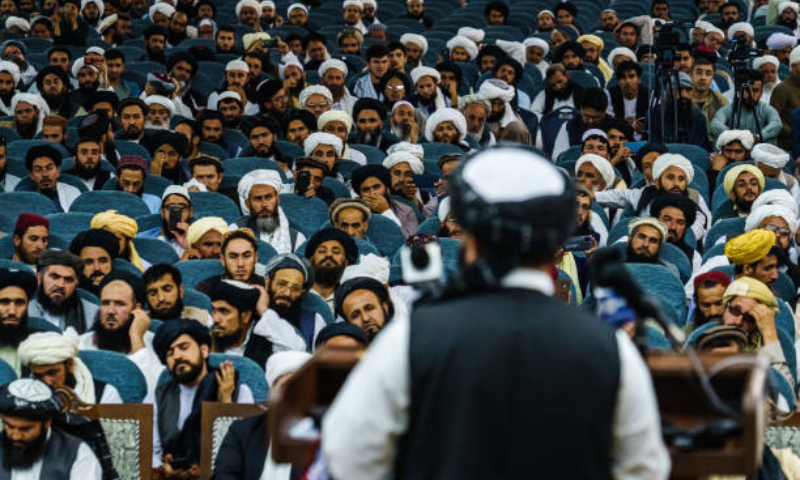



KABUL/ISLAMABAD: A major gathering of more than one thousand Afghan religious scholars and tribal elders convened in Kabul this week, urging the Afghan Taliban authorities to strictly enforce a ban on fighters traveling abroad for militancy and reaffirming that Afghan soil must not be used against any other country.
Participants from across Afghanistan adopted a formal resolution stating that the Islamic Emirate has full authority to take action against individuals or groups who violate these directives. The assembly echoed the position the Afghan Taliban have publicly reiterated since taking power — that Afghanistan will not be allowed to serve as a base for attacks on other nations, a commitment first articulated in the 2020 Doha Agreement.
The scholars further stressed that any preventive or proactive jihad requires the explicit permission of the country’s rulers, and that any military activity undertaken without such approval constitutes terrorism, not holy war.
The call comes amid heightened tensions with Pakistan, which has repeatedly accused the banned Tehrik-i-Taliban Pakistan (TTP) of using Afghan territory to stage cross-border attacks. Islamabad maintains that the spike in terrorism inside Pakistan is linked to TTP sanctuaries across the border.
In response to a question regarding the resolution passed by Afghan scholars, Pakistan Foreign Office spokesperson Tahir Andrabi reiterated Pakistan’s demand for written assurances from the Afghan leadership that terrorist groups will not use their soil to carry out attacks inside Pakistan.
Speaking at his weekly press briefing in Islamabad on Thursday, he noted that similar commitments had been made in the past but were not honored. Andrabi added that the resolution “does not qualify as a full written assurance,” reports Radio Pakistan.
In mid-2023, Pakistan sent a group of senior Islamic clerics to Kabul, pressing the interim Afghan government to honour commitments made under the Doha Agreement. Earlier this year, Pakistan also presented the Taliban administration with a comprehensive set of demands seeking stronger border controls and the dismantling of TTP safe havens after Kabul failed to provide a verifiable action plan.
Pakistan has additionally expressed concern over the involvement of Afghan nationals in several recent attacks, urging the Taliban leadership to issue a clear religious decree declaring TTP violence against Pakistan un-Islamic.
In a recent interview, Afghan interim defence minister Mullah Yaqub said the Taliban’s supreme leader had declared that Afghans launching attacks outside the country were not engaged in jihad. While he did not name Pakistan, the statement was widely interpreted as directed at fighters involved in attacks across the border.
Pakistani officials, however, said the media statements were “not sufficient” and insisted that explicit, visible steps were needed. Pakistan also wants the interim Afghan government to take practical measures to stop Pakistani TTP militants from being sheltered in Afghanistan and to act firmly against those who violate these commitments.
For Islamabad, the resolution adopted in Kabul by more than a thousand Afghan scholars strengthens its long-held position: that the Taliban must act decisively to prevent militants — particularly the TTP — from using Afghanistan as a safe haven.