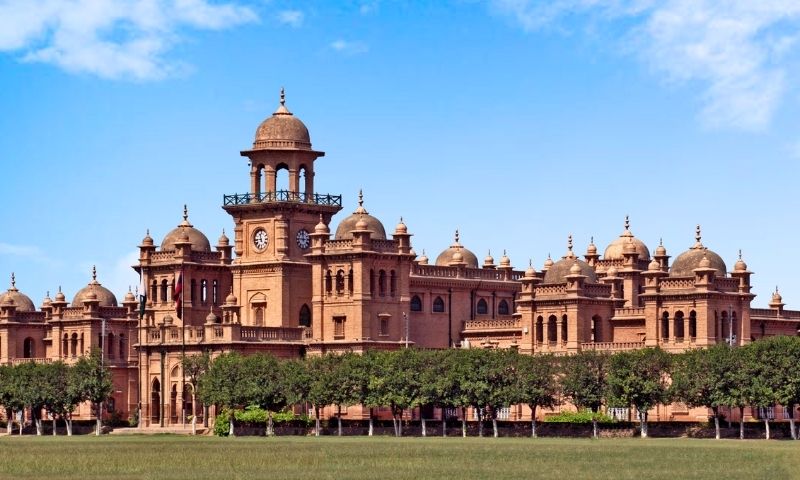
PESHAWAR: Established in 1913 at the foothills of Koh e Sufaid, Islamia College Peshawar (ICP), which has held the torch of educating the people of Khyber Pakhtunkhwa for the past 110 years, also saw the historic independence movement of Pakistan.
One traveling through the historic Jamrud Road can’t remain unimpressed while passing under the shadows of its tall domes, lush-green lawns, and majestic edifice of its beautiful architecture. It reminds visitors of the glorious role its students played during the Pakistan Movement led by the father of the nation, Quaid-e-Azam Muhammad Ali Jinnah.
“The history of the Pakistan Movement is incomplete without mentioning the role of the students of ICP,” said Younas Khan, Chairman Pakistan Studies Department, ICP, while talking to APP on Thursday.
He said the legendary Quaid visited ICP in 1936, 1945, and 1948 to acknowledge its students’ outstanding role while completing his mission for Pakistan.
On April 12, 1948, Quaid-e-Azam visited ICP as the first Governor General of Pakistan, where he presented glowing tributes to the services of its students towards making Pakistan.
“I am indeed very pleased to be present here today and to have the privilege of addressing students of this great Darul Uloom, who are the future builders of the nation. Remember your government is like your own garden. Your garden flourishes by the way you take care of it and the efforts that you put towards its betterment. Similarly, your government can only flourish by your honest, patriotic and constructive efforts to improve it,” Quaid said.
He wished to construct a university near ICP which the government fulfilled within a gap of one year by establishing the University of Peshawar in 1949.
Quaid-e-Azam became an honorary member of the Khyber Union, a college debating society, in 1936. His love for the college can be judged from his will written on May 30, 1939, in Mumbai, wherein he declared ICP, the Muslim University Aligarh, and Sindh Madrassatul Islam Karachi as among the inheritor of his property.
“The Quaid Trust later paid Rs10,811,600 in different installments to the college. The amount was spent on the
establishment of Quaid-e-Azam College of Commerce, University of Peshawar, construction of Jinnah residential quarters for the college employees, Jinnah College for Women and the newly constructed Takbeer block and others projects,” he said.
The college, which is a beautiful combination of the Aligarh and Deoband School of Thought, is a mere testimony to
the greatness of its Founder, Nawab Sir Sahibzada Abdul Qayyum Khan, besides the glorious history of strength and commitment.
“The idea to establish a college clicks in the minds of Nawab Sahib and Sir George Roos-Keppel, the then Chief Commissioner NWFP (Now KP) in early 1909 when they met the Pathan students during their visit to the Muslim University Aligarh,” says ex-principal ICP,” Prof G.D. Khilji in his memoirs.
The students requested either to construct a Frontier hostel in Aligarh or a college may be built in the frontier province. As a token, the students raised some sixty-odd rupees and gave them to Roos Keppel to form a Frontier Hostel Fund or any other project.
Keppel later passed the money on to Nawab Sahib, who gave it to his servant Habibullah, who always accompanied him.
It was April 12, 1911, when philanthropists Ghulam Haider Khan, Habibullah Khan, Khushal Khan, Sethi Karim Bakhsh and
Sahibzada Abdul Qayyum had gathered at the house of Abdul Karim Khan Indrabai in Peshawar for a social gathering. Habibullah reminded his master of the sixty-odd rupees, and Nawab Sahib floated the idea of establishing a college at Peshawar.
Karim Bakhsh Sethi offered to build a mosque, while Rahim Shah Kakakhel promised to construct a hostel known as Rahim Shah Ward. Abdul Karim donated Rs.10,000, Sethi Karim Bakhsh Rs.50,000, and the Nawab of Dir promised Rs.100,000.
Besides the subscription of Afridi chiefs, an example was set by Bibi Gul, widow of Khairullah Khan of Prang, who offered her ornaments on June 6, 1911, towards the college fund.
Later, a 10-member ad-hoc college committee under the chairmanship of Col. Muhammad Aslam Khan was set up on May 29, 1911, to table proposals for the establishment of the college. Leading Khans and Ulema were invited, and seven resolutions, including calling the proposed college ‘Darul-Ulum-i-Islamia Suba-i-Sarhad,’ were unanimously passed.
A committee was also constituted to select a suitable site for the college. The proposal to set up the college at Wazir
Ross Keppel rejected Bagh to spare the place of recreation.
The second option selection of Larama, about three miles north of Peshawar, could not materialize as people refused to donate the land. Other proposals were Rajjar in Charsadda and Darmangi on Michani Road. At the same time, Mian Rahim Shah Kakakhel offered to give land on the bank of River Kabul, but only some of these were accepted.
Sahibzada Abdul Qayyum, in consultation with Ross Keppel, selected the existing place for the college. The land chosen for the college was the property of the Khalil tribe of Tehkal. Nine hundred sixteen kanals and seventeen marlas were bought at Rs.30 per kanal. To foil the negative propaganda against the establishment of the college, renowned religious scholar and freedom fighter Haji Sahib of Turangzai was requested to lay the foundation stone of the college mosque and attached Collegiate School in 1911.
Sir Spenser Harcourt Butler, education member of the Viceroy’s council on April 5, 1913, performed the opening ceremony of Islamia Collegiate School. Later, the Islamia College was opened on October 1, 1913, with 26 students on roll.
Sahibzada Khurshid was the first admitted student who, in 1949, became the Governor of the NWFP. Initially, the college had only ten teaching staff. L. Tipping (1913-17) was its first Principal. Henry Martin served on the principal post for 12 years, nine months, and 15 days while Prof. Taj Muhammad Khattak served only for three-month and seven days. Arbab Sikandar Hayat had the distinction of serving the college as its Principal on three occasions.
The college remained closed on few times. First, it was closed for about three weeks in 1919 due to the second Afghan
War and students were shifted to Shahi Mehman Khana, Peshawar. It was again closed for a few days in 1920 due to the Non-Cooperation Movement.
The history of the college would be incomplete without mentioning the inauguration of the Khyber Union in 1921. Besides many stalwarts, Quaid-e-Azam Muhammad Ali Jinnah, Eleanor Roosevelt of the USA, first Governor of the NWFP Sir Ralph Griffith, renowned writer of Turkiye Khalida Adeeb Khanum, leader of All Indian Muslim League Sir Muhammad Shafi, Pundit Jawahar Lal Nehru, Maulana Abdul Kalam Azad, Governor then NWFP George Cunningham and Sardar Abdur Rab Nishtar are among its honorary members.
According to the Board of Trustees (BoT), the college owns about 544.5 acres of cultivable land in Charsadda, 395 shops, and flats in Khyber bazaar Peshawar and Charsadda.
The college’s clock tower, now Peshawar’s pride symbol, has long figured on the back of an Rs.1000 currency note. ICP is a unique educational institution in Khyber Pakhtunkhwa where students from KG to a Ph.D. level were getting a quality education and contributing to the prosperity of Pakistan.
- APP