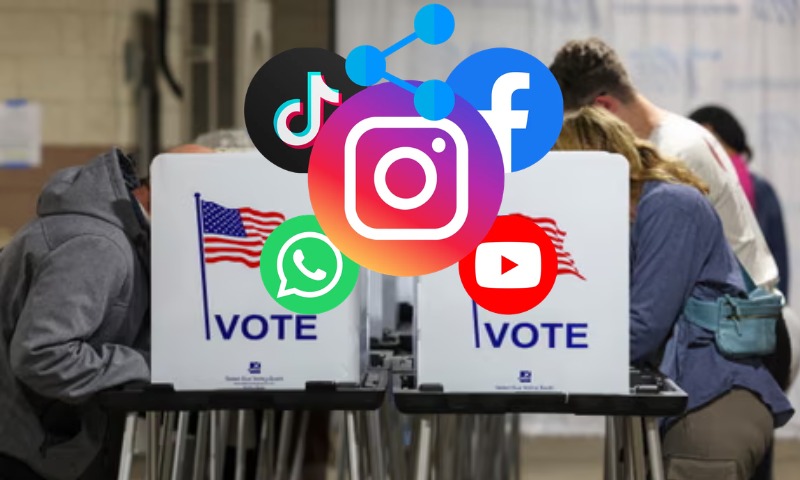
The United States’ political campaigns are no longer fought only through television advertisements, public rallies and traditional media interviews. Increasingly, they are also taking place on smartphone screens, where a short video, viral post, or online debate can bring a candidate directly into millions of people’s daily lives.
The 2026 US midterm elections have once again highlighted the importance of understanding how Americans consume political information. Democrats have secured control of both chambers of Congress, in a major setback for President Donald Trump and the Republican Party. However, social media alone cannot explain the results. Concerns over living costs, the economy, foreign policy, and the administration’s performance also shaped the election, according to Associated Press reporting.
Yet the growing role of digital platforms raises an important question: are social media networks changing not only how politicians campaign, but also how Americans engage with politics?
A massive digital audience
The scale of social media use in the United States provides some context. According to DataReportal’s Digital 2026 report, the country had around 254 million social media user identities in October 2025, equivalent to 73 per cent of its population.
Figures from platform advertising tools indicated that Instagram had a potential advertising audience of 182 million in the US, while TikTok reported an advertising audience of 153 million adults aged 18 and above. These are advertising-reach estimates, not verified counts of unique active users, and should not be added together.
The younger population is particularly active on these platforms. A 2026 Pew Research Center survey found that 79 percent of Americans aged 18 to 29 use Instagram, while 65 percent use TikTok. Among those aged 30 to 49, the figures were 64 percent and 45 percent, respectively.
Teenagers are also part of this digital environment. Pew’s 2024 survey of Americans aged 13 to 17 found that 63 percent used TikTok and 61 percent used Instagram, while 90 percent used YouTube. Nearly half said they were online almost constantly.
Although most teenagers are not yet eligible to vote, their exposure to political discussions can shape their understanding of public issues and their future engagement with elections.
Democrats and Republicans compete for attention
Social media is not the territory of one political party. Both Democrats and Republicans use digital platforms to promote their policies, communicate with supporters and challenge their opponents.
Pew Research Center’s 2026 findings show some differences in platform use among adults who identify with or lean towards the two parties. Instagram use stood at 56 per cent among Democrats, compared with 47 percent among Republicans. TikTok use was 42 per cent among Democrats and 33 per cent among Republicans.
However, Facebook showed a different pattern, with 74 per cent of Republicans reporting its use, compared with 68 percent of Democrats. On X, the figures were almost identical, at 20 percent among Republicans and 19 percent among Democrats. YouTube use was also widespread across both groups.
These figures measure platform use among each political group, not the political preferences of everyone using a particular platform. Still, they show why digital campaigning cannot be reduced to the strategy of a single party.
Mamdani and El-Sayed: Two examples of digital campaigning
Zohran Mamdani’s 2025 New York mayoral campaign became a prominent example of a candidate using social media to reach audiences beyond traditional political circles.
His campaign used short videos, humour, street conversations and collaborations with online creators to discuss issues such as housing costs, public transport and affordability. A Washington Post analysis in June 2025 reported that Mamdani’s Instagram engagement rate was 14 times that of rival Andrew Cuomo during that month. The newspaper also cited social media analytics showing that conversations about Mamdani outnumbered those about Cuomo by more than 30 to one.
In the 2026 midterms, Michigan Democrat Abdul El-Sayed also drew attention during his Senate campaign. His victory over Republican Mike Rogers, projected by CBS News, made him the first Muslim elected to the US Senate.
Their campaigns offer different examples of how candidates can use online communication to explain their positions and connect with audiences. However, their individual results do not establish that social media was the deciding factor.
Does online popularity translate into votes?
The influence of social media may extend beyond the number of followers or views a candidate attracts. A Sprout Social survey published in October 2026 found that 55 percent of US respondents said social media posts had informed or changed their opinion about whom to vote for. Among Generation Z respondents, the figure was 79 percent.
These are self-reported survey findings, rather than evidence that online posts directly changed election results. Nevertheless, they point to the growing role of digital content in how people form political opinions.
There are also serious challenges. Misleading information, manipulated videos, political polarisation, and AI-generated deepfakes can spread through the same networks that candidates use to reach voters. A large online following does not necessarily represent broad public support, and viral engagement does not guarantee votes.
Social media has clearly become an important part of American political campaigning, but it has not replaced traditional campaigning, local outreach, or the issues that matter to voters.
The real test for politicians is not simply how many people watch, like, or share their content. It is whether they can turn that attention into meaningful political engagement and public trust. In an increasingly digital America, the campaign trail may now run through people’s social media feeds, but the final decision is still made at the ballot box.