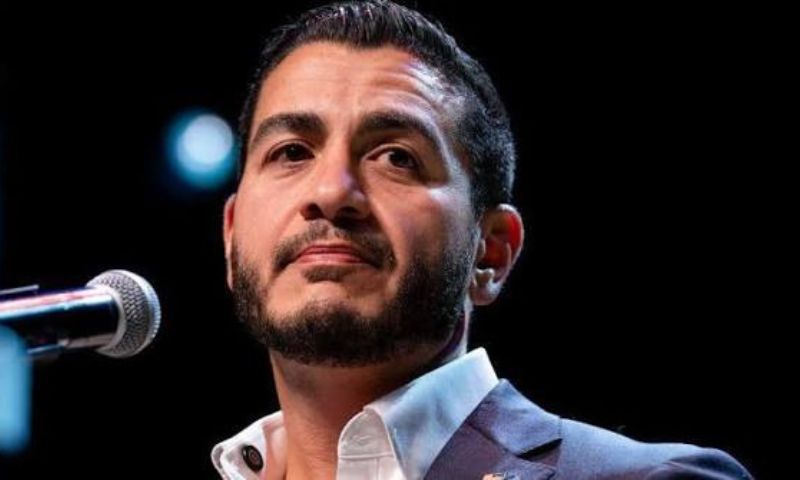
WASHINGTON: Abdul El-Sayed has made American political history, becoming the first Muslim elected to the US Senate after defeating former Republican congressman Mike Rogers in Michigan’s closely watched midterm election.
Abdul El-Sayed was born in Rochester Hills, Michigan, on 31 October 1984. He is an American citizen of Egyptian descent.
The Democratic candidate’s victory preserves a crucial Democratic-held Senate seat and marks a historic milestone for Muslim representation in the United States Congress. He will take office when the new Congress convenes in January.
A medical doctor and former public health official, El-Sayed emerged from a competitive Democratic primary to contest the seat being vacated by retiring Senator Gary Peters.
🚨 FIRST MUSLIM EVER ELECTED TO THE US SENATE!
Democrat Abdul El-Sayed has made history by defeating Republican Mike Rogers to win Michigan’s open Senate seat, becoming the first Muslim ever elected to the US Senate.
El-Sayed secured approximately 51% of the vote against Rogers’ 47%, campaigning on affordable living, healthcare access and fewer foreign military interventions.
His victory adds to Democratic gains in a midterm election reshaping the balance of power in Washington.
#AbdulElSayed #Michigan #USMidterms2026 #HistoryMade
— Sajjad Tarakzai (@SajjadTarakzai) November 4, 2026
His campaign unfolded against a deeply polarised political backdrop, with his Muslim faith repeatedly brought into the political debate.
President Donald Trump and other Republicans targeted his religious background during the campaign, making his identity a prominent issue in the race.
El-Sayed rejected allegations linking him to extremism and continued his campaign in a state that narrowly voted for Trump in the 2024 presidential election.
‘The Bad Guys Lost’
The historic victory brought an emotional celebration at El-Sayed’s election-night gathering in Michigan early Wednesday.
Addressing jubilant supporters, the newly elected senator thanked voters and promised to take the same determination, openness and compassion to Washington that he said they had demonstrated throughout his campaign.
“Michigan, I cannot wait to serve you with the same big-heartedness, open-mindedness, grit, and earnestness that you’ve shown me,” he said.
He urged supporters to see the result as a collective achievement and a rejection of the political forces that had opposed his campaign.
“Let them know tomorrow that the bad guys lost,” he declared. “Let them know that we, together, fighting for something bigger, we won. We won! So Mike, enjoy your retirement.”
The remarks drew a sharp line between the victorious Democrat and his Republican opponent, whom he had just defeated.
Message To Vance
El-Sayed also directed a pointed message at Vice President JD Vance, referring to the constitutional process through which newly elected senators take their oath of office.
“There is this delicious irony in the fact that you’re constitutionally obligated to swear me in in January,” he said.
He then turned his attention to Trump, recalling the president’s campaign rallies, where he had made a show of struggling to pronounce the Democratic candidate’s name.
“Donald, look, I know you struggled with my name,” El-Sayed said. “So after JD swears me in in January, you can just go on and call me senator.”
A Historic Milestone
El-Sayed’s election marks a significant moment for Muslim representation in American national politics, making him the first Muslim elected to the US Senate.
His victory also carries particular significance in Michigan, a politically competitive state where the Senate contest attracted national attention.
From a campaign in which his religious identity became a central political issue to a victory speech directly addressing the country’s highest political leadership, El-Sayed’s journey to the Senate has placed him at the centre of a historic election night.
In January, he will take his seat in a Senate transformed by the Democratic victories — bringing a new chapter in Muslim representation to the upper chamber of the US Congress.