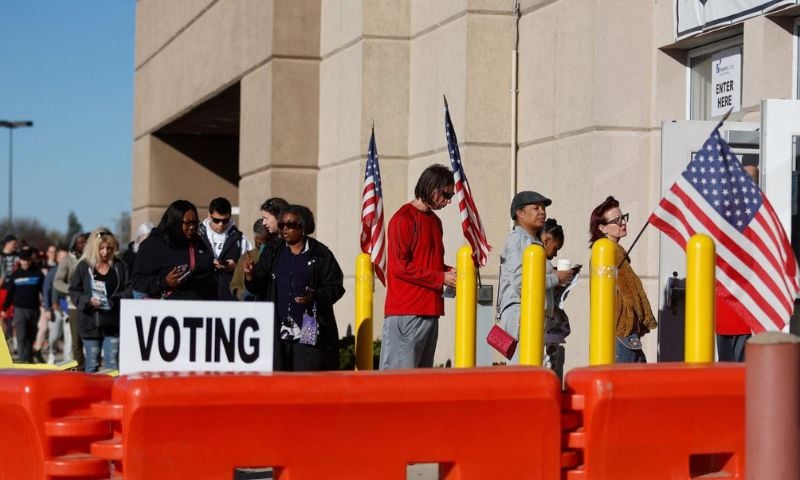
WASHINGTON: Polling stations across the United States have begun closing in the 2026 midterm elections, setting off a nationwide count that will determine control of Congress and shape the final two years of President Donald Trump’s second term.
The first polling places closed in parts of Indiana and Kentucky, followed by Georgia, Virginia, South Carolina and other eastern states. More closures are scheduled through the night, with California and other western states among the last to finish voting.
The election is being closely watched worldwide because its outcome will determine whether Trump retains Republican control of both chambers of Congress or faces a Democratic-controlled House or Senate that could block parts of his legislative agenda and investigate his administration.
Polls Close in Stages
Unlike countries where polling stations close nationwide at the same time, US voting ends at different hours because states set their own schedules and the country spans several time zones.
All times below are Eastern Time (ET), followed by the equivalent time in Pakistan (PKT). Pakistan is 10 hours ahead of Eastern Time during the November election.
- 6 pm ET (4 am Wednesday PKT): The first polling stations closed in parts of Indiana and Kentucky.
- 7 pm ET (5 am PKT): Polls closed in Georgia, South Carolina, Vermont and Virginia, as well as the remaining polling places in Indiana and Kentucky and most of Florida.
- 7:30 pm ET (5:30 am PKT): North Carolina, Ohio and West Virginia followed.
- 8 pm ET (6 am PKT): Polls closed in Alabama, Connecticut, Delaware, the District of Columbia, Illinois, Maine, Maryland, Massachusetts, Mississippi, Missouri, New Hampshire, New Jersey, Oklahoma, Pennsylvania and Rhode Island, along with remaining locations in some states.
- 8:30 pm ET (6:30 am PKT): Arkansas was scheduled to close.
- 9 pm ET (7 am PKT): Polls were due to close in Arizona, Colorado, Kansas, Louisiana, Michigan, Minnesota, New Mexico, New York, South Dakota, Tennessee, Wisconsin and Wyoming. Most of Texas was also scheduled to close by this time, although some areas close earlier.
- 10 pm ET (8 am PKT): Iowa, Montana, Nebraska, Nevada, North Dakota and Utah were scheduled to finish voting.
- 11 pm ET (9 am PKT): Polls were due to close in California, Idaho, Oregon and Washington.
- Midnight ET (10 am Wednesday PKT): Hawaii was scheduled to close.
- 1 am ET (11 am Wednesday PKT): The final polling places in Alaska were scheduled to shut, although most of the state closes earlier.
The schedule refers to the latest closing times in each state; some states have polling places in more than one time zone. The end of voting does not mean the final results will be available immediately. Close contests, mail-in ballots and state-specific counting procedures could delay final calls.
Democrats Score Early Wins
The first major Senate results have brought victories for Democrats.
In Georgia, Democratic Senator Jon Ossoff won re-election, defeating Republican challenger Mike Collins and holding a seat Republicans had hoped to capture.
In North Carolina, former Democratic governor Roy Cooper defeated Republican Michael Whatley to win an open Senate seat, flipping it from Republican control. The victory gives Democrats an important gain as they attempt to take control of the upper chamber.
Democratic Senator Mark Warner also won re-election in Virginia, according to media projections.
The early results do not settle the battle for the Senate. Republicans entered the election with a 53-47 majority, and Democrats need a net gain of four seats to take control.
What Voters Are Saying
Early exit polls suggest that dissatisfaction with the country’s direction and the state of the economy is weighing heavily on voters.
A CBS News exit poll put Trump’s job approval among voters at 38 per cent. The network said the figure was on course to be the lowest approval rating for a president in a midterm election since it began tracking the measure in 2006.
Roughly three-quarters of voters said they were dissatisfied with the direction of the country. Economic concerns were prominent, with many voters expressing negative views of the economy and saying their financial circumstances had worsened.
The cost of everyday essentials, including groceries, fuel and household bills, has been a major campaign issue. Democrats made affordability a central part of their challenge to Republican candidates, while Republicans sought to blame the previous administration for economic pressures.
Trump himself was a significant factor in the House vote for many voters. CBS found that roughly six in 10 said the president influenced their choice, with opposition to Trump particularly strong among those voting for Democrats.
Foreign policy also featured in the campaign. The war with Iran and its impact on fuel prices and wider regional stability added to scrutiny of the administration’s decisions.
Battle for Congress
All 435 seats in the House of Representatives and 35 Senate seats are being contested. Thirty-six states are also electing governors.
Democrats need a net gain of three seats to take control of the House, while they need four additional Senate seats to win a majority in the upper chamber.
The House battle is particularly important because a Democratic majority would give the party control of committees, greater power to scrutinise the administration and the ability to block or delay parts of Trump’s legislative programme.
A change in Senate control would also affect the president’s ability to secure confirmation of federal judges and other senior appointments.
Why the Result Matters
Midterm elections are held halfway through a US president’s four-year term and often serve as a measure of public support for the administration.
A Democratic victory in either chamber would create a major political obstacle for Trump during the remainder of his term. It could trigger congressional investigations, intensify oversight of executive decisions and complicate the passage of legislation.
For governments, businesses and allies around the world, the results will offer an indication of how much domestic political support Trump retains as his administration pursues its economic, trade and foreign policy agenda.
With Western states still voting and several closely contested races yet to be decided, the national balance of power remains unresolved.