Key Points
- More than 12.7 million domestic tourists visited Khyber Pakhtunkhwa in 2025.
- Kalam Road remains affected by incomplete post-flood rehabilitation.
- World Bank downgraded KITE implementation progress to moderately unsatisfactory.
- Sustainable tourism requires infrastructure, safety and environmental protection.
PESHAWAR, Pakistan: From the snow-capped mountains of Swat and the lush green meadows of Kumrat to the breathtaking landscapes of Kaghan and the Galiyat, Khyber Pakhtunkhwa (KP) possesses some of Pakistan’s most attractive tourist destinations.
Every summer, millions of domestic visitors travel to these scenic valleys in search of pleasant weather, natural beauty and respite from the heat of urban centres. International tourists, too, are increasingly exploring the province’s mountains, cultural heritage and adventure tourism opportunities.
However, behind the spectacular landscapes lies a persistent challenge: the infrastructure and essential services needed to accommodate the growing influx of visitors have struggled to keep pace with tourism development.
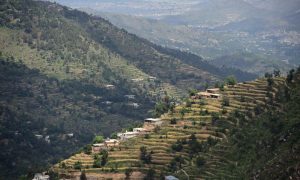
Poor road connectivity, inadequate sanitation, insufficient waste management, unregulated construction, limited emergency response facilities and a shortage of organised visitor services continue to undermine the experience at several destinations.
The contradiction is particularly evident in places such as Kalam, Kumrat and other remote valleys, where the journey to some of the most celebrated natural attractions can be as challenging as the terrain itself.
The issue raises a fundamental question about the province’s tourism strategy: can KP turn its natural beauty into a sustainable economic asset without first establishing the infrastructure needed to support it?
Millions of visitors
Tourism statistics underline the scale of the opportunity.
According to the annual performance report of the Khyber Pakhtunkhwa Culture and Tourism Authority (KPCTA), more than 12.7 million domestic tourists visited the province in 2025, alongside over 8,700 foreign visitors.
The corresponding domestic figure for 2024 was reported at 20.6 million, indicating a significant decline in recorded arrivals rather than uninterrupted growth.
The figures nevertheless demonstrate the substantial scale of domestic tourism in the province, although differences in reporting periods, counting methods and coverage need to be examined before drawing direct conclusions about visitor trends.
Popular destinations include Swat, Kumrat, Kaghan, Naran, Galiyat, Kalash Valley, Garam Chashma and Booni-Mastuj.
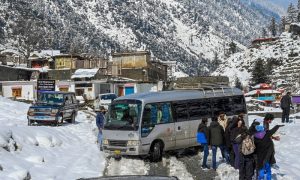
The seasonal concentration of visitors creates additional pressure on roads, accommodation, drinking water supplies, sanitation facilities and emergency services, particularly during public holidays and the summer vacation period.
On June 25, 2026, for instance, Khyber Pakhtunkhwa recorded 231,786 domestic tourists in a single day, according to figures released by the KPCTA. Naran-Kaghan alone received 109,292 domestic visitors, while Swat welcomed 57,704.
Such large visitor numbers highlight the importance of preparing tourist destinations for seasonal surges rather than relying exclusively on infrastructure designed for ordinary population levels.
Roads to nowhere
Road connectivity remains among the most visible obstacles to tourism development in the province.
The condition of the Kalam Road, also known as the N-95, illustrates the problem, which suffered extensive damage at seven locations during the devastating floods of 2022. Although temporary restoration work subsequently re-established connectivity, several sections deteriorated further because permanent rehabilitation remained incomplete.
The affected stretches included Qandil, Damlai Madyan, Bahrain Bazaar, Ramait Bahrain, Hawai Ramait, Asrait Kalam and Bodal Kamar.
The same is the case with the access roads leading to Kumrat and other tourist destinations in Upper Dir.
For visitors travelling with families, damaged roads can turn what should be a recreational journey into an exhausting experience. For local businesses, poor connectivity can translate into fewer visitors, higher transportation costs and lost income.
Infrastructure under pressure
Roads are only one component of the infrastructure challenge.
Many tourist destinations require reliable drinking water supplies, public toilets, drainage systems, designated parking areas, waste collection arrangements and properly maintained public spaces. The rapid expansion of hotels, restaurants and commercial buildings has also created pressure on the natural environment.
In several locations, commercial establishments have expanded along riverbanks, sometimes without adequate arrangements for wastewater treatment and solid waste disposal.
The issue is particularly significant in Swat and other river valleys, where clean water and the natural landscape are among the principal attractions for visitors.
Without effective wastewater treatment and waste disposal systems, tourism development can gradually undermine the environmental assets on which the industry depends.
Unregulated construction also raises questions about riverbank encroachments, land-use planning, building regulations and exposure to flooding.
The devastating floods of 2022 demonstrated the vulnerability of settlements and infrastructure located close to rivers and streams. Subsequent flooding has further underscored the importance of enforcing construction regulations and adopting climate-resilient planning.
World Bank warning
The challenges confronting Khyber Pakhtunkhwa’s tourism sector are also reflected in the implementation record of a major development initiative.
The Khyber Pakhtunkhwa Integrated Tourism Development Project (KITE), supported by the World Bank, was designed to improve tourism infrastructure, develop tourism assets and strengthen destination management across the province.
The project originally carried financing of $70 million, subsequently increased by an additional $30 million, taking total World Bank financing to $100 million.
The provincial government has also committed Rs3 billion for land acquisition.
However, in an August 2026 assessment, the World Bank downgraded the project’s overall implementation progress from moderately satisfactory to moderately unsatisfactory, although progress towards its development objective remained moderately satisfactory.
The project is scheduled to close on April 30, 2027, leaving a relatively short period to complete outstanding activities and ensure the sustainability of its investments.
A decade of missed opportunities
The infrastructure deficit in Khyber Pakhtunkhwa’s tourism sector also raises questions about the performance and priorities of successive Pakistan Tehreek-e-Insaf (PTI) provincial governments, which have remained in power since 2013, with brief interruptions in the continuity of individual administrations.
Having governed the province for more than a decade, PTI has had multiple opportunities to translate its tourism ambitions into a comprehensive development programme. Yet, persistent shortcomings in road connectivity, sanitation, waste management, destination planning and visitor facilities suggest that the development of tourism infrastructure has not kept pace with the province’s promotional ambitions.
Significantly, the provincial government’s own Tourism Policy 2015 had already identified poor infrastructure, weak institutional capacity, inadequate regulation, limited private investment and insufficient tourism-related information as major obstacles to the sector’s growth.
The policy envisaged transforming tourism into a leading economic sector through infrastructure development, institutional reforms, workforce training, quality assurance and public-private partnerships. More than a decade later, several of the same challenges continue to feature in discussions about the province’s tourism development.
The launch of the World Bank-funded Khyber Pakhtunkhwa Integrated Tourism Development Project (KITE) in 2019 was expected to address some of these longstanding deficiencies. However, the project’s implementation difficulties and the World Bank’s August 2026 downgrade of its implementation progress to moderately unsatisfactory have raised fresh questions about institutional capacity, project execution and the effectiveness of government oversight.
The provincial government must explain why problems identified in its own 2015 tourism policy remain unresolved, why major development schemes have experienced delays and what corrective measures have been taken to ensure that public money and international development financing translate into functioning facilities.
For a political party that has repeatedly presented tourism as one of Khyber Pakhtunkhwa’s major economic opportunities, the question is no longer simply how many tourists visit the province or how many promotional campaigns are launched. It is whether more than a decade in government has produced the roads, sanitation systems, emergency facilities and regulatory framework necessary to sustain the industry.
The PTI-led provincial government must, therefore, be judged not only by its tourism announcements and investment commitments but also by the infrastructure and services it has actually delivered.