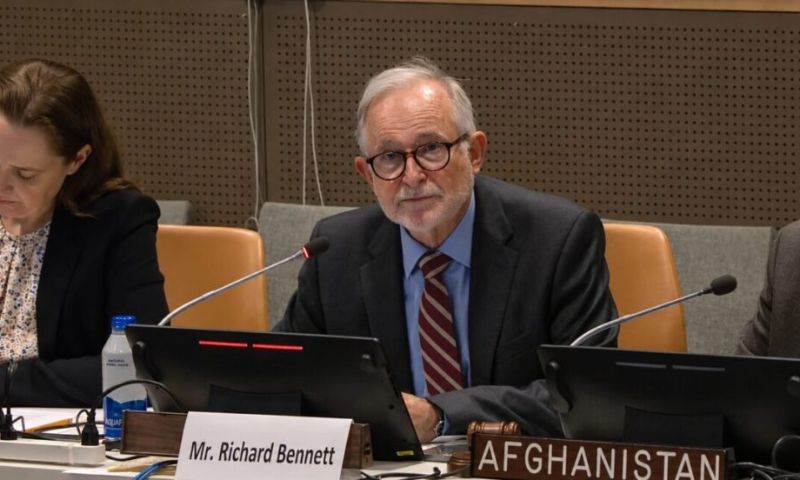
GENEVA: Taliban regime policies have severely restricted or eliminated opportunities for young Afghans to pursue higher education, build careers, achieve financial independence and participate in public life, UN Special Rapporteur Richard Bennett told a meeting on Afghan youth at the United Nations.
Bennett said young Afghans continue to aspire to study, find meaningful employment, start families and contribute to their communities, but many of those paths have been closed off under Taliban rule.
“Afghanistan’s youth aspire to pursue higher education, find meaningful employment, achieve financial independence, start families, participate in public life and serve their communities,” Bennett said. “Yet today in Afghanistan, many of these opportunities have either been severely restricted or completely taken away.”
Bennett spoke at an event titled “Afghan Youth at a Crossroads: Rights, Aspirations, Challenges and Opportunities,” which brought together Afghan youth, diplomats and human rights advocates, including participants joining from inside Afghanistan.
Speakers at the meeting warned that the consequences of five years of Taliban rule extend beyond the well-documented restrictions on women and girls, affecting young Afghans’ education, employment prospects and ability to participate in society.
Naseer Ahmad Faiq, Afghanistan’s charge d’affaires to the United Nations, said young Afghans have seen their education interrupted, career plans disappear and opportunities to participate in society steadily restricted.
“We need opportunities, not charity.”
At today’s #UNGA81 side event, young people joining from inside Afghanistan spoke about exclusion, unemployment and the denial of women’s and girls’ rights. Their recommendations were clear:
▪️ Expand access to quality education and support their efforts to educate the next generation.
▪️ Create jobs and remote work opportunities that put their knowledge and skills to use.
▪️ Connect youth-led businesses to international markets and support financial independence.
▪️ Provide safe platforms for participation, global youth connections and psychosocial support.In my opening remarks, I stressed that Afghan women and young people must have a meaningful role in decisions shaping their future. Afghanistan’s Mission remains committed to bringing their voices to the United Nations and carrying their perspectives into our diplomatic work.
Their message must guide our response: “Help us build our own future.”
Watch the full meeting, including my opening remarks and the youth presentations: 👇
https://t.co/WMdFciz9BQFull statement: 👇
https://t.co/cr4jeQwjIU#Afghanistan #AfghanYouth
— Naseer A. Faiqنصیراحمد فایق (@faiq_naseer) November 3, 2026
“Behind these figures are young people who hoped to become doctors, teachers, engineers or journalists, or simply to earn a living and support their families and have a dignified life,” Faiq said. “Every year of exclusion makes those aspirations harder to fulfill and deprives Afghanistan of skills it urgently needs.”
Faiq also raised concerns about a shift in Afghanistan’s education system, saying madrasas, or Islamic religious schools, are increasingly replacing mainstream education while subjects such as foreign languages and civic education are being removed.
By September 2025, more than 23,000 religious institutions had been “registered, repurposed or established by the Taliban,” he said.
“We are concerned that madrasas are increasingly replacing mainstream education,” Faiq said.
He linked those changes to the skills Afghan youth will need as technology reshapes education and employment around the world.
Women and girls continue to face the most extensive restrictions. Girls are barred from formal education beyond the sixth grade and women from universities, while the Taliban regime has imposed wide-ranging restrictions on women’s employment, movement and participation in public life.
UNICEF reported in August that more than 2.6 million Afghan girls had been denied secondary education since the Taliban returned to power in 2021.
Nuala Ní Mhuircheartaigh, Ireland’s deputy permanent representative to the United Nations, said the quality of boys’ education had deteriorated because of factors including the loss of qualified female teachers, shortages of specialist educators and the removal of key subjects from school curricula.
She said Afghan girls, meanwhile, continue trying to pursue education through online learning, informal schools and peer-to-peer teaching despite the restrictions.
Ní Mhuircheartaigh pointed to testimony in one of Bennett’s reports from a girl in Herat who had hoped to become a pilot but said the loss of access to education had destroyed her dream.
“When education was closed to us, my dreams were destroyed,” the girl said. “I wanted to become a pilot. Now I cannot be a pilot and my youth has been wasted. Who will give me back those lost years?”
“We can’t resolve the lost years,” Ní Mhuircheartaigh said. “But what we do need to ask ourselves now is what more we can do today to make sure that no further time is lost.”