
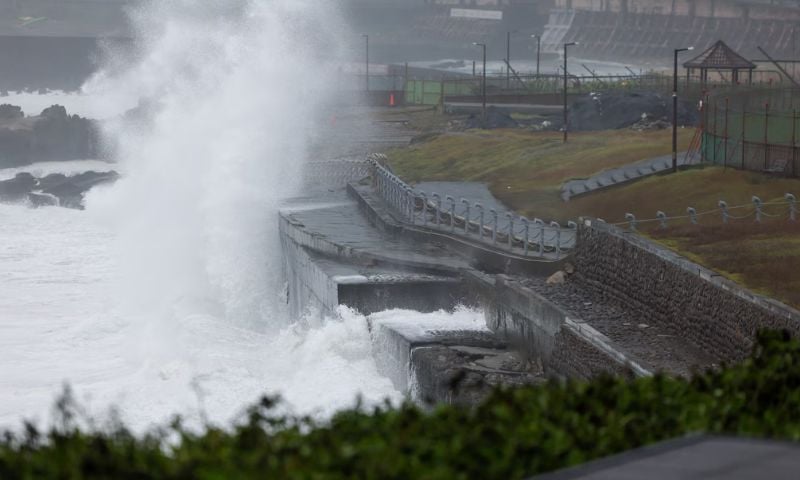
TAIPEI, Taiwan: Typhoon Champi left around 56,000 households without electricity in Taiwan on Saturday as emergency crews worked to restore power following fierce winds, heavy rainfall and flooding.
At least one person has died, and more than 500 others have been injured since Thursday, when authorities began issuing warnings ahead of the approaching storm, according to AFP.
More than 5,000 people were evacuated from their homes as powerful winds uprooted trees, damaged power lines and caused temporary flooding.
Nearly 24 centimetres of rainfall was recorded in the western county of Miaoli on Saturday, while the northeastern county of Yilan received approximately 65 centimetres since Thursday.
Most businesses across northern and central Taiwan remained closed for a second consecutive day.
Storm weakens but warnings remain
Taiwan’s Central Weather Administration said the most severe phase of the typhoon had passed, although strong winds and dangerous sea conditions continued.
“Although the period of the typhoon’s most severe impact has passed, we would like to remind everyone that winds and waves in the waters around Taiwan remain strong,” weather official Wuu Woan-hwa said.
ALSO READ: Several Feared Trapped After 16-Storey Building Collapses in Nairobi
Champi briefly reached super typhoon strength earlier in the week, with maximum sustained winds reportedly approaching 300 kilometres per hour.
By Saturday, its winds had weakened to approximately 120 kilometres per hour, according to the Joint Typhoon Warning Center.
China and Japan prepare for impact
As Champi moved northwards, Chinese authorities warned of strong winds and heavy rainfall along the country’s eastern coast.
Train services were suspended in some areas, while tens of thousands of residents were evacuated in Shanghai.
Heavy to torrential rainfall was forecast across parts of Jiangsu, Shanghai and Zhejiang.
In Japan’s southern Okinawa prefecture, authorities reported two injuries, while dozens of regional flights were cancelled.
The storm comes during an active Pacific typhoon season influenced by El Niño, which has contributed to unusually warm ocean temperatures.
The United Nations has warned that the developing El Niño event could intensify weather-related risks, including flooding and drought, with effects potentially extending into 2027.