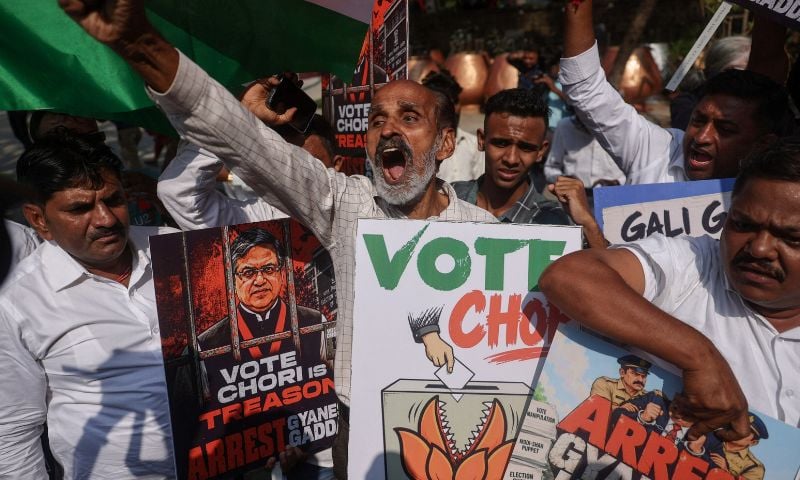
NEW DELHI: Protests against what opposition parties call “vote theft” have continued across India despite a sweeping security crackdown, arrests and violence against demonstrators challenging Prime Minister Narendra Modi’s government over a controversial revision of electoral rolls.
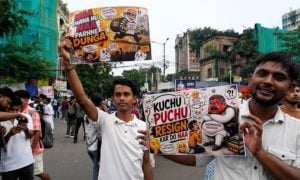
The youth-led Cockroach Janata Party (CJP) and student groups have led demonstrations demanding the resignation of Chief Election Commissioner Gyanesh Kumar.
Opposition parties say the revision risks removing millions of eligible voters, particularly among poor and marginalised communities, to benefit Modi’s ruling Bharatiya Janata Party (BJP).
The Election Commission of India denies favouring any political party. It says the Special Intensive Revision (SIR) is intended to remove deceased, duplicate and otherwise ineligible entries from voter lists.
Despite the crackdown, CJP founder Abhijeet Dipke vowed on Monday that the movement would not be silenced.
In a video statement shared on social media, he criticised Modi over the continued detention of activists Saurav Das and Ashutosh Ranka, whose judicial custody was extended by two days by a New Delhi magistrate.
“You must be feeling very strong keeping a 26-year-old Saurav Das in jail. You must be feeling very strong beating children on the streets,” Dipke said.
“Is this strength? Hiding behind the police, hiding behind the courts, is this Narendra Modi’s strength?” he asked.
Message to Modi https://t.co/44wzkog71Q
— Cockroach Janta Party – CJP (@Cockroachisback) October 19, 2026
Protests Continue Despite Arrests
Thousands of protesters defied a heavy security deployment in New Delhi over the weekend after the CJP called on supporters to unfurl the national flag as part of its campaign against election chief Kumar.
Police deployed thousands of personnel around two protest sites, Jantar Mantar and a park in Connaught Place. At least 150 people were arrested at the demonstrations.
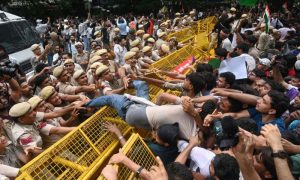
Das and Ranka were detained on October 14 after allegedly jumping security barricades to wave the national flag at Jantar Mantar, a long-standing protest site in the capital.
A magistrate extended their detention by two days on Monday, after they had spent five days in custody. Television footage showed the two activists being taken away in a police van following the hearing.
The movement’s legal affairs head, Ratna Singh, criticised the decision. “This is an absolute mockery of the justice system,” she told reporters.
Dipke praised the two men for remaining defiant despite their detention. He said Das had appeared in court smiling and remained unafraid when informed that his custody had been extended.
“Mr Modi, I’m sorry to say this, none of us are scared of you. And none of us is going to remain silent,” Dipke said.
He also questioned the use of police barricades and the detention of young protesters, arguing that arrests would not deter the movement.
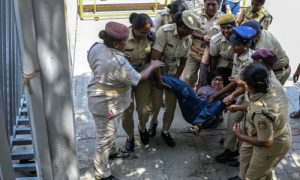
Dipke himself was released on Saturday, a day after police detained him while he was attempting to join a protest rally in Connaught Place.
Neha Bora, president of the All India Students’ Association (AISA), was also detained during Friday’s protests but released later that evening.
Jantar Mantar has been sealed off with yellow metal barricades for more than a week. Delhi Police said last week that the site had been removed from its list of designated protest venues.
Electoral Roll Revision to Benefit BJP
The protests have spread to several cities, including Bengaluru, and drawn support from opposition parties, student groups and civil society organisations.
Thousands of CJP supporters and student activists demonstrated in Bengaluru on Thursday. A day earlier, opposition leader Rahul Gandhi was briefly detained during a protest in New Delhi.
Images of police officers dragging Gandhi towards a vehicle circulated widely on social media.
Gandhi’s Congress party and other opposition lawmakers have also staged protests against the voter-roll revision.
More than 130 million names have been removed from electoral rolls since the SIR began last year. The scale of the deletions has become a central point of contention, with opposition parties warning that eligible voters could be excluded to benefit the ruling BJP.
An investigation by The Indian Express reported that two fellow election commissioners had raised objections to the revision process and that Kumar had not acted on their concerns.
Opposition parties have also questioned the process for restoring deleted names, arguing that documentation requirements and a lack of older government records could make appeals difficult for some voters.
The controversy has placed renewed scrutiny on the commission’s neutrality as Modi serves his third term.
The BJP failed to win a parliamentary majority on its own in the 2024 general election but retained power through its coalition.
Violence Against Protesters
The crackdown has also drawn attention to allegations of attacks on protesters by men described by activists as vigilantes.
Videos circulating on social media appeared to show men wearing saffron scarves chasing and beating demonstrators in central New Delhi on October 10.
One video appeared to show a woman pushed to the ground and assaulted after intervening on behalf of a male protester, while a police officer stood nearby.
Reports identified four men subsequently targeted by police action as Raman Saini, Vivekanand, also known as Vivek, Kapil Kumar, and Ravinder Singh, also known as Govind Hindu. They were identified as members of the Hindu Raksha Dal (HRD), a Hindu nationalist organisation.
HRD chief Bhupendra Singh Tomar, also known as Pinky Bhaiyya, confirmed that the men belonged to his organisation and defended their actions in comments reported by Outlook magazine.
The four men were later released on bail. The allegations have prompted criticism of the authorities’ handling of violence against demonstrators and questions about the response of police officers present during the assaults.
Critics have accused Hindu nationalist vigilante groups of targeting government opponents and minority communities while avoiding meaningful accountability.
The CJP has called for further demonstrations in New Delhi, with protesters seeking access to Jantar Mantar despite the security restrictions.
Dipke said the arrests and intimidation would not deter the campaign, insisting that young protesters would continue to speak out against the government.