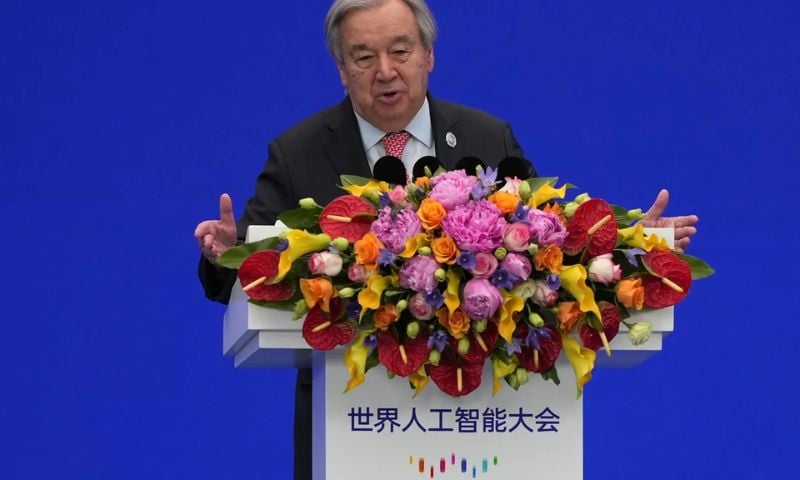
UNITED NATIONS: Outgoing UN Secretary-General Antonio Guterres on Wednesday called for stronger climate action and concrete plans to phase out fossil fuels, as he addressed his final high-level climate meeting at the United Nations headquarters in New York before leaving office at the end of the year.
Guterres, who has made climate change a central issue during his nine-year tenure, said the rapid expansion of renewable energy offered grounds for optimism despite worsening climate impacts around the world.
“Renewables are the cheapest, fastest and most secure source of new electricity almost everywhere,” he said in his opening address to the High-level Event on Climate Action and the Just Transition. “Clean energy has gone from alternative to unstoppable.”
The UN general secretary @antonioguterres at UNGA. @UN #clean #energy #climate change #nepal #energy security #power balance #climate justice pic.twitter.com/ydHnPr0h1y
— Ashu🇳🇵 (@ashuananda) September 23, 2026
He urged countries to increase their emissions-reduction targets and publish concrete plans for moving away from fossil fuels. His appeal came hours after Germany, Europe’s largest economy, announced a roadmap for phasing out fossil fuels.
Germany became the third country to publish such a plan, following France and the Netherlands. “We are the first generation with the tools to end the fossil fuel age — and the last who can avert climate catastrophe,” Mr Guterres said.
The former Portuguese prime minister’s tenure as UN chief ends on December 31. Climate campaigners have credited him with keeping the issue high on the international agenda and highlighting the impact of climate change on vulnerable communities.
Climate impacts intensify
The UN meeting comes as extreme weather events and climate-related disasters continue to affect communities across the world.
Recent events have included severe heatwaves and wildfires in Europe, while devastating flooding in Nepal and Tibet has been linked to the collapse of a glacier.
Scientists have also warned that the world is on course to temporarily exceed the 1.5°C temperature threshold above pre-industrial levels. Sustained warming beyond that level is expected to increase the frequency and severity of many climate-related hazards.
A strengthening El Niño cycle is also expected to contribute to worsening extreme weather, with the current event having already matched a record for intensity, according to the report.
COP31 expectations
Australian Prime Minister Anthony Albanese and Turkish President Recep Tayyip Erdogan followed Guterres at the climate meeting.
Australia and Türkiye are co-hosting the COP31 climate talks in Antalya in November under an unusual arrangement in which Australia will lead the negotiations while Türkiye will host the event and seek support for voluntary commitments.
Albanese said climate action could not be delayed, pointing to the contribution of renewable energy to Australia’s electricity supply during the previous summer.
However, Australia’s Climate Change and Energy Minister Chris Bowen is also travelling to India and Saudi Arabia this week for talks aimed at strengthening Australia’s oil supplies.
Erdogan struck a more cautious tone on expectations for COP31, saying climate policies would have to take account of social and economic considerations. “Any proposal that fails to reconcile our climate objectives with social and economic realities will be doomed to fail,” he said.
UK announces £330m climate funding
Britain’s Foreign Secretary Ed Miliband announced a £330 million ($437m) contribution to the Global Environment Facility, which provides financing for international efforts on climate change, nature and pollution.
Climate policy analyst Cosima Cassel of the E3G think tank said it was disappointing that the summit had produced relatively few new commitments and announcements, although she welcomed Germany’s fossil-fuel roadmap.
READ ALSO: Pakistan Welcomes $250 Million UN Climate Fund Support for Swat Basin
Guterres called on governments to accelerate the transition towards greener economies and increase climate finance for developing countries. He also urged the international community to ensure that life-saving early warning systems reach everyone by 2027.
Electrification gains momentum
The meeting also highlighted the growing emphasis on electrification, including replacing combustion-based technologies in sectors such as transport and heating with electricity.
Türkiye has promoted a “35×35” target aimed at increasing electricity’s share of global energy consumption to 35 per cent by 2035. However, the target does not specify that the additional electricity must come from renewable sources, a distinction considered important for reducing greenhouse gas emissions.
Nepal’s Foreign Minister Shisir Khanal used the meeting to highlight the vulnerability of developing countries to climate-related disasters.
More than 1,400 people have died and thousands remain missing following devastating floods in Nepal on August 26.
“Such tragedies are not isolated events; they are symptoms of global crisis, a crisis Nepal did not create,” Mr Khanal said. “At this point, we’re asking for what we call climate justice.”