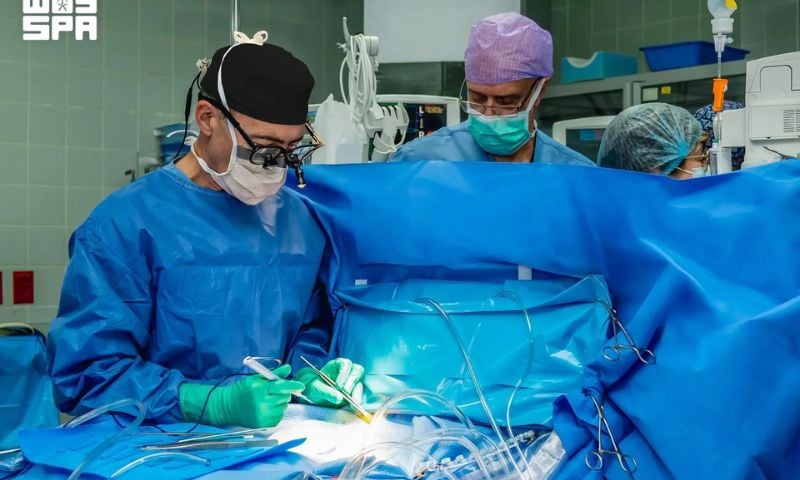
RIYADH: Saudi Arabia’s King Faisal Specialist Hospital and Research Centre (KFSH) has successfully treated two children using a single donor heart in the first paediatric domino heart transplant of its kind in the Middle East and Europe.
The donor heart was transplanted into a child with end-stage heart failure, while the healthy pulmonary valve and root from his removed heart were used to treat a second child, the Saudi Press Agency (SPA) reported on Wednesday.
Known as a domino heart transplant, the procedure involves using healthy tissue from the heart removed from a transplant recipient to treat another patient, thereby maximising the medical benefit of a donated organ.
The first patient, a 12-year-old boy with dilated cardiomyopathy and end-stage heart failure, had spent around six weeks in hospital receiving continuous medication to support his heart while awaiting a transplant. Although he required a complete heart transplant, his pulmonary valve and root remained healthy and suitable for use in another patient.
#التخصصي ينجح في علاج طفلين بقلب متبرع واحد، ضمن أول عملية زراعة قلب متتابعة للأطفال من نوعها في الشرق الأوسط وأوروبا؛ إذ زُرع قلب المتبرع لطفل كان يعاني فشلًا قلبيًا، فيما استفاد طفل آخر من الصمام الرئوي وجذره المأخوذين من قلب الطفل الأول بعد استئصاله، في إجراء يتيح توسيع أثر… pic.twitter.com/wPUQwngAa1
— مستشفى الملك فيصل التخصصي ومركز الأبحاث (@KFSHRC) September 16, 2026
Meanwhile, a nine-year-old boy with severe aortic stenosis and regurgitation underwent a complex Ross procedure, having previously undergone two operations to repair the affected valve.
During the procedure, the second child’s healthy pulmonary valve was moved to the aortic position to replace the damaged valve. The pulmonary position was then reconstructed using the pulmonary valve and root taken from the first child’s removed heart.
The first child therefore became both a heart recipient and a source of viable cardiac tissue for the second patient, enabling one donor heart to benefit two children through a carefully coordinated sequence of procedures.
Because the transplanted valve is living tissue, it has the potential to grow with the child, which may reduce the need for repeated valve replacement surgery as the patient develops, unlike conventional prosthetic valves, which remain fixed in size.
Rare heart transplantation
Executive Director of the Heart Centre of Excellence at KFSH Dr. Hani Alsergani said: “This is one of the rarest forms of partial heart transplantation in children and places KFSH among a select group of centres worldwide capable of performing it, building on the hospital’s expertise in heart transplantation and complex congenital cardiac surgery.”
ALSO READ: Saudi Hospital Saves Vision of 84%Children Suffering from Cancer
The procedure required the simultaneous coordination of two complex operations and close collaboration between specialists in heart transplantation, paediatric and congenital cardiac surgery, paediatric cardiology, heart failure, cardiac imaging, anaesthesia and critical care.
The teams were supported by perfusion, nursing and transplant co-ordination staff, while the hospital’s ability to assess, preserve and prepare viable cardiac tissue for transplantation was also crucial to the success of the procedure.
KFSH was ranked first in the Middle East and Africa and 12th globally among the world’s top 250 academic medical centres for 2026.
It was also recognised as the most valuable healthcare brand in Saudi Arabia and the Middle East by Brand Finance and was listed by Newsweek among the World’s Best Hospitals, World’s Best Smart Hospitals and World’s Best Specialised Hospitals for 2026.