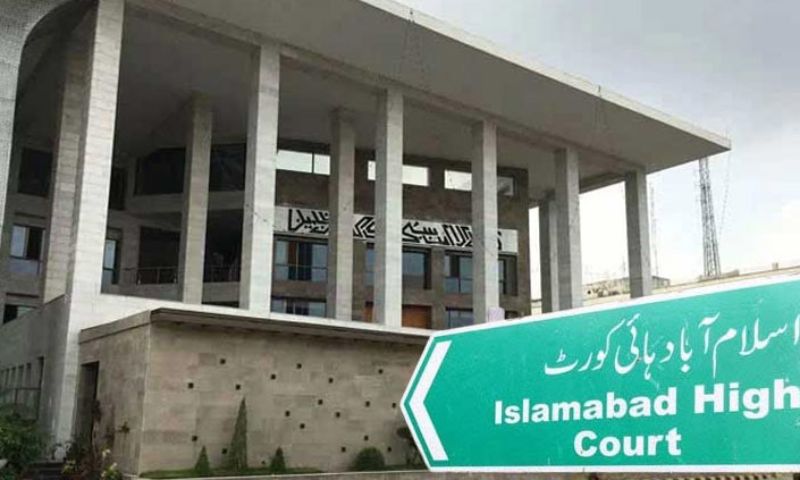
ISLAMABAD: The Islamabad High Court (IHC) on Monday ruled that no political party or its leadership has the lawful right to occupy public roads, highways, interchanges, toll plazas, and buildings for political protests and disrupt public life.
A three-member bench of the IHC, comprising Chief Justice Sardar Muhammad Sarfraz Dogar, Justice Muhammad Azam Khan and Justice Muhammad Asif, disposed of a plea against the Pakistan Tehreek-e-Insaf’s (PTI) announced long march and protest in the federal capital on September 27, directing the chief ministers of all provinces to ensure that no government resources or official machinery were used in this regard.
A citizen, Waqas Ahmed, had challenged the protest, arguing that it could disrupt normal life, traffic and business activities in the federal capital.
In its short order, which was announced in the court, the Islamabad High Court ruled that no political party or its leadership had the “lawful right to occupy public roads, highways, interchanges, toll plazas and buildings in Islamabad that would obstruct in any manner access to educational institutions and medical facilities”.
No political party or political leader had the right to obstruct the free movement of citizens, the order stated, adding that provincial governments must ensure that government resources were not used for any march, procession or rally.
Islamabad High Court bars use of state resources for protests
The high court observed that chief ministers must ensure that public funds or government officials were not used for any protest, and official vehicles, machinery or other government equipment must not be used to facilitate any march, procession or rally.
Moreover, no public servant should be compelled to participate in any march, procession or rally, the court ruled.
Any person, public office holder who undertook any activity against these instructions should be deemed to have violated the Constitution, it said.
The court directed the Islamabad administration and the interior ministry to ensure protection of citizens’ constitutional rights, and the chief secretaries and provincial police chiefs to ensure implementation of court directives.
Earlier, the bench had reserved its verdict on the plea after the Khyber Pakhtunkhwa police chief assured the court that no “illegal or unconstitutional activities” would be allowed in connection with the protest.
State resources and political protests
The Islamabad High Court’s ruling has drawn a clear distinction between political activity and the use of state resources, stressing that government machinery, vehicles and employees cannot be deployed for political protests.
The issue of government resources being used in Pakistan Tehreek-e-Insaf (PTI) protests is not new. In September 2024, reports emerged that Rescue 1122 equipment from Khyber Pakhtunkhwa had been transported to Islamabad in connection with a PTI rally, prompting questions over the use of emergency-service resources for political activities.
Similar questions were raised over the use of Khyber Pakhtunkhwa government machinery during PTI protests in November 2024.
The Peshawar High Court also addressed the issue in November 2025, directing that government vehicles and employees not be used for political activities or protests.
ALSO READ: Govt Says PTI Violated Apex Court Order Over Imran Khan’s Medical Examination
The latest IHC ruling therefore places renewed emphasis on keeping state machinery separate from political activity and ensuring that public resources remain available for their intended purpose of serving citizens.
Overall, the ruling seeks to safeguard the constitutional rights of ordinary citizens while protecting government employees from undue political interference and pressure, a development that has been welcomed as a positive step towards upholding the rule of law.