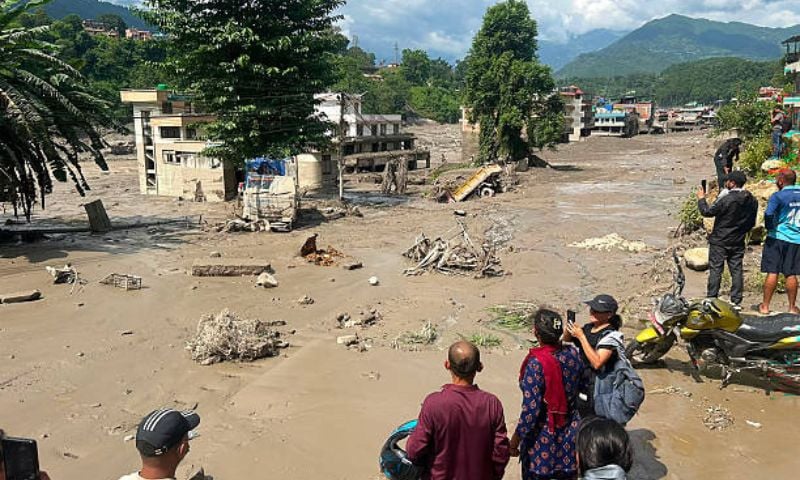
NEW DELHI: Millions of people living in India’s low-lying coastal regions face growing risks from rising sea levels, with cities including Mumbai and Kolkata increasingly vulnerable to flooding, displacement and saltwater intrusion, according to a new United Nations report.
The report warns that sea-level rise is no longer a distant environmental concern but an accelerating global crisis that is already affecting coastal communities, infrastructure, economies and ecosystems.
India is among the countries facing serious consequences because large populations live in vulnerable coastal and delta regions. In South Asia, the combination of rising seas and sinking land is expected to intensify the exposure of major urban centres and surrounding communities to flooding and permanent inundation.
The United Nations Secretary-General’s Special Report on “Challenges related to sea-level rise and ways and approaches to address it” was presented on August 31 by the UN Deputy Secretary-General during the 55th Pacific Islands Forum Leaders Meeting in Palau.
According to the report, global sea levels are rising as oceans warm and glaciers and ice sheets lose mass. The rate of increase reached nearly six millimetres in 2024, described in the report as the highest annual rise recorded.
The UN estimates that about 770 million people – roughly one in every 10 people worldwide – currently live in coastal areas less than five metres above the high-tide line, leaving them exposed to significant risks from rising seas and increasingly severe coastal flooding.
India and South Asia face mounting exposure
India’s extensive coastline and densely populated coastal and delta regions make it particularly vulnerable to the consequences of sea-level rise. The UN report identifies Mumbai and Kolkata in India, along with Dhaka in Bangladesh, as major cities located in low-lying South Asian delta areas where rising sea levels are increasing the risk of displacement.
More than 14 million people across these areas are described as being at immediate risk of losing their homes because of permanent inundation.
The threat can become considerably worse where rising seas coincide with land subsidence, or the gradual sinking of the ground. In such locations, the effective rise in water levels can be greater, increasing the frequency and severity of flooding.
Saltwater intrusion presents another major danger. As seawater moves further inland, it can contaminate freshwater sources and agricultural soils, threatening drinking-water supplies, farming, irrigation and groundwater-dependent ecosystems.
The consequences are not limited to residential areas. Roads, ports, electricity networks, water systems, hospitals, businesses and other essential infrastructure in coastal areas are also increasingly exposed to rising average and extreme sea levels.
Global risks accelerating
The scale of the challenge extends well beyond South Asia. Even under a very low greenhouse-gas emissions scenario, involving end-of-century warming of between 1 and 1.9 degrees Celsius, the global average sea level could rise by about 0.23 metres by 2050, according to projections cited from the Intergovernmental Panel on Climate Change’s Sixth Assessment Report.
European coastlines are already experiencing significant changes. In Germany, around 70 per cent of the coastline is affected by coastal retreat associated with erosion. Along the French Riviera, small sandy beaches have lost roughly half of their surface area since the late 19th century, according to the International Union for Conservation of Nature.
The report also warns that coastal flooding events that historically occurred roughly once every 100 years could become about 10 times more frequent by 2050 at many locations along the Mediterranean and Atlantic coasts.
In the United Kingdom, sea levels could rise by more than a metre by 2100. In England, projections indicate that by the middle of the century, one in four properties could be located in areas at risk from flooding caused by rivers, the sea or surface water.
Up to 1.2 billion people could be displaced
The UN report warns that the consequences of rising seas could ultimately affect as many as 1.2 billion people by 2050 if adequate adaptation measures are not implemented. The impacts include the loss of homes and livelihoods as well as growing threats to food security, healthcare, education, cultural heritage and fundamental human rights.
Some Pacific Island communities have already begun relocating as the gradual loss of land makes parts of their traditional territories increasingly difficult to inhabit. The economic cost is also expected to be substantial.
Damage to coastal infrastructure is currently estimated at more than $1.8 trillion, while annual global economic losses could reach between $1.2 trillion and $4 trillion by the end of the century if sufficient adaptation measures are not put in place.
The report cites the Irish city of Limerick as an example of the potential scale of future losses, noting that a single extreme flooding event under a high-end sea-level-rise scenario could result in damage exceeding one billion euros.
In the Caribbean, the threat is particularly significant for tourism-dependent economies. The report indicates that nearly 40 per cent of the region’s beaches could disappear by 2050, potentially undermining an important source of employment and export earnings.
Human rights and sovereignty concerns
The UN says the consequences of rising seas increasingly threaten basic human rights, including access to adequate housing, safe drinking water, sanitation, food, healthcare and education.
Indigenous communities and people living in small island states are considered particularly vulnerable because the loss of land can also mean the loss of cultural heritage, traditional livelihoods and long-established connections with ancestral territories.
READ ALSO: El Niño Threatens India with Extreme Rainfall and Floods
Sea-level rise is also creating complex legal questions concerning state sovereignty and maritime boundaries. The UN maintains that rising sea levels should not undermine the continuity of states or their existing rights over maritime zones and ocean resources recognised under international law.
The Secretary-General has therefore called for stronger international cooperation and a robust political declaration by UN member states to provide greater legal certainty and protect populations affected by rising seas.
UN calls for urgent action
The report sets out 18 recommendations for member states aimed at limiting the human and economic consequences of sea-level rise. These include faster reductions in greenhouse-gas emissions, stronger early-warning systems, greater financing for climate adaptation, improved scientific monitoring and data collection, and increased support for communities facing the greatest risks.
For India, the findings highlight the growing need to strengthen coastal protection, improve urban flood management and safeguard freshwater resources in vulnerable coastal and delta regions.
The UN’s central warning is that sea-level rise is already reshaping coastal areas around the world and that delaying adaptation could significantly increase the scale of displacement, economic losses and humanitarian challenges in the decades ahead.