Key Points
- Pakistan seeks bigger role in global auto supply chains
- Government links vehicle production with export growth
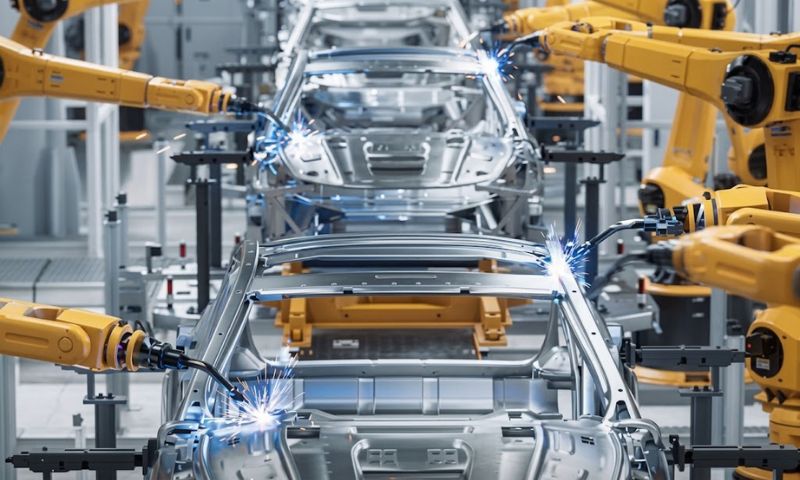
ISLAMABAD: Pakistan is moving to transform its automotive industry from a predominantly domestic-market assembly base into an export-oriented manufacturing hub as countries are increasingly ordering made-in-Pakistan automobiles.
Following the July order of 5800 MG vehicles for export to Bangladesh, Suzuki rolled out the Alto and Every, both built by its Pakistani subsidiary Pak Suzuki Motor Company (PSMC), in Brunei through local distributor Boustead Sdn. Bhd.
It marked the first time Suzuki has exported mini-vehicle-spec models from an overseas production base.
Pakistan’s government is placing greater emphasis on vehicle exports, localisation and new-energy vehicles as it seeks to integrate the sector into global supply chains.
Auto export opportunities
The government’s push towards new-energy vehicles could provide another route to achieving that objective.
Pakistan’s New Energy Vehicle Policy 2025-30 seeks to increase the share of new-energy vehicles in sales to 30 per cent by 2030.
The policy covers electric vehicles and other new-energy technologies across passenger cars, commercial vehicles, buses, trucks, motorcycles and three-wheelers.
Suzuki Motor Corporation’s view of Pakistan as a potential “globalisation hub for Japanese-style light vehicles” is significant in this context.
The assessment suggests that Pakistan could potentially serve not only as a market for Suzuki vehicles but also as a production base for compact vehicles destined for international markets.
The opportunity is particularly relevant for Pakistan because the country already has decades of experience producing small and compact vehicles, supported by an established vendor industry and a large domestic customer base.
Pak Suzuki Motor Company’s recent activities provide an early indication of this shift. The company has moved beyond its traditional domestic focus, with Ecstar engine oil to Oman and Suzuki Cultus genuine body parts to Thailand, before exporting Pakistan-built Alto and Every vehicles to Brunei.
The Brunei shipment itself is less important than what it demonstrates: Pakistan’s Suzuki operation is beginning to participate more directly in the Japanese automaker’s overseas production and distribution network.
Other manufacturers are also beginning to test Pakistan’s export potential. MG JW Automobile Pakistan has agreed to export 5,800 locally assembled vehicles to Bangladesh over four years, including 100 units during the current year.
The agreement provides another indication that locally assembled vehicles can be positioned for regional markets.
Bigger role in global auto trade
Pakistan’s new automotive policy framework focuses on exports and higher domestic value addition. The new policy follows the Auto Industry Development and Export Policy 2021-26.
The government has been pushing manufacturers to establish longer-term export targets and improve their competitiveness in international markets.
The country’s vehicle manufacturing capacity provides a potentially larger base for that transition.
Installed capacity for cars and sport utility vehicles has reached around 600,000 units, according to the Pakistan Economic Survey 2025-26, giving assemblers greater scope to pursue economies of scale and allocate production towards overseas markets.
Recent government initiatives indicate that exports are moving higher up the industry’s policy agenda.
The Planning Commission held a policy dialogue in August on unlocking Pakistan’s high-value export potential in the automotive sector and called on industry stakeholders to establish five-year export targets.
READ ALSO: Pakistan Targets $1 Billion Auto Exports, 500,000 Vehicle Production in 5 Years
The objective is to move beyond the limited export volumes Pakistan has historically achieved and develop an industry capable of supplying vehicles and components to regional markets on a sustained basis.
Localisation for auto-export competitiveness
A significant element of this strategy is localisation. Pakistan’s assemblers have traditionally depended heavily on imported components, particularly completely knocked-down and semi-knocked-down kits.
Higher local content would reduce exposure to foreign-exchange constraints and imported supply disruptions, whilst increasing the domestic value generated by every vehicle exported.
Vehicle production has also recovered significantly, providing manufacturers with a stronger platform for export-oriented growth. Car production rose 51.3 per cent to 115,495 units during July-March of fiscal year 2025-26 from 76,339 units in the corresponding period a year earlier.
Production of light commercial vehicles, jeeps, sport utility vehicles and pickups increased 24 per cent to 32,465 units, according to the Economic Survey.
Yet higher production alone will not make Pakistan an automotive export hub.
Manufacturers will need internationally competitive costs, reliable component supplies, consistent quality, modern testing facilities and deeper localisation.
The transition towards electric vehicles will add another challenge, requiring capabilities in areas such as batteries, electric motors, power electronics and electronic control systems.
For policymakers, the central task will be to align tariff policy, investment incentives, infrastructure, skills development and new-energy vehicle measures around a single export-oriented industrial strategy.