GAZA CITY, Palestine: Palestinian group Hamas on Sunday reaffirmed its commitment to implementing a US-backed roadmap for Gaza, saying it was ready to engage with mediators and the Board of Peace to complete the second phase of the plan despite Israeli Prime Minister Benjamin Netanyahu’s rejection of the agreement.
Hamas said it remained committed to “responsibly engaging” in the implementation of the 15-point plan and called for a clear timetable to carry out its provisions.
“The priority at this stage must be to ensure the implementation of all phases and obligations of the agreement,” Hamas said in a statement.
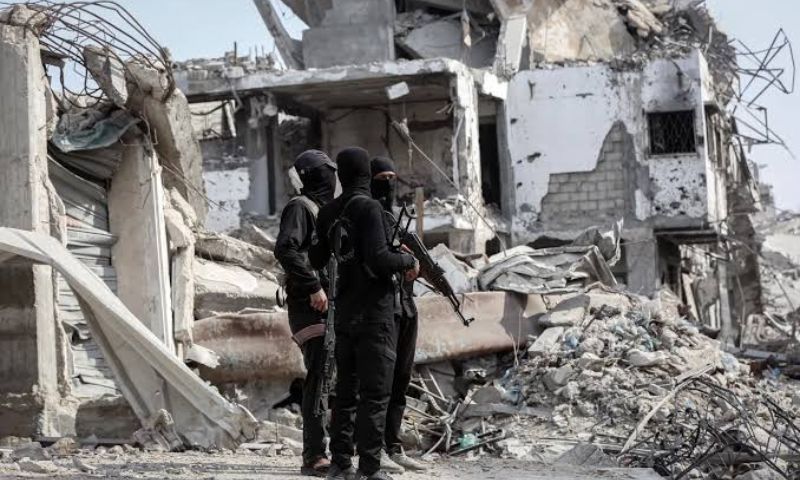
The Palestinian group said implementation should lead to a complete ceasefire, an end to Israeli attacks, the completion of an Israeli withdrawal from Gaza, the reopening of border crossings and the entry of humanitarian aid and shelter supplies.
It also called for reconstruction to begin and for the National Committee for the Administration of Gaza to be allowed to start its work.
Hamas called on mediators, guarantors and the Board of Peace to “shoulder their responsibilities” and ensure that all parties complied with the agreement.
It also urged them to prevent violations that could obstruct implementation or undermine the ceasefire.
Hamas said it would continue to engage “positively and responsibly” with efforts to complete the agreement, end the suffering of Palestinians in Gaza and protect their “rights and national interests”.
Netanyahu rejects Gaza peace plan
Hamas’s statement came hours after Netanyahu rejected the 15-point Gaza plan, insisting that Israeli forces would not withdraw from the territory until Hamas was disarmed.
“Israel rejects the 15-point document,” Netanyahu said at a cabinet meeting, referring to the plan endorsed by Hamas in late July.
The Israeli military “will not carry out any withdrawal until Hamas is disarmed and will continue to thwart threats against our forces and our citizens”, he said.
Netanyahu said Israel was raising its objections with Washington, while describing US President Donald Trump as “our greatest friend in the White House”.
“They have ideas; some of them are acceptable to us and some are not, and we know how to stand our ground on these matters,” Netanyahu said.
Hamas had earlier called on Washington to pressure Netanyahu to adhere to the roadmap.
“We expect the mediators and the American guarantor to pressure Netanyahu and his government to adhere to the roadmap and not obstruct the process for internal political and electoral reasons,” Bassem Naim, a member of Hamas’s political bureau, told AFP.
Disagreement over disarmament
The dispute centres on the sequencing of Hamas’s disarmament and an Israeli military withdrawal from Gaza.
Trump had described Hamas’s agreement to surrender its weapons to a Palestinian governing body as a “major milestone”.
Under the plan, Israel was to begin withdrawing its forces in tandem with Hamas’s disarmament.
Israel has rejected that timetable.
Following a meeting with Netanyahu last week, the Board of Peace, the body overseeing implementation of the agreement, said Israel would only be required to withdraw after Hamas had been completely disarmed.
“Hamas must give up all of its weapons,” Netanyahu said. “We are talking about real disarmament, not fictitious disarmament.”
Nickolay Mladenov, the Board of Peace’s high representative for Gaza, defended the US-backed plan in an interview with Israel’s Channel 12 television.
“The option we are offering today is the only way forward that ensures this tragedy does not happen again,” Mladenov said, referring to Hamas’s October 7, 2023 attack on Israel.
Tensions between Netanyahu and Trump
Netanyahu’s rejection of the plan comes amid political pressure from his right-wing and far-right supporters.
He is facing a closely contested election scheduled for October 27, according to the supplied reports. Polls have shown him running level with or behind rivals, while the Gaza plan is reportedly unpopular among his right-wing base.
Far-right members of his cabinet have urged him to call a new vote to block the plan.
Hamas announced its support for the roadmap shortly after selecting Khalil al-Hayya as its new leader.
The group has sought to portray itself as committed to implementing the agreement while calling on the United States and other mediators to ensure Israel complies with its provisions.
The disagreement over Gaza adds to growing differences between Netanyahu and Trump.
Netanyahu had previously campaigned on the strength of his close relationship with Trump, who has taken several major steps in support of Israel since his first term.
The two leaders have also differed over Iran. Trump sought a ceasefire with Iran in April as the conflict placed pressure on the US economy and pushed oil prices higher, while Netanyahu has maintained that Iran must not be allowed to acquire nuclear weapons.
“With an agreement or without an agreement, as long as I am prime minister, Iran will not have nuclear weapons,” Netanyahu told his cabinet.
Netanyahu also ordered fresh strikes on Lebanon last week in response to what Israel described as a ceasefire violation by Hezbollah. The strikes came as Israel and Lebanon were engaged in US-mediated talks.
The latest Gaza roadmap is part of a US-brokered ceasefire announced in October that has reduced, but not ended, Israeli military operations in the Palestinian territory.