WASHINGTON: US President Donald Trump said on Monday that fresh negotiations with Iran were Tehran’s “last chance” to avoid further escalation of the conflict, despite Iran’s repeated denials that any talks with the United States were underway.
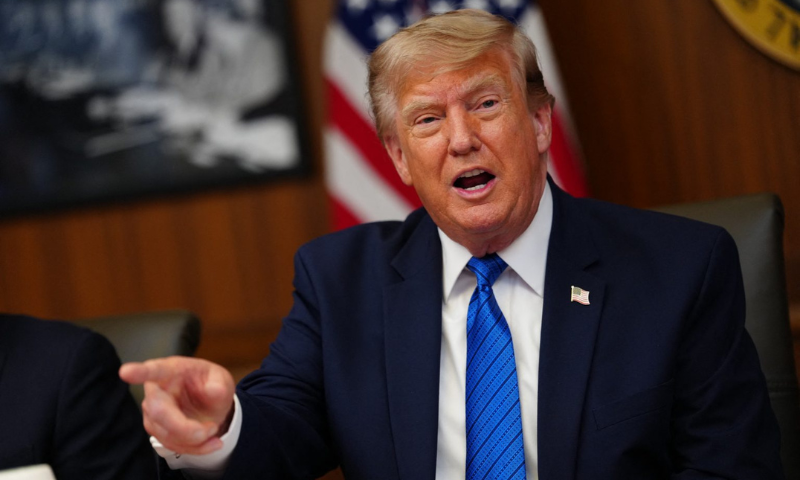
Speaking to reporters in the Oval Office, Trump warned that failure to reach an agreement could trigger far more severe military action. He said the United States was pursuing diplomacy while maintaining military pressure, describing the current negotiations as Tehran’s final opportunity to secure a deal.
“This is a last chance for them to sign a good document,” Trump said. “I want to give them every last chance before decapitation.”
⚡️BREAKING: President Trump threatens Iran with Decapitation
“This is their Last Chance to make a Deal before Decapitation” pic.twitter.com/fYVahhSwn8
— Iran Observer (@IranObserver0) August 3, 2026
The US president insisted that talks with Tehran were already taking place, contradicting repeated statements by Iranian officials denying any direct negotiations with Washington.
“We are talking right now,” Trump told reporters, adding that he had agreed to continue diplomatic efforts following requests from Saudi Arabia, the United Arab Emirates, Qatar and other regional partners seeking to prevent a wider Middle East conflict.
Trump said the negotiations are initially focusing on reopening the Strait of Hormuz, one of the world’s most strategically important shipping lanes, before addressing Iran’s nuclear programme.
“The first phase is the opening of the straits. The second phase will be denuclearisation,” he said, adding that shipping routes could reopen “literally by tomorrow,” while resolving the nuclear issue would take longer.
Iran, however, rejected Trump’s claims. Foreign Ministry spokesman Esmail Baghaei said Tehran was “not currently negotiating with the United States” and stressed that its ongoing discussions were solely with Oman regarding arrangements for commercial shipping through the Strait of Hormuz.
READ ALSO: Trump Says US, Iran Are Engaged in Talks Despite Tehran’s Denials
According to Baghaei, Tehran and Muscat are working on a temporary maritime corridor while continuing negotiations on a permanent navigation route. He said both sides had exchanged maps and were trying to reach an arrangement acceptable to all parties.
Iranian officials insisted that any agreement on shipping routes should not be interpreted as reopening the strategic waterway, arguing that broader political and security disputes with Washington remain unresolved.
The Strait of Hormuz has become one of the central flashpoints in the conflict. Since the collapse of the previous ceasefire, Iran has resumed restrictions on maritime traffic through the narrow waterway, while the United States has reinforced its naval presence in the Gulf.
Trump accused Iran of acting in bad faith, alleging that Tehran was privately seeking negotiations while publicly denying any contact with Washington.
In a social media post, he described Iran’s leadership as “duplicitous,” claiming they were discussing a solution behind closed doors while publicly insisting that no negotiations were taking place.
The US president also claimed Washington had imposed an effective counter-blockade on Iranian ports, declaring that “nothing gets through to Iran” unless a comprehensive agreement is reached.
Trump further stated that he had cancelled a massive military strike against Iran over the weekend after Saudi Crown Prince Mohammed bin Salman urged him to give diplomacy another chance.
According to Trump, the suspended operation would have been the largest US military action since the Second World War.
Iranian media rejected Trump’s assertion that Tehran had asked the United States to refrain from launching further attacks. The conflict between Washington and Tehran has continued since late February, when the United States and Israel launched coordinated strikes on Iranian targets.
Despite months of intermittent diplomatic contacts, the two sides remain engaged in military confrontation, with Iran continuing to launch missiles and drones at US and allied positions while retaining significant stockpiles of enriched uranium.