
Key Points
- Smoke triggers “very unhealthy” air warning
- Drones hamper aerial firefighting operations
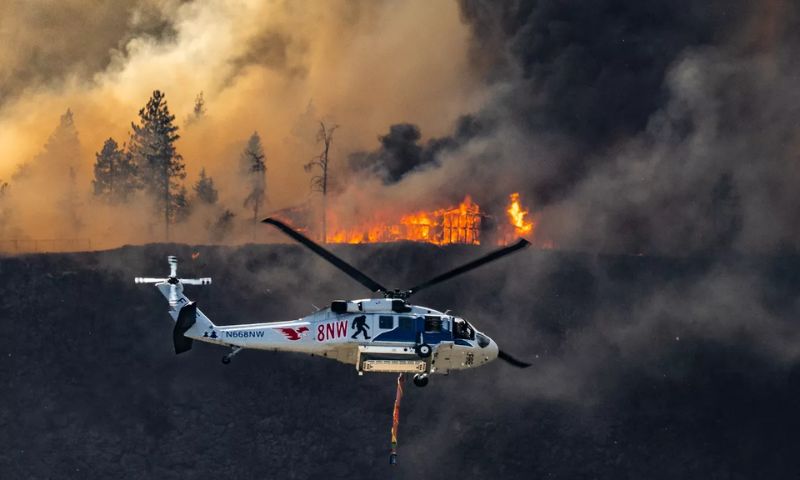
ISLAMABAD: US Firefighters continued battling massive wildfires in and around Spokane, Washington, early Monday after fast-moving blazes destroyed hundreds of homes and buildings, forcing thousands of residents to evacuate as officials warned the crisis was far from over.
Three separate wildfires erupted over the weekend in eastern Washington State, fuelled by powerful winds, prolonged drought and exceptionally dry conditions.
Fire authorities said all three fires remained at zero per cent containment late Sunday, with emergency crews working through the night to prevent further destruction.
Spokane Mayor Lisa Brown said hundreds of homes and other structures had been reduced to ashes, adding that authorities were still assessing whether there had been any fatalities.
“To the people who are suffering right now in our region from either loss or uncertainty… our hearts go out to you. We are here for you for the long term,” Brown told a press briefing.
Spokane resident Geoff Beadles described the devastation after evacuating with his fiancée and two dogs.
“Just driving around looking at the homes—it’s just one of the most heartbreaking things I’ve ever seen in my life,” he told AFP.
The largest blaze, the Old Trails Fire, crossed the Spokane River on Saturday and spread into the city, consuming neighbourhoods as residents fled.
Another evacuee, Tena Risley, said she narrowly escaped after spotting flames behind her home and became trapped in heavy traffic as evacuation routes clogged with hundreds of vehicles.
Wildfire triggers warnings
Authorities issued the highest-level “Go Now” evacuation order for large parts of northern Spokane. Emergency shelters were opened at the Spokane Convention Centre for displaced residents.
According to the National Weather Service, extreme fire weather conditions driven by strong winds and critically dry vegetation fuelled the rapid spread of the fires.
Winds were expected to ease on Monday, offering firefighters a reprieve, although forecasters warned temperatures would climb again later this week, increasing the risk of further fire growth.
Smoke blanketing Spokane was forecast to push air quality into the “very unhealthy” category on Monday, prompting health officials to advise residents to remain indoors and avoid prolonged outdoor activity.
Spokane County Sheriff John Nowels said no deaths or injuries had been confirmed. However, he cautioned that casualty assessments could take time because investigators were unable to access active fire zones.
ALSO READ: Water Bombers Rejoin Greece Wildfire Battle
Washington Governor Bob Ferguson declared a state of emergency, noting the state was experiencing its fourth consecutive year of drought, conditions that scientists say have been intensified by climate change.
He said he had spoken with President Donald Trump and federal officials to secure additional firefighting resources.
Fire authorities also warned residents against flying unauthorised drones near wildfire zones. The warnings were issued after repeated incursions into restricted airspace forced firefighting helicopters and aircraft to suspend operations, hampering efforts to contain the blazes.
David Upthegrove, head of Washington’s Department of Natural Resources, said the Spokane fires were among 15 major wildfires burning across the state.
“This is an extraordinary wildfire season in the Pacific Northwest. It’s not a normal season,” he said, citing a combination of severe weather and multiple simultaneous fires that were stretching firefighting resources.
By Sunday morning, the three Spokane-area fires had burned more than 5,390 acres (about 2,180 hectares), according to CNN, as emergency crews continued efforts to protect communities threatened by the advancing flames.
The Spokane disaster comes amid another intense global wildfire season. Large fires have burned across parts of Canada, the western United States, southern Europe and the Mediterranean in recent months, driven by prolonged heatwaves, drought and strong winds.
Scientists say climate change is increasing the frequency and intensity of extreme fire weather in many regions, extending wildfire seasons and making blazes more destructive.