
Key Points
- Washington cites national security and AI protection concerns
- Existing approved devices remain exempt for now
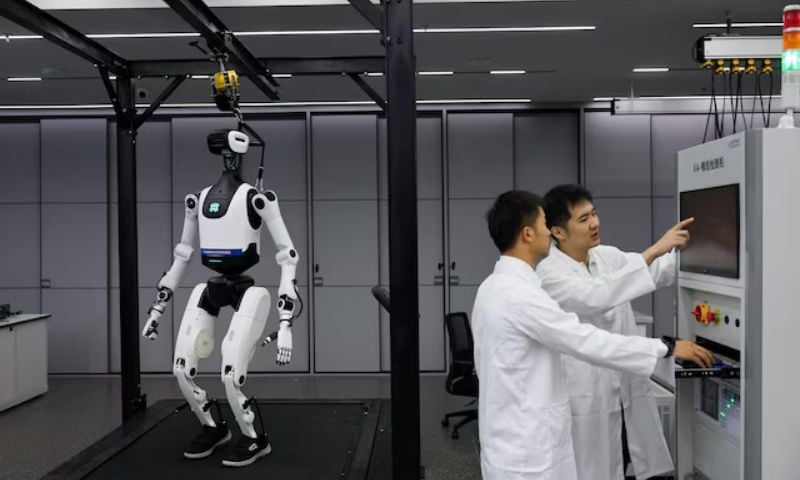
ISLAMABAD: The US administration has banned imports of new Chinese-made humanoid and quadruped robots, as well as related power inverters.
The restrictions, announced by the US Federal Communications Commission (FCC), apply to future products seeking approval for sale in the United States. Existing devices already operating in the country will not be affected at this stage.
The Trump administration intends to safeguard its artificial intelligence infrastructure and reduce reliance on Chinese technology, the US officails said.
The decision was driven by national security concerns, with officials warning that internet-connected robots could collect sensitive information, conduct surveillance, or be remotely controlled by foreign actors.
Power inverters, which are widely used in renewable energy systems, batteries and data centres, have also come under scrutiny over possible vulnerabilities in the electricity grid.
The measures are expected to affect several Chinese manufacturers, including Unitree Robotics, which has been placed on a Pentagon list of companies allegedly linked to the Chinese military.
ALSO READ: China Retaliates Against US by Sanctioning 56 American Firms
Chinese inverter producers, including Huawei Technologies and Sungrow Power Supply, are also covered by the new restrictions.
The latest move reflects intensifying rivalry between Washington and Beijing in artificial intelligence and advanced robotics.
Analysts view humanoid robots as a critical part of the next phase of AI development, often described as “embodied AI,” where machines can interact with and perform tasks in the physical world.
China criticised the restrictions and urged Washington to resolve differences through dialogue, warning that such actions could undermine trade ties and technological cooperation.
The ban is the latest in a series of American measures aimed at limiting China’s influence in strategic technologies, including semiconductors, artificial intelligence and telecommunications equipment.
US-China tech rivalry
The latest restrictions follow a series of tit-for-tat measures between Washington and Beijing as the two powers compete for technological supremacy.
Earlier this month, the United States added several Chinese firms, including robotics company Unitree, to a Pentagon list of companies allegedly linked to the Chinese military. Beijing condemned the designation as politically motivated.
China responded by accusing Washington of abusing national security arguments to suppress Chinese enterprises. Beijing also retaliated by restricting as many as 56 US companies by blacklisting 46 and imposing trade restrictions on 10.
In June, US authorities tightened export controls on advanced semiconductor technologies and expanded restrictions on the sale of high-performance artificial intelligence chips to Chinese entities.
Beijing, in turn, accelerated support for domestic chipmakers and continued to impose export licensing requirements on critical minerals, including gallium and germanium, which are essential for semiconductor manufacturing.
Last year, the United States imposed higher tariffs on a range of Chinese products, including electric vehicles, batteries and solar equipment. The US administration had argued that state subsidies gave Chinese manufacturers an unfair advantage.
China retaliated by launching anti-dumping investigations into selected US imports and lodging complaints through international trade channels.
The dispute can be traced back to President Donald Trump’s first term, when Washington imposed tariffs on hundreds of billions of dollars of Chinese goods beginning in 2018. He had alleged unfair trade practices and intellectual property concerns.
Beijing responded with tariffs on US exports, triggering a trade war that has since evolved into a broader contest over semiconductors, artificial intelligence, telecommunications and robotics.
Analysts observe that each new measure has reinforced a cycle of retaliation, making technology a central front in US-China strategic competition.
They warn that the growing rivalry could further fragment global supply chains and reshape international trade and investment patterns in the years ahead