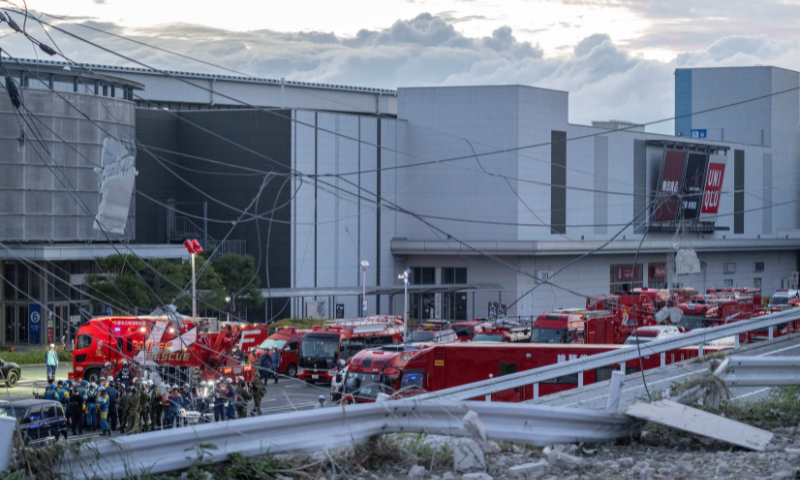
TOKYO: The death toll from a powerful 7.1-magnitude earthquake that struck southwestern Japan has risen to 13, Prime Minister Sanae Takaichi said on Wednesday, as rescue teams raced to reach people trapped under collapsed buildings and more than 9,000 people remained in evacuation centres.
The earthquake struck Kumamoto Prefecture on Japan’s southwestern island of Kyushu on Tuesday at a depth of about 10 kilometres (6 miles). It registered the maximum Shindo 7 intensity on Japan’s seismic scale, causing severe shaking across the region.
Japanese authorities initially issued a tsunami advisory for the Ariake Sea and Yatsushiro Sea, warning of waves of up to one metre and urging residents to move away from coastal areas. The advisory was later lifted after the threat subsided.
Casualties and Rescue Efforts
Prime Minister Takaichi confirmed that 13 people had died in the disaster and said rescuers were in a “race against time” to save those still trapped beneath collapsed structures.
Among the hardest-hit sites was a partially collapsed Aeon shopping mall, where rescue teams pulled survivors from the rubble while searching for others believed to be trapped. A chimney collapse at a paper factory also left several workers missing.
Government spokesman Minoru Kihara said seven people had suffered serious injuries and 29 others sustained minor injuries.
“As of 7:00 a.m. today (2200 GMT Tuesday), 9,186 people have sought refuge in 506 evacuation centres across five prefectures, including Kumamoto and Fukuoka,” Kihara said.
Widespread Damage
Authorities urged around 260,000 residents to evacuate as the earthquake damaged homes, roads and public infrastructure across Kyushu. More than 36,000 households lost electricity, while transport services were severely disrupted, including high-speed rail operations and flights at Kumamoto Airport.
Hospitals in the affected region were overwhelmed with casualties, and several major manufacturers temporarily suspended operations to assess damage to facilities.
Officials said no abnormalities had been detected at nearby nuclear power plants.
Aftershock Warning
The Japan Meteorological Agency warned residents to remain vigilant as strong aftershocks and landslides remain possible in the coming days. High temperatures were also raising concerns about heat-related illnesses among displaced people staying in evacuation centres.
Japan is one of the world’s most earthquake-prone countries, sitting on the Pacific “Ring of Fire,” where several major tectonic plates meet and generate frequent seismic activity.