ISLAMABAD: In a world scarred by war, displacement, and rising division, a 76-year-old Japanese Buddhist monk has issued a quiet but powerful call: that the ancient cradle of Buddhist civilisation in Pakistan once again become a beacon of peace for all humanity.
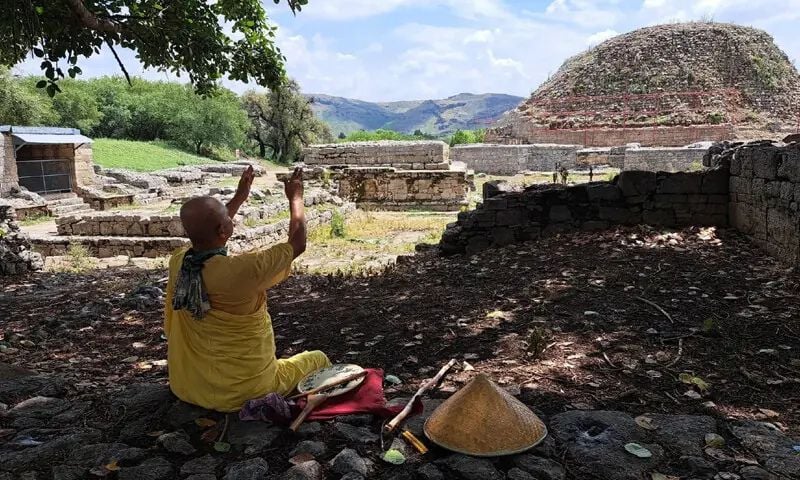
Standing before the weathered stones of the nearly 2,000-year-old Dharmarajika Stupa in Taxila, Monk Junsei Terasawa offered prayers not for any nation or creed, but for the entire human family.
Speaking to journalists after his solemn ritual, he appealed to Buddhist monks and followers across the world to gather at this historic site for a collective prayer, a moment of shared silence and intention to counter the growing clamour of conflict.
“The message of peace was raised from Taxila and flourished across the globe,” Terasawa said, his voice carrying the weight of decades spent walking through war zones. “Today, when the world is once again facing conflict and uncertainty, that message must rise again from this sacred land.”
Read Also: Japan’s $0.31m Investment Upgrades Conservation at Pakistan’s Taxila Museum
His words come at a time when the world watches conflict rage from Ukraine to Gaza, and tensions simmer across Asia. For Terasawa, the Buddha’s timeless teachings of compassion, non-violence, and reconciliation are not mere philosophy, they are an urgent prescription for survival.
Sri Lanka, Nepal, Thailand, Myanmar, and Vietnam Ambassadors organized a dignified prayer ceremony at Dharmarajika Stupa, Taxila, on the occasion of International Vesak Day, marking the birth of Lord Buddha.
Senator Danesh Kumar attended the event as a guest of Honour pic.twitter.com/RRWOPniDGN
— Senator Danesh Kumar Palyani (@palyani) May 2, 2026
A pilgrimage through the heart of Buddhist civilisation
The Japanese monk is in the midst of a month-long pilgrimage across Pakistan, visiting some of the most significant Buddhist heritage sites in Punjab and Khyber Pakhtunkhwa. From the monastic complexes of the Swat Valley to the archaeological wonders of Taxila, he has traced the footsteps of an ancient tradition that once shaped the spiritual landscape of Asia.
At Dharmarajika, where archaeologists have discovered sacred relics traditionally associated with the Buddha himself, Terasawa described the site as “one of the most spiritually significant in the Buddhist world and an enduring symbol of peace.”
But his journey is not merely archaeological. For decades, Terasawa has been globally recognised for his humanitarian missions in regions torn apart by armed conflict, from Chechnya to Iraq, and more recently, Ukraine.
He has organised peace marches, led prayer gatherings, and supported initiatives aimed at reconciliation and human dignity, always insisting that lasting peace begins with recognising the shared humanity of all people, regardless of nationality or religion.
Ancient cite of Taxila, once served as the greatest learning center of the Gandhara Civilization, is among world’s old hubs for civilizations & faith traditions. The chants of Buddhist monks were heared once again at the ancient Dharmarajika Stupa in Taxila after nearly 15 years.…
— Sultan Ahmed Ali (@SultanAhmadAli) May 13, 2026
Bridging civilisations: Gandhara and Japan
The monk also took care to highlight the profound historical ties between the ancient Gandhara civilisation and Japan.
He observed that many of the visual representations of the Buddha found in Japanese art, the flowing robes, the serene expressions, the distinctive iconography, can be traced back to the ancient workshops of Gandhara, where regional and classical influences fused into a unique artistic language.
“Gandhara was one of the principal sources of the religious and philosophical traditions that later shaped Japanese society,” Terasawa said, praising the artistic achievements of a civilisation that served as a crossroads for cultures and faiths.
His pilgrimage, he made clear, is a reminder that the bonds between peoples are older and deeper than the conflicts that divide them.
Read Also: Taxila: Echoes of an Ancient Crossroads
A call that transcends borders
As he prepares to continue his journey across Pakistan, Terasawa’s appeal to the global Buddhist community is both simple and profound: come to Taxila. Pray together. Let the ancient stones of Dharmarajika witness a renewed commitment to peace.
“The Buddha’s teachings spread from this centre to the farthest corners of Asia,” he reflected. “Now, in a time of global crisis, we must return to the source, not to look back, but to draw strength for the road ahead.”
In a world that often feels fractured beyond repair, one elderly monk’s voice, steady, compassionate, and unwavering, offers a different vision. Not of walls, but of bridges. Not of victory, but of understanding. And from the dust of an ancient stupa, a prayer for peace rises once more.
Standing tall in the heart of Pakistan,this magnificent UNESCO world heritage site is living testament to our ancient glory.
Built over the relics of of Buddha by emperor Ashoka in the 3rd century BCE , the Dharmarajika stupa ( great stupa of Taxila ) is one of the oldest and… pic.twitter.com/jaTMzmiNxM
— Shumail 🇵🇰🍁 (@Pakforever9) July 9, 2026
The ancient Dharmarajika Stupa: A millennia-old beacon of Buddhist heritage
The Dharmarajika Stupa, located near Taxila in Punjab, Pakistan, is one of the oldest and most venerated Buddhist monuments in South Asia.
Traditionally attributed to Emperor Ashoka in the 3rd century BCE, it was built to enshrine sacred relics of the Buddha and later expanded into a sprawling monastic complex during the Kushan era in the 2nd century CE.
The site flourished as a major centre of pilgrimage and Buddhist learning for nearly a thousand years, with its name believed to derive from “Dharmaraja”, a title honouring either the Buddha or Ashoka himself.
The Vesak Day celebrations in Taxila brought together international Buddhist monks, diplomats, and delegates from several countries, featuring prayers, a peace bell ceremony, and symbolic pigeon release, highlighting messages of peace, interfaith harmony, and shared cultural… pic.twitter.com/dj2VkmWFAY
— Pakistan TV (@PakTVGlobal) May 2, 2026
The stupa’s prominence waned after invasions by the Persian Sassanids and was ultimately destroyed by the White Huns in the 5th century CE. Excavated by British archaeologist Sir John Marshall between 1913 and 1916, the ruins yielded invaluable relics, sculptures, and inscriptions, including a silver scroll in Kharosthi script detailing relic installations in 78 CE.
Read Also: Pakistan’s Gift of Fasting Buddha Replicas Installed in Thailand and Vietnam
Today, the Dharmarajika complex, with its main stupa standing approximately 15 metres high, forms a vital part of the UNESCO-listed Ruins of Taxila, preserving an enduring legacy of peace and spiritual devotion.