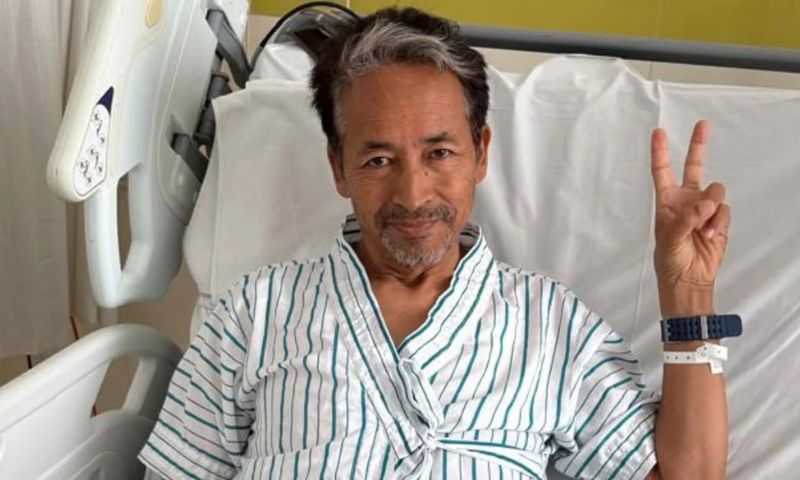
NEW DELHI: Indian education and climate activist Sonam Wangchuk on Saturday announced the next phase of the country’s youth-led protest movement, shifting its focus to pursuing reforms in the education system after the resignation of Education Minister Dharmendra Pradhan.
In a post on X, Wangchuk hailed Pradhan’s resignation as “a victory of democracy” and said the movement would now concentrate on securing lasting changes to prevent future examination scandals.
“From accountability, now to reforms,” Wangchuk wrote, outlining the next stage of the campaign.
He described the minister’s resignation as “direct democracy… straight from the streets” and praised citizens across India for overcoming “the fear of fear” to join the movement.
“It’s a victory of peace, patience and perseverance,” he said.
Wangchuk also congratulated the Cockroach Janta Party (CJP), Generation Z and citizens across the country for supporting the protests.
IT'S A VICTORY OF DEMOCRACY
direct democracy… straight from the streets.
It's a victory of peace, patience & persévérance.
Congratulations CJP, Gen Z of the nation and thank you all citizens for shedding fear and the fear of fear and rising up from every corner of the nation.… pic.twitter.com/rSLOfvba2R— Sonam Wangchuk (@Wangchuk66) July 25, 2026
India’s education minister resigns
Pradhan announced his resignation just hours before a scheduled third round of talks between the government and the CJP, the youth-led movement spearheading the demonstrations.
In a post on X, the minister said he had submitted his resignation to Prime Minister Narendra Modi.
In a detailed statement, Pradhan said his decision was taken in the interests of students and to prevent the unrest from being exploited.
— Dharmendra Pradhan (@dpradhanbjp) July 25, 2026
“I have been dedicated to students, teachers, and education reform for over four decades. It has always been my firm belief that a strong, inclusive, and visionary education system is the foundation of a strong nation,” he wrote.
Pradhan said the situation at New Delhi’s Jantar Mantar protest site and elsewhere in the country had prompted him to step down so that “anti-national forces do not take advantage of this situation.”
DEMOCRACY WINS! 🇮🇳
Education minister Dharmendra Pradhan has resigned. pic.twitter.com/DsB6hCHUzP
— Cockroach Janta Party (@CJP_for_India) July 25, 2026
Main protest demand
Pradhan’s resignation marked a significant breakthrough for protesters, who had been camped at Jantar Mantar for more than a month demanding his removal over repeated examination paper leaks and irregularities in India’s education system.
From Chandigarh,
Students celebrating after the resignation of Union Education Minister Dharmendra Pradhan.
pic.twitter.com/o2WFDKY59N— Cockroach Janta Party (@CJP_for_India) July 25, 2026
The Cockroach Janta Party welcomed the development on X, posting: “Cockroaches won… Democracy won!”
Government representatives had already held two rounds of talks with CJP leaders earlier in the week, but the discussions made little progress as protesters insisted that Pradhan’s resignation remained their principal demand.
The minister announced his resignation before the third round of negotiations could begin.
Focus shifts to education reforms
With their primary demand now met, protest leaders have signalled that the movement will continue, but with renewed emphasis on structural reforms to India’s examination and education systems.
The demonstrations were initially triggered by allegations of leaks in national entrance examinations, including a medical entrance test that forced millions of candidates to retake the examination.
Public anger was further fuelled by reported failures in an online marking system affecting nearly two million high school students.
The protesters have also called for compensation for students affected by the examination irregularities and for legal cases against demonstrators to be withdrawn, according to CJP spokesman Ashutosh Ranka.
Wangchuk reflects on hunger strike
On Friday, a day after ending his 26-day hunger strike, Wangchuk released a video on YouTube in which he responded to criticism over his decision to stop fasting.
He said many supporters were unaware of what had happened after he was transferred to Safdarjung Hospital on July 18.
AFTER 26 DAYS OF HUNGER DO I NEED TO PROVE MY SINCERITY !!!
Do please watch and help spread the word. Find the full 22 minutes video on my YouTube Channel: Sonam Wangchuk pic.twitter.com/6CO3tjZsSD— Sonam Wangchuk (@Wangchuk66) July 24, 2026
Wangchuk alleged that he was treated “like a prisoner” during his stay, claiming he was not allowed to move freely, meet visitors or keep a mobile phone or laptop.
The protests have evolved from opposition to examination irregularities into a wider campaign addressing unemployment, opportunities for young people and Prime Minister Narendra Modi’s increasingly authoritarian style of governance.
The movement has emerged as one of the most significant public challenges to Modi’s government since his re-election in 2024, drawing support from students, professionals and civil society groups across India.