
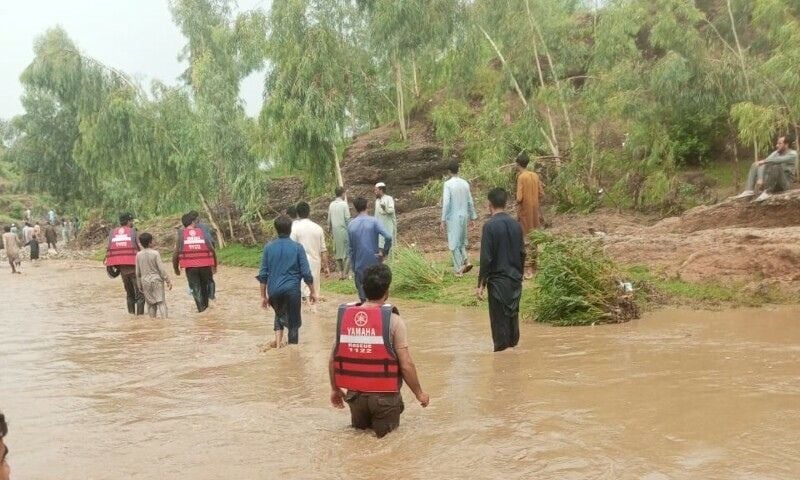
ISLAMABAD: At least 72 people have lost their lives and 187 others injured across Pakistan since the monsoon season began on June 26, as torrential rains trigger house collapses and flash floods across Punjab and Khyber Pakhtunkhwa.
The situation has been further complicated by India’s release of water into eastern rivers, raising water levels in the Chenab, Jhelum and Ravi rivers, forcing authorities to maintain active flood alerts and evacuation operations through July 24.
FFD Lahore reports High Flood at Head Marala on River Chenab, with inflow/outflow at 253,912 / 236,912 cusecs. Riverine and low-lying areas should remain alert and follow official updates.#PMD #FFD #RiverChenab #HeadMarala #HighFlood #FloodAlert #StaySafe pic.twitter.com/NLswwTI5DK
— Pak Met Department محکمہ موسمیات (@pmdgov) July 22, 2026
India’s water release adds to Pakistan’s monsoon misery
The flooding crisis has taken a concerning turn with India releasing significant amounts of water into rivers that flow into Pakistan. The Chenab, Jhelum and Ravi rivers have recorded rising water levels, prompting Punjab authorities to issue flood alerts and begin evacuations in low-lying areas.
According to the Pakistan Meteorological Department’s Flood Forecasting Division, as of 6:00 PM on July 22, medium-level flooding is being observed in the River Chenab at Marala and Khanki headworks, as well as in the River Ravi at Jassar and Balloki headworks. Low-level flooding continues in the River Indus at Tarbela, Kalabagh and Chashma, while the River Kabul at Warsak and the River Aik at Nizampur are also experiencing low flood conditions.
FFD Lahore has issued a High Flood Advisory for River Chenab. High flows are expected to persist at Marala for the next 6–8 hours, while Khanki and Qadirabad may attain high flood level in 10–18 hours. Avoid riverbanks and follow official updates.#PMD #RiverChenab #FloodAlert pic.twitter.com/aE9eTVroyc
— Pak Met Department محکمہ موسمیات (@pmdgov) July 22, 2026
In addition, nullahs and streams in Balochistan are flowing at high to very high flood levels. The Flood Forecasting Division noted that river water levels are expected to fluctuate depending on rainfall and upstream inflows.
Local administrations have been working round the clock to move families to safer grounds, with emergency response teams on high alert along the riverbanks.
The timing of India’s water release has compounded the challenges posed by the ongoing heavy rainfall. The National Disaster Management Authority (NDMA) has been coordinating with provincial governments to monitor the situation and ensure timely evacuations. Rescue teams have been deployed to vulnerable areas, particularly in Punjab, where riverine flooding has threatened several villages.
Glacier melt and rainfall create storm
The Pakistan Meteorological Department (PMD) has issued a stern warning about a significant increase in water levels in rivers, streams and nullahs across the glaciated regions of Gilgit-Baltistan and Khyber Pakhtunkhwa. Real-time observations from the hydrometeorological monitoring network installed for GLOF monitoring indicate that many snow-fed and glacier-fed watercourses are currently flowing at peak values.
According to the PMD, the accelerated snow and glacier melt, coupled with recent rainfall, has created dangerous hydrological conditions. These conditions could trigger riverbank erosion, landsliding and localized flooding. With the prevailing weather system, there is a high likelihood of current high-flow conditions developing into medium to high flood situations in susceptible valleys and downstream areas.
Glacier Lake Monitoring Update: Maximum Air Temperatures Observed Across Glaciated Valleys on July 22, 2026.#PMD #GLOFMonitoring #GlacierLakeMonitoring #PakistanWeather #AirTemperatureUpdate #GlaciatedValleys #GilgitBaltistan #KhyberPakhtunkhwa #NorthernPakistan #GlacierMelt pic.twitter.com/U8YTFQYdno
— Pak Met Department محکمہ موسمیات (@pmdgov) July 22, 2026
Evacuations underway, more rain forecast
Authorities have been forced to evacuate thousands of people from flood-prone areas, particularly along the rivers in Punjab. The Provincial Disaster Management Authorities (PDMAs) have established emergency operation centres and are working with rescue services, including Rescue 1122, fire brigades and civil defence teams, to respond to emergencies.
The PMD has warned that additional rainfall is forecast over the coming weeks, raising concerns that the situation could worsen. Officials have advised travellers and tourists to plan their trips carefully, avoid flooded areas and stay clear of rivers and nullahs. Local administrations have been directed to regulate traffic at picnic spots, secure loose structures and alert communities living in low-lying areas.
Safety guidelines issued for public
Authorities have issued comprehensive safety guidelines for the public to minimize risks during the ongoing monsoon season:
For travelers and tourists:
- Plan travels to picnic spots considering weather and traffic conditions
- Avoid swimming in rivers, nullahs or any water bodies
- Stay at least 20 feet away from rivers and nullahs
- Choose hotels on higher ground away from water bodies
- Avoid walking or driving through flooded areas—just 6 inches of moving water can knock you off your feet
- Avoid trekking, hiking or camping during heavy rains due to landslide risks
- Do not cross bridges or roads submerged in water
- Keep children away from drainage lines and ponds
For local administrations:
- Activate round-the-clock monitoring through Emergency Operation Centres (EOCs)
- Disseminate advisories and alerts to all concerned departments
- Generate Situation Reports (SITREPs) for major incidents
- Keep rescue services on high alert with sufficient personnel and equipment
- Alert communities in low-lying areas and activate community-based alert systems
- Regulate traffic at tourist spots to prevent congestion
- Secure loose structures like billboards and hoardings
Provincial coordination underway
The PMD has directed Provincial Disaster Management Authorities to coordinate with their respective departments to align local efforts with provincial strategies. Key measures include ensuring staffing at EOCs, establishing efficient communication channels for timely dissemination of weather forecasts and ensuring rapid damage assessments following major incidents.
Situation remains critical
With additional rainfall predicted and water levels continuing to rise, the coming days will be critical for flood-affected areas. The combination of heavy rains, glacier melt and water release from India has created a challenging situation for authorities. Evacuation operations are ongoing, and rescue teams remain on standby to respond to any emergencies.
The death toll of 72 is expected to rise as reports from remote areas continue to come in. Officials have urged the public to cooperate with local authorities and rescue agencies during emergencies and to prioritize safety above all else.
🌊 PMD Flood Update | 22 Jul (1200 PKT)
Most major rivers are flowing within normal limits. Low flood is observed at Kalabagh, Chashma, Marala & Qadirabad, while Medium flood continues at Khanki (River Chenab).#PMD #FloodUpdate #Monsoon2026 #RiverFlows #PakistanWeather pic.twitter.com/2TTryK331T— Pak Met Department محکمہ موسمیات (@pmdgov) July 22, 2026
Weather forecast for Thursday
According to PDM, widespread intermittent rain accompanied by wind and thundershowers is expected across several regions of Pakistan, including Khyber Pakhtunkhwa, Kashmir, Islamabad, Punjab, northeastern Balochistan, southeastern Sindh and Gilgit-Baltistan. Isolated places may experience heavy to very heavy rainfall during this period.
Weather warning for tonight and Thursday
Authorities have issued a warning for multiple weather-related hazards. Heavy rains may trigger landslides in vulnerable areas, including Khyber Pakhtunkhwa, Gilgit-Baltistan, Murree and Galliyat, and Kashmir.
Flash flooding is also likely in local streams and nullahs across Kashmir, Murree and Galliyat, northeastern Punjab, Islamabad, Khyber Pakhtunkhwa, Gilgit-Baltistan, the hill torrents of Dera Ghazi Khan, and northeastern parts of Balochistan.
Urban flooding is expected in major cities, including Islamabad and Rawalpindi, Peshawar, Nowshera, Gujrat, Gujranwala, Lahore, Sialkot, Sahiwal, Khanewal, Multan and Faisalabad. Additionally, windstorms, lightning and heavy rains may damage weak structures such as solar panels, electric poles and billboards during the forecast period.
Read Also: Pakistan Issues Nationwide Flood Alert as Monsoon Death Toll Rises to 53
Regional forecasts
Islamabad and Surroundings will experience cloudy weather with rain, windstorms and thundershowers, with isolated heavy to very heavy falls possible.
Khyber Pakhtunkhwa will see intermittent rain and windstorms across all districts, including Dir, Chitral, Swat, Kohistan, Peshawar, Mardan and Dera Ismail Khan, among others. Isolated heavy falls may also occur.
Punjab is expected to have widespread rain across the province, from Rawalpindi, Murree and Gujranwala in the north to Bahawalpur, Multan and Rahim Yar Khan in the south. Heavy falls may occur at isolated places.
Sindh will likely experience rain and thundershowers in districts such as Tharparkar, Sukkur, Hyderabad and Larkana, with light rain or drizzle possible along other coastal areas.
Balochistan is forecast to receive rain and windstorms in Zhob, Quetta, Kalat, Khuzdar and surrounding areas, with isolated heavy falls.
Kashmir will have cloudy weather with intermittent rain and thundershowers, with scattered heavy to very heavy falls. Gilgit-Baltistan is also expected to have rain with isolated heavy falls.