
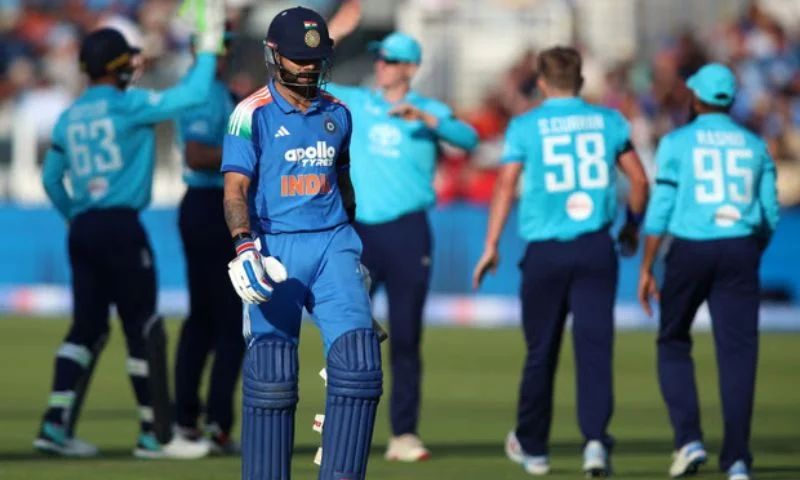
LONDON: England’s 2-1 ODI series win over India should worry the visitors because it was not built on one lucky performance. It exposed familiar weaknesses that India can no longer ignore.
England sealed the series with a 27-run victory in the third and deciding ODI at Lord’s, where they posted a huge 387-3 before restricting India to 360-7. Ben Duckett’s 141, Jacob Bethell’s 91, Joe Root’s unbeaten 74 and Jos Buttler’s explosive 41 off 13 balls powered England, with 82 runs coming in the last five overs.
That final burst was the first major warning for India. Their death bowling again failed under pressure. Against elite white-ball sides, leaking such runs at the back end can turn a chase from difficult to almost impossible.
India’s batting still produced big names and big numbers. Rohit Sharma scored 138, while Shubman Gill and Virat Kohli made important contributions, but India still fell short. Rohit’s century came after an 11-match wait for a hundred and arrived in a losing cause as England won the series 2-1.
That is the second concern: India remain heavily dependent on senior batters to rescue games. When Rohit, Kohli or Gill do not convert, the middle order often looks uncertain about tempo, role clarity and finishing responsibility.
ALSO READ: England Complete Dominant Home Series with Thrilling 27-Run Victory Over India in Final ODI
The management also faces questions over batting positions. Former India captain Kris Srikkanth criticised the decision to send KL Rahul at No. 6 in the deciding ODI, saying such handling could damage players’ confidence.
England, by contrast, looked clearer in their white-ball identity. Their aggression was not reckless; it was structured. Duckett attacked, Root anchored, Bethell accelerated, and Buttler finished brutally. That balance allowed England to keep pressure on India across phases.
The wider context is even more troubling for India. England’s ODI triumph followed a 4-0 T20 victory over India, giving their white-ball setup a major lift under Brendon McCullum and Harry Brook.
For India, the worry is not only the scoreline. It is the pattern. Expensive death overs, unstable roles, over-reliance on senior stars and tactical uncertainty are problems that stronger opponents will punish again.
England’s win should therefore be treated as more than a bilateral setback. It is a warning before the next major ICC cycle.