
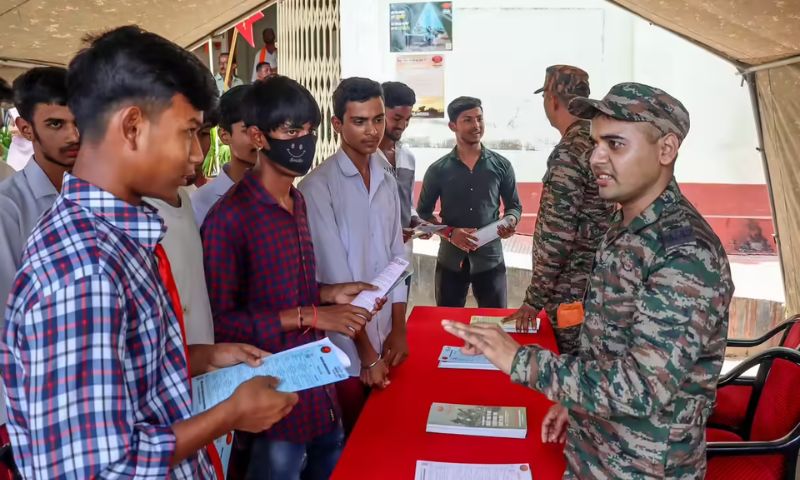
NEW DELHI: India’s controversial Agnipath military recruitment scheme is set to leave thousands of young soldiers facing job uncertainty as the first batch of Agniveer recruits approaches the end of its four-year service period.
Under the scheme approved in 2022, Agniveers are enrolled in the armed forces for four years, after which up to 25 percent of each batch can be absorbed into the regular cadre.
The remaining 75 percent are required to leave service with a one-time financial package but without the traditional long-term pension and career security earlier associated with army service.
The policy was introduced as a major reform to create a younger military profile and reduce the long-term burden of salaries and pensions.
However, critics say the model has turned the dream of a stable army career into a short-term contract for many rural youths who join the forces for livelihood, dignity and social status.
The first Agniveer batch recruited in 2022 is expected to complete service later this year, raising concern among families and former soldiers over what happens next.
In Maharashtra alone, 2,839 Agniveers are due to complete service in October and November, with the state government examining possible absorption in police, forest, fire brigade and other public-sector roles.
Several states have announced or discussed reservations, age relaxation and job preferences for former Agniveers. But rights advocates and opposition leaders argue that these measures do not guarantee employment for most recruits leaving the armed forces in their early 20s.
The uncertainty has also triggered internal debate within India’s defence establishment. Reports say the armed forces are reviewing the scheme and seeking a higher retention rate for Agniveers after completion of their four-year tenure, though the present cap remains 25 percent.
For many families in rural India, army recruitment was once seen as a path to secure employment, healthcare benefits and lifelong pension support. The Agnipath model has changed that equation, leaving thousands of trained young soldiers to compete for civilian jobs after limited military service.
The government maintains that the scheme will create disciplined, skilled and employable youth, while critics warn it could produce a generation of trained but insecure former soldiers.