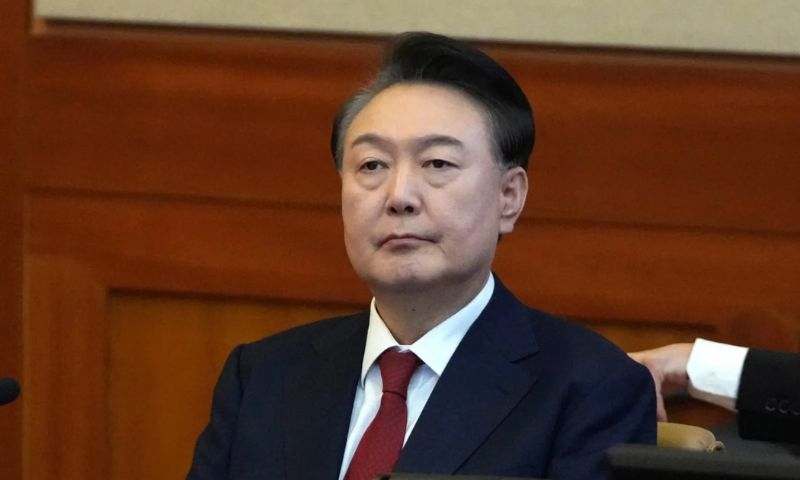
SEOUL: South Korea’s former president, Yoon Suk Yeol, was sentenced to 30 years in prison on Friday after a court found him guilty over a controversial drone operation involving North Korea, in a case that prosecutors said was linked to his 2024 declaration of martial law.
The Seoul Central District Court imposed the sentence over allegations that Yoon authorised or facilitated drone incursions into North Korean territory in an attempt to manufacture heightened security tensions and create a justification for imposing martial law. Court officials confirmed the sentence but did not immediately release further details.
The ruling comes months after Yoon was handed a life sentence in February on separate charges of leading an insurrection. Prosecutors had accused the former president of attempting to undermine democratic institutions by using martial law to neutralise the National Assembly during the political crisis of 2024.
Special prosecutors, who filed the latest charges in April, argued that the drone operation had been intended to “fabricate wartime conditions” and had ultimately endangered national security.
According to South Korea’s Yonhap News Agency, investigators maintained that the mission increased tensions with North Korea and resulted in the exposure of sensitive military information after some of the drones crashed.
Prosecutors further contended that details relating to South Korea’s defence capabilities were compromised, creating additional security risks at a time of already strained relations on the Korean Peninsula.
Yoon has appealed against his earlier conviction for insurrection, maintaining that his declaration of martial law had been undertaken “solely for the sake of the nation”.
His legal team also rejected the accusations surrounding the drone operation, insisting that there had been neither a prior order nor subsequent approval from the former president.
Defence lawyers argued that the drone flights were a legitimate response to North Korea’s campaign of sending balloons laden with rubbish across the border and had no connection with the martial law declaration. They described the prosecution’s case as a “speculative and false novel”.
Drone-related incidents have remained a major source of friction between the two Koreas, which are technically still at war since the 1950-53 Korean conflict ended with an armistice rather than a peace treaty.
Earlier this year, South Korean President Lee Jae Myung expressed regret after an investigation concluded that government officials had dispatched drones into North Korea in January.
The remarks were welcomed by Kim Yo Jong, the influential sister of North Korean leader Kim Jong Un, who described the comments as “wise behaviour”.
However, hopes of improved ties between the two neighbours soon diminished as Pyongyang reverted to describing South Korea as its “most hostile” adversary, underlining the continued volatility of relations on the Korean Peninsula.