
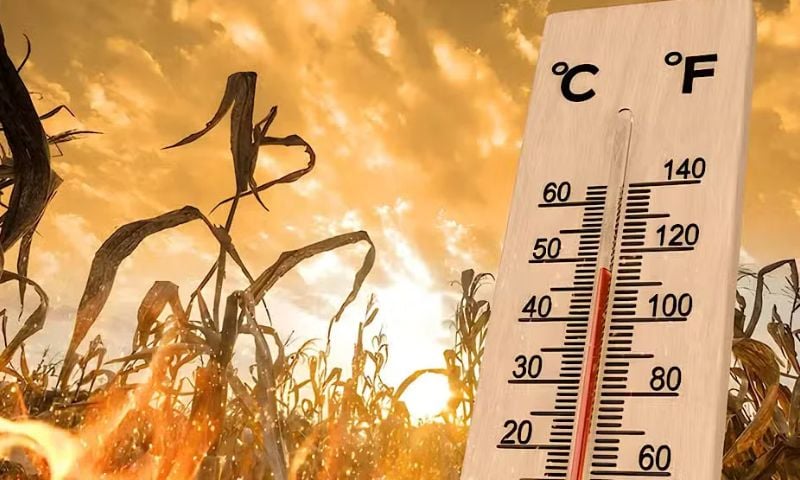
ISLAMABAD: Pakistan experienced its second consecutive year of exceptionally high temperatures in 2025, making it the second-warmest year recorded over the past six and a half decades, according to the Economic Survey 2025-26.
The findings underline the increasing impact of climate change on the country, with experts warning that rising temperatures, irregular rainfall and extreme weather events are emerging as major threats to both livelihoods and economic stability.
According to the survey, 2024 remained the hottest year on record, while 2025 ranked as the second warmest in 65 years, marking an unprecedented back-to-back occurrence of record heat.
Pakistan registered a national annual mean temperature of 23.9 degrees Celsius in 2025, which was 1.09 degrees above the long-term average temperature of 22.8 degrees Celsius.
Despite contributing less than one per cent to present global greenhouse gas emissions and only 0.4pc historically, Pakistan continues to face disproportionately severe consequences of climate change.
The survey stated that climate change has ceased to be a distant challenge and has instead become an immediate reality with profound implications for the country’s economy, infrastructure and population.
Over the last five decades, Pakistan’s average annual temperature has increased by roughly 0.5 degrees Celsius. Climate projections indicate that temperatures could rise by a further three to five degrees Celsius by the end of the century if global warming continues at the current pace.
Northern regions witnessed particularly intense warming in 2025. Temperature anomalies reached 1.24 degrees Celsius in Gilgit-Baltistan, 1.29 degrees Celsius in Khyber Pakhtunkhwa and 1.56 degrees Celsius in Azad Jammu and Kashmir, with all three regions recording their highest annual temperatures in the past 65 years.
Rainfall patterns also remained highly uneven. Pakistan received 288.5 millimetres of precipitation during the year, around three per cent below the long-term average of 297.6 millimetres.
While Sindh, Punjab and Gilgit-Baltistan experienced above-normal rainfall, Khyber Pakhtunkhwa and Balochistan recorded below-average precipitation.
The July-September monsoon season brought rainfall levels that were 23pc higher than normal. However, the year began with significantly drier conditions during the January-March period, resulting in an uneven distribution of rainfall throughout the year.
According to the survey, these changing weather patterns are accelerating glacial melting and altering the dynamics of the monsoon system. Scientists have observed fewer rainy days accompanied by more intense downpours, while monsoon activity has shifted southwards, changing the nature and distribution of flood risks.
As a result, flooding in 2025 affected all four provinces, reflecting patterns similar to the devastating floods witnessed in 2022. The report also cautioned that Pakistan could struggle to meet its commitments under international climate agreements because of insufficient financial support from the global community.
Earlier estimates by the World Bank placed Pakistan’s baseline climate-resilient investment requirements at $348 billion through 2030. To meet total projected climate-related needs of approximately $565.7bn, the country would require an additional $217.7bn in financing.
Heat emergencies claim thousands worldwide
As Pakistan copes with soaring temperatures, health authorities around the world are also grappling with the deadly consequences of extreme heat.
The World Health Organisation (WHO) said on Thursday that more than 200,000 people have died across Europe since 2022 due to heat-related causes, following a series of severe heatwaves that have pushed temperatures to unprecedented levels.
Hans Henri Kluge, WHO Regional Director for Europe, described extreme heat as the most immediate and lethal manifestation of climate change.
He warned that vulnerable groups, including the elderly, children and people with existing medical conditions, face increased risks from dehydration, heat exhaustion and heatstroke.
Kluge noted that many of the deaths could have been prevented and stressed that the current crisis represents only the beginning, with millions more people experiencing both physical and mental health impacts linked to rising temperatures.
He further observed that Europe is warming faster than any other continent and called on governments to establish comprehensive heat-warning systems and adopt stronger institutional responses to tackle the growing crisis.
El Niño expected to intensify
Adding to concerns over global weather instability, the United States National Oceanic and Atmospheric Administration (NOAA) announced that El Niño conditions have now emerged and are expected to strengthen further during the latter part of the year.
Scientists believe the phenomenon could become one of the strongest El Niño events recorded since observations began in 1950. According to NOAA, there is a 63pc probability that a very strong El Niño episode will develop between November and January, placing it among the most significant events in the historical record.
El Niño is a naturally occurring climate pattern characterised by unusually warm sea-surface temperatures in the central and eastern equatorial Pacific Ocean. The phenomenon influences atmospheric circulation and frequently alters rainfall patterns across the globe.
Researchers fear that El Niño will amplify the effects of human-induced climate change, contributing to higher temperatures and increasingly erratic weather conditions.
Historically, major El Niño events have been associated with drought conditions in parts of the Amazon Basin, Indonesia and Australia, while also affecting rainfall and monsoon systems across South Asia.
United Nations Secretary-General Antonio Guterres urged governments worldwide to view the development as a serious warning. “El Niño conditions will pour fuel on the fire of a warming world,” he said.
Delayed monsoon raises concerns in India
The effects of changing weather patterns are already becoming evident in neighbouring India, where meteorological officials expect below-average rainfall during the next two weeks.
Senior officials from India’s weather bureau said the movement of the southwest monsoon has slowed due to the influence of western disturbances.
Nearly half of India’s agricultural land relies solely on rainfall, while around half of the country’s population depends directly or indirectly on farming for income. Meteorologists warned that weaker rainfall could delay the sowing of summer crops and potentially affect agricultural output.
The annual June-to-September monsoon usually reaches the southern state of Kerala around June 1 and spreads across the entire country by mid-July. However, this year its arrival was delayed by three days. Rainfall during June has so far remained 26.5pc below normal levels.
India’s weather department has forecast that the monsoon season will deliver around 90pc of average rainfall overall, while rainfall during June alone is expected to reach 92pc of normal levels amid the influence of El Niño.
The developments have heightened concerns among scientists and policymakers that increasingly frequent heatwaves, shifting monsoon patterns and more intense weather events are becoming defining characteristics of a warming planet.
Vulnerable countries such as Pakistan are expected to bear some of the gravest consequences of climate change, despite contributing only a small share to global greenhouse gas emissions.