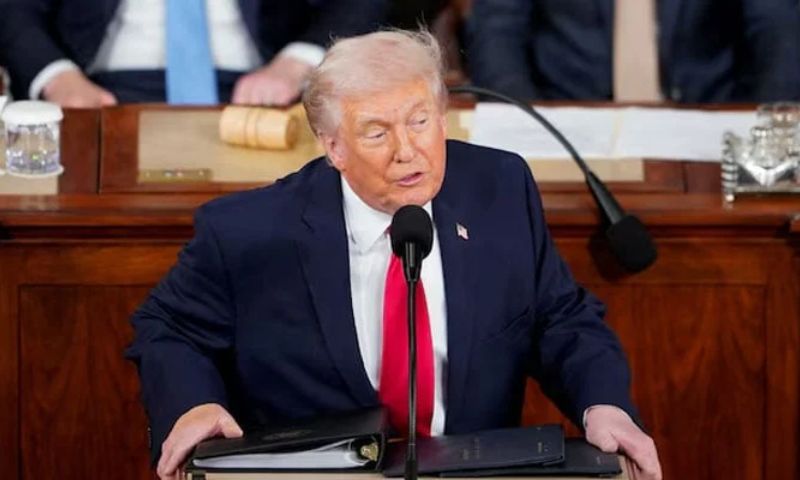



WASHINGTON: US President Donald Trump has expressed confidence that renewed military exchanges between Israel and Iran will not derail ongoing diplomatic efforts between Washington and Tehran, insisting that a potential agreement to end months of regional conflict remains within reach.
Speaking after a fresh round of hostilities between the two regional rivals, Trump maintained that negotiations with Iran were progressing despite concerns that recent developments could jeopardise peace efforts. His remarks came after Israel launched strikes near Beirut on Sunday and Iran responded by firing missiles towards Israeli targets, raising fears of a broader escalation across the Middle East.
Trump dismissed suggestions that the latest violence would undermine the diplomatic process, stressing that the United States remained firmly in control of negotiations, according to the Financial Times.
“It’s not going to have any impact on the deal,” Trump said, adding that decisions regarding the peace initiative were being directed by Washington rather than Israeli leadership.
The latest exchange of fire occurred after Israel carried out strikes in the Beirut area for the first time since the United States unveiled a truce proposal for Lebanon last week.
The attacks prompted a retaliatory missile barrage from Iran, intensifying concerns over the stability of an already fragile regional environment.
Despite the escalation, Trump reiterated that a negotiated settlement with Tehran was still achievable and suggested that substantial progress had been made in recent discussions aimed at ending the wider conflict.
The developments had immediate repercussions in global energy markets, with oil prices rising by more than two per cent in early Monday trading. International benchmark Brent crude climbed back above $95 per barrel as investors reacted to fears of further instability in the region.
Iran’s Islamic Revolutionary Guard Corps said it had targeted the Ramat David air base near Nazareth as part of its response. Israeli military officials confirmed that missiles had been launched from Iranian territory and said air defence systems had intercepted the incoming projectiles.
As tensions mounted, Trump and Israeli Prime Minister Benjamin Netanyahu held a telephone conversation lasting nearly half an hour on Sunday.
While neither the White House nor Netanyahu’s office released an official readout of the discussion, reports indicated that Trump urged the Israeli leader to avoid further military action that could complicate ongoing diplomatic efforts.
According to a US official cited by Axios, Trump told Netanyahu that Washington was close to securing a breakthrough agreement and sought restraint to preserve momentum in the talks. The official suggested that the conversation had effectively bought additional time for diplomacy to continue.
Hours later, shortly after midnight on Monday, the Israeli military issued a statement quoting Chief of Staff Lieutenant General Eyal Zamir as saying that no orders had yet been issued for direct attacks on Iran. However, he emphasised that Israeli forces stood ready to act decisively if instructed to do so.
Since the start of US-Iran negotiations aimed at ending the conflict, Israel has continued military operations in Lebanon against Hezbollah, arguing that the campaign is separate from any ceasefire arrangements involving Tehran.
Iran, however, has consistently linked the success of any agreement with the United States to the maintenance of a ceasefire in Lebanon. Tehran has argued that a lasting settlement cannot be achieved while Israeli military operations continue across Lebanese territory.
Israel launched its military campaign in Lebanon in March, targeting Hezbollah fighters who had conducted cross-border attacks in support of Iran. The conflict has resulted in thousands of deaths and displaced hundreds of thousands of civilians.
Iranian Parliamentary Speaker Mohammed Baqer Qalibaf, who has played a leading role in peace negotiations, accused Israel and the United States of undermining stability in the region.
He stated that American military installations and Israeli assets remained legitimate targets in response to what he described as hostile actions and violations of agreements relating to Lebanon.
Before Sunday’s missile launches, Iran had largely refrained from directly attacking Israel since a broader ceasefire took effect in April. However, Hezbollah has continued launching attacks, maintaining pressure on Israeli forces.
Trump has argued that a negotiated settlement remains close. In a pre-recorded interview with NBC News’ “Meet the Press”, broadcast on Sunday to mark 100 days since the conflict began, the US president reiterated his belief that an agreement could soon be reached.
He warned, however, that military options remained available should diplomacy fail, underscoring the high stakes surrounding the negotiations.
Meanwhile, Netanyahu defended Israel’s latest strikes in Beirut’s southern suburbs, an area widely regarded as a Hezbollah stronghold, saying the attacks were a response to Hezbollah fire directed at Israeli territory.
As diplomatic efforts continue, regional and international observers remain closely focused on whether Washington can secure a breakthrough agreement with Tehran while preventing further military escalation involving Israel, Iran and Hezbollah.