Key Points
- Over 17,500 security personnel deployed across Gilgit-Baltistan
- More than 1,300 polling stations set up across the region
- Diamer district has the highest number of highly sensitive polling stations
- Women’s participation reported at notable levels in several areas
- Election held after a four-month delay due to harsh winter conditions
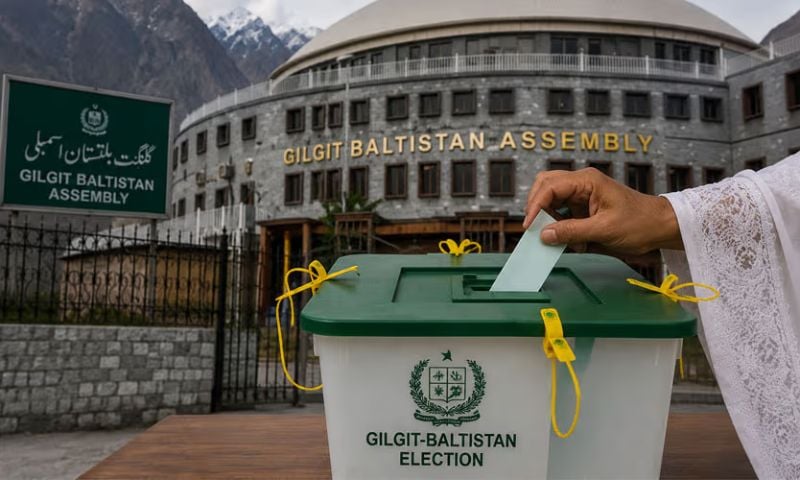
GILGIT, Pakistan: Polling commenced across Gilgit-Baltistan on Sunday for elections to 24 directly contested seats of the regional Legislative Assembly, with authorities enforcing stringent security measures in view of the region’s sensitive security environment.
Voting began at 8:00am and will continue uninterrupted until 5:00pm. According to the Election Commission, around 958,480 registered voters are eligible to cast their ballots, although some official briefings have placed the figure at approximately 963,034 across the region’s ten districts.
The elections, held after a four-month delay due to harsh winter conditions, feature more than 396 candidates, including a significant number of independents. Of these, around 266 are contesting as independent candidates, while women remain underrepresented, with only eight female candidates in the race.
Authorities have established 1,391 polling stations across Gilgit-Baltistan. Of these, 488 have been declared normal, 349 sensitive, and 551 highly sensitive, reflecting security concerns in several districts.
District-wise arrangements show Gilgit hosting 253 polling stations, Skardu 208, Ghizer 207, Diamer 174, Ghanche 154, Astore 108, Hunza 88, Nagar 85, Shigar 71, and Kharmang 43. Diamer has the highest number of highly sensitive polling stations, with 119 such sites.
Security has been tightened across the region, with more than 17,500 personnel deployed, including contingents from Gilgit-Baltistan Police, Gilgit-Baltistan Scouts, and reinforcements from Punjab and Islamabad police. Officials said around 6,000 personnel from Punjab Police and 2,000 from Islamabad Police have been assigned election duties, particularly in vulnerable constituencies.
Law enforcement agencies conducted flag marches in several areas ahead of polling to demonstrate readiness and deter potential disruptions. Additional forces have been positioned at sensitive and highly sensitive stations, while district administrations remain on high alert throughout the voting process.
Chief Election Commissioner Raja Shahbaz Khan visited multiple polling stations in Gilgit city to review arrangements, meet polling staff, and monitor the electoral environment. Speaking to the media, he said voting had started on time and was proceeding in a peaceful and orderly manner, adding that voter participation appeared encouraging, including notable turnout among women.
The Election Commission confirmed that all necessary administrative and security arrangements had been finalised to ensure free, fair, and transparent elections. Political parties are also contesting vigorously.
The Pakistan People’s Party (PPP) and Pakistan Muslim League-Nawaz (PML-N) have fielded the highest number of candidates among mainstream parties, followed by independents backed by various political groups, including elements aligned with Pakistan Tehreek-e-Insaf (PTI).
Other participating parties include the Istehkam-e-Pakistan Party (IPP), Jamiat Ulema-e-Islam-Fazl (JUI-F), Jamaat-e-Islami (JI), Majlis Wahdat-e-Muslimeen (MWM), Muttahida Qaumi Movement-Pakistan (MQM-P), and others.
Prominent contests are being observed in key constituencies, including Gilgit, where senior political figures from PPP and PML-N are in direct competition. Campaigning in the run-up to polling saw extensive political activity, with major party leaders visiting the region and addressing rallies.
In the previous 2020 elections, PTI emerged as the leading party. However, subsequent political developments led to a change in the regional government. Ahead of the current polls, opposition parties raised concerns over the electoral environment, deployment of additional police forces from other provinces, and alleged disparities in campaign conditions.
Despite these concerns, election authorities and caretaker officials expressed optimism that polling would remain peaceful throughout the day and that voters would be able to exercise their democratic right without disruption.
Former three-time elected prime minister and PML-N supremo Nawaz Sharif visited Gilgit-Baltistan during the election campaign, where he engaged with party candidates and addressed public gatherings in support of the Pakistan Muslim League-Nawaz.
He urged voters to back PML-N nominees, highlighting the party’s development agenda and pledging continued focus on infrastructure, governance, and economic opportunities in the region.
His campaign appearances drew large public gatherings, with party workers and supporters turning out in significant numbers. Similarly, Pakistan People’s Party (PPP) Chairman Bilawal Bhutto Zardari also toured Gilgit-Baltistan as part of the party’s election campaign.
He addressed multiple rallies across key constituencies, emphasising the PPP’s political legacy and commitment to strengthening democratic institutions. Bilawal called for increased investment in education, health, and connectivity in the mountainous region, urging voters to support PPP candidates for stronger representation at the national level.
Both leaders’ visits were seen as high-profile interventions in the election campaign, underscoring the importance of Gilgit-Baltistan’s political landscape for mainstream national parties. Their engagements reflected intensified political competition, with both PML-N and PPP mobilising leadership-level support ahead of polling.
Independent assessments indicate that public sentiment in Gilgit-Baltistan is strongly shaped by longstanding demands for jobs, infrastructure development, improved connectivity, and constitutional and ownership rights.
Voters across urban centres such as Gilgit and Skardu, as well as remote valleys, have consistently expressed expectations that the incoming government will prioritise basic public services, including education, healthcare, electricity supply, and road infrastructure. Many residents view the election more in terms of governance and delivery of development projects than party ideology.
At the same time, political engagement has been high, with visible participation from supporters of the three major national forces—PPP, PML-N, and PTI-aligned independents—reflecting a competitive electoral environment.
Observers note that while PPP and PML-N have conducted extensive campaign rallies led by senior leadership, voters remain cautious and are assessing which party can most effectively translate federal influence into tangible benefits for the region. Issues such as land ownership rights and greater political representation have also featured prominently in voter discussions.
Regarding electoral prospects, credible reporting and pre-poll assessments suggest that no single party is likely to secure a clear majority, with the outcome expected to depend on closely contested constituencies and post-poll alliances.
Despite PTI’s strong presence in the previous Gilgit-Baltistan Assembly, the current electoral environment is widely viewed as being more competitive for all major political forces.
According to prevailing political assessments and ground reporting, PTI’s prospects appear comparatively constrained due to internal organisational challenges and a fragmented campaign structure in the region, where many former representatives are contesting as independents.
At the same time, observers note that PPP and PML-N have maintained a visible organisational presence and conducted extensive leadership-led campaigning across Gilgit-Baltistan.
Both parties have focused on consolidating support through high-profile visits and targeted outreach in key constituencies, which may strengthen their position in closely contested seats.
Analysts broadly emphasise that the contest remains open and highly competitive, with independents and local dynamics expected to play a decisive role in government formation rather than any single party achieving a decisive majority.