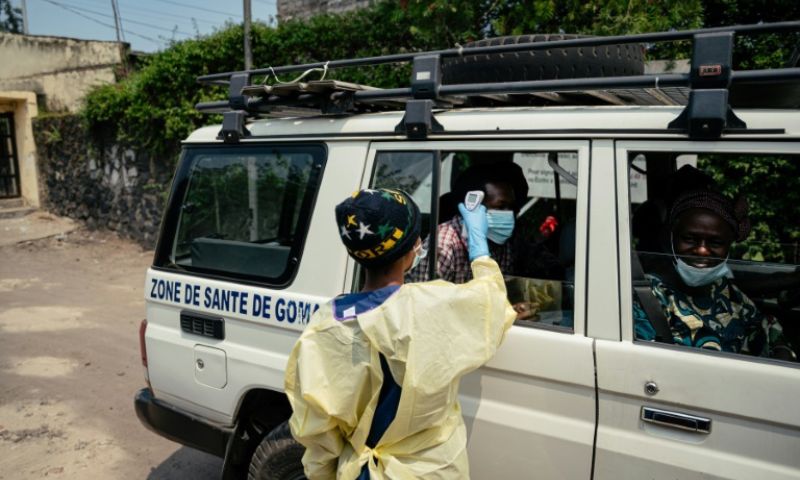
KINSHASA, DR Congo: The World Health Organization (WHO) on Tuesday expressed alarm over the “scale and speed” of a deadly Ebola outbreak in the Democratic Republic of Congo (DRC), warning that the epidemic could continue for months as authorities struggle to contain the spread of the rare Bundibugyo strain of the virus.
The United Nations health agency has declared the outbreak a public health emergency of international concern after the highly contagious haemorrhagic fever killed more than 130 people and spread into neighbouring Uganda.
WHO Director-General Tedros Adhanom Ghebreyesus said the agency was “deeply concerned about the scale and speed of the epidemic” as cases continued to emerge in conflict-hit and difficult-to-access regions in eastern Congo.
Congolese Health Minister Samuel Roger Kamba told reporters that 136 deaths were suspected to be linked to Ebola, while around 543 suspected cases had been recorded so far.
He appealed for international support to strengthen containment efforts.
The outbreak is centred in northeastern Ituri province near the borders with Uganda and South Sudan.
Health workers and aid agencies said the response had initially been slow despite rapidly rising infections.
No vaccine or therapeutic treatment exists
Health experts say the latest outbreak differs from previous Ebola epidemics because it involves the rare Bundibugyo strain, for which no approved vaccine or therapeutic treatment currently exists.
WHO representative in the DRC Anne Ancia said a vaccine candidate known as Ervebo was being considered for possible use, but cautioned that it could take at least two months before it becomes available.
“I don’t think that in two months we will be done with this outbreak,” she said.
French immunologist Aurelie Wiedemann, an Ebola specialist at France’s National Institute for Health and Medical Research (Inserm), said the outbreak was complicated by “a combination of unfortunate circumstances”.
She said the Bundibugyo strain had only previously been identified during outbreaks in Uganda in 2007 and the DRC in 2012, leaving scientists with limited understanding of the variant.
“We still have hope; it’s still an Ebola virus, albeit a different strain. But we’re going in a bit blind,” Wiedemann said.
She noted that the Bundibugyo strain shares only about 65 percent similarity with the Zaire strain, which was used to develop the main Ebola vaccines currently available.
Cases spread beyond DR Congo borders
Authorities said suspected cases had now been reported in the commercial city of Butembo and in Goma, the capital of North Kivu province.
Congolese Nobel Peace Prize laureate Denis Mukwege urged the M23 group to reopen Goma airport to facilitate humanitarian operations and medical assistance.
The virus has also spread into neighbouring Uganda, where authorities confirmed one Ebola infection and one death involving Congolese nationals who crossed the border.
Germany said on Tuesday it was preparing to receive and treat a US citizen infected with Ebola.
The patient is reportedly a doctor working for an American Christian non-governmental organisation.
The United States announced additional screening measures for air passengers arriving from affected areas and temporarily suspended visa services linked to outbreak zones.
Washington also urged citizens to avoid travel to the DRC, South Sudan and Uganda, while advising caution regarding travel to Rwanda.
Aid cuts and delayed detection
Health officials and aid workers warned that reduced international funding was hampering response efforts.
Mamadou Kaba Barry, who oversees field operations for medical NGO Alima, said the reduction in foreign assistance, particularly from the United States after cuts to USAID programmes, had affected containment operations.
“The reduction in aid has had an impact on the response,” Barry said. “Releasing funds as quickly as possible could make a big difference from today.”
Researchers and epidemiologists said delayed detection had also worsened the outbreak because early screening tests were primarily designed to detect the Zaire strain rather than Bundibugyo.
Researchers at Imperial College London said modelling studies suggested the actual scale of the epidemic could be significantly larger than current figures indicate.
Despite growing concern, experts said the outbreak was unlikely to become a global pandemic.
Epidemiologist Anne Cori said Ebola spreads through direct contact with bodily fluids rather than through the air, making worldwide transmission less likely than diseases such as Covid-19 or measles.
“Ebola is not an airborne virus,” Cori said. “It requires relatively close contact and is therefore harder to spread globally.”
The current outbreak is the 17th recorded Ebola epidemic in the DRC, where more than 100 million people live.
The country’s deadliest outbreak between 2018 and 2020 killed nearly 2,300 people.