
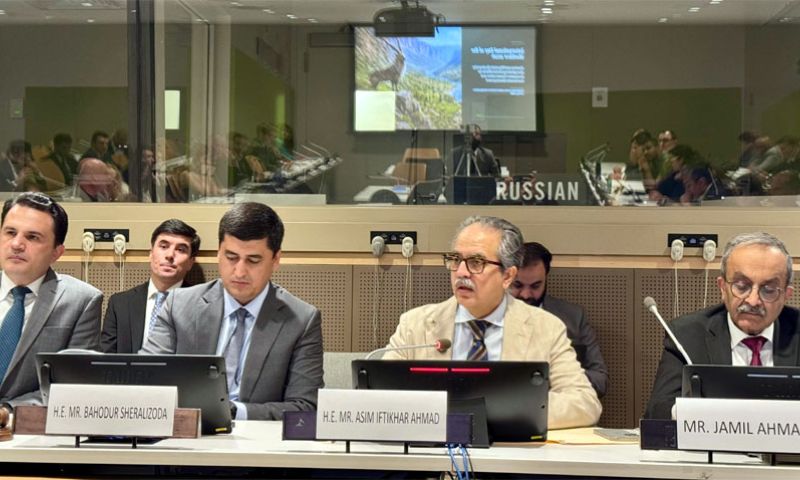
NEW YORK: Pakistan’s Permanent Representative to the United Nations, Asim Iftikhar Ahmad, has highlighted the country’s successful efforts in conserving the endangered Markhor animal as a model for wildlife preservation.
He also called on the international community to strengthen initiatives aimed at safeguarding mountain ecosystems, emphasising that protecting biodiversity in high-altitude regions is crucial for ecological balance, local livelihoods, and global environmental health.”
He was addressing a side-event at the United Nations Headquarters in New York marking the International Day of the Markhor, co-hosted by the Permanent Missions of Pakistan and Tajikistan along with IUCN and UNEP, according to a press release issued by Pakistan’s Mission at the UN.
He said Markhor is not merely a conservation subject but Pakistan’s national animal and a symbol of resilience and majesty.
Asim Iftikhar Ahmad said the species is native to the high mountain regions of Chitral, Kohistan, Kalam, Gilgit-Baltistan, Balochistan, and Azad Jammu and Kashmir.
Pakistan’s Permanent Representative to the United Nations, Asim Iftikhar Ahmad says Markhor is not merely a conservation subject but Pakistan’s national animal and a symbol of resilience and majesty@PakistanPR_UN @PakistanUN_NY #News #RadioPakistan https://t.co/vLLE3VwkuE pic.twitter.com/Syxur2upo2
— Radio Pakistan (@RadioPakistan) May 19, 2026
He said Markhor, which once teetered on the brink of extinction, has grown steadily over the past decade — a testament to proactive conservation, community ownership, and sustained political will.
“Our conservation strategy, including a CITES-recognised programme, has been central to this turnaround,” he added.
Pointing to the challenges, he said that climate change is fundamentally altering the ecosystems that the Markhor depends upon.
He described warming temperatures as driving apex predators like the snow leopard to ever higher altitudes in parts of Pakistan, thus compounding the problem. He said that the situation has disrupted the predator hierarchy, with lynx and other predators now roaming freely and hunting Markhor kids far more intensively.
“While Pakistan has made significant strides against poaching, illegal hunting remains a persistent threat across the species’ range states. These are not isolated pressures — they are interconnected, and they are accelerating,” he warned.
He conveyed Pakistan’s readiness to work with all partners to ensure that the “mountain monarch” continues to reign.
Delivering the keynote address, Bahodur Sheralizoda, Chairman of the Committee for Environmental Protection under the Government of Tajikistan, highlighted Tajikistan’s successful recovery of the Markhor population, which had fallen to nearly 300 in the 1990s and has since increased to more than 7,000 through scientific monitoring, community-based protection, political will and responsible wildlife management.
Jamil Ahmad, Director of the United Nations Environment Programme placed Markhor conservation within the broader environmental crisis facing mountain regions.
He warned that highlands are warming faster than lowlands, with glacier melt, snow cover decline, permafrost thaw and water stress placing ecosystems, livelihoods and energy investments at risk.
Dr. Sofie Sandström Jaffe, Permanent Observer of International Union for Conservation of Nature, said the International Day of the Markhor recognises both an iconic species and the mountain ecosystems on which nearly half of the world’s biodiversity hotspots depend.
She described the Markhor as a barometer of ecosystem health and stressed that its recovery demonstrates what is possible when communities are empowered, science guides management, and cooperation extends across borders.