
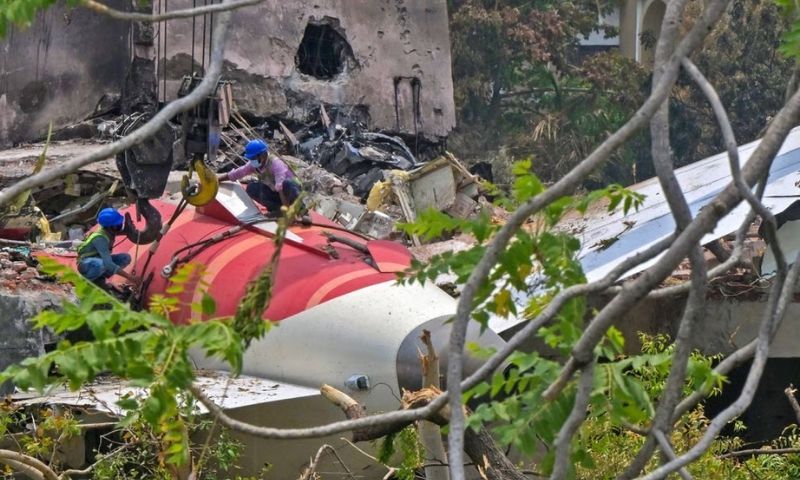
NEW DELHI: India’s national carrier Air India is facing growing financial and operational turmoil ahead of the expected release of the final investigation report into last year’s deadly Ahmedabad plane crash, with the airline’s turnaround strategy now under increasing pressure, according to the BBC.
The crash of the London-bound Air India flight AI-171, which went down seconds after take-off from Ahmedabad on June 12, 2025, killing 260 people, continues to cast a shadow over the airline as authorities prepare to publish final findings next month.
According to the BBC, a leadership vacuum, rising financial losses, airspace restrictions, and soaring fuel costs linked to Middle East tensions have compounded the airline’s crisis. The broadcaster also noted that a series of recent operational failures and safety incidents has further damaged the carrier’s image.
The Air India chief executive officer, Campbell Wilson, resigned before completing his term after the airline reportedly posted losses of $2.4 billion for the year ending March 2026.
Air India is currently the largest loss-making entity within the Tata Group, which acquired the struggling airline from the Indian government in 2022.
According to local media cited by the BBC, Tata Group board members recently discussed cost-cutting measures and warned employees of “tough times” ahead.
The arrival of senior Singapore Airlines executives at Tata headquarters in Mumbai also fuelled speculation that the airline may deepen its involvement in Air India, where it currently holds a 25.1% stake.
Air India declined to respond to the BBC’s detailed questionnaire, but aviation experts told the broadcaster that Wilson’s departure has left the airline without stable leadership during a critical period.
“They needed a clear vision right now. Air India had given itself a five-year plan to revamp itself after the privatisation. But one can’t really say that it’s been a happy ride so far. Between their plan and its implementation, there have been big and growing gaps,” former Air India executive director Jitendra Bhargava told the BBC.
Bhargava said the Tata Group had underestimated the scale of problems inherited from the legacy carrier, while Wilson failed to build a strong management team quickly enough to execute reforms effectively.
According to the BBC, Air India has continued to struggle with operational failures and safety concerns despite efforts to improve its public image.
In March, one of the airline’s flights from Delhi to Vancouver was forced to turn back after flying for nearly eight hours because it reportedly lacked approval to enter Canadian airspace.
Air India described the issue as operational, but aviation consultant Alok Anand told the BBC the incident was “highly unusual” and suggested a serious breakdown in internal procedures.
The broadcaster also reported that India’s aviation regulator identified 51 safety violations at Air India during last year’s annual audit, including seven classified at the highest safety risk level.
Apart from internal difficulties, external pressures have also worsened the airline’s challenges.
The delays in aircraft deliveries caused by global supply chain shortages disrupted Air India’s fleet expansion plans, while several international routes, including Delhi-Washington and Mumbai-San Francisco, have been suspended since 2024.
Aviation analyst Mahantesh Sabarad said that the depreciation of the Indian rupee against the US dollar has further complicated Air India’s recovery because major airline expenses, particularly fuel costs, are linked to the dollar.
According to Sabarad, Tata Group and Singapore Airlines may now need to inject additional capital into the airline to absorb growing losses.
Shareholder support is required. The Tatas didn’t give up then and have experience dealing with such scenarios… but they should start looking at innovative financing arrangements going forward,” he said.
Experts believe Air India’s financial situation may deteriorate further before improving, especially as the impact of high fuel prices, currency depreciation, and route closures continues to unfold.
Analysts told the broadcaster that the final findings of the Ahmedabad crash investigation could also have major consequences for Air India’s reputation and future recovery efforts.