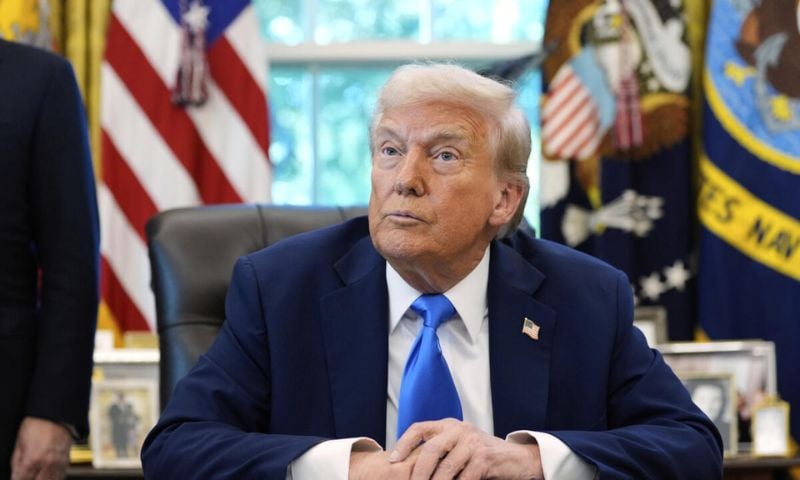



WASHINGTON: US President Donald Trump said on Wednesday that an agreement with Iran could bring an end to the military operation “Epic Fury” and lead to the reopening of the Strait of Hormuz, while warning of military action if Tehran rejects the terms.
In a post on Truth Social, Trump said tensions could ease significantly if Iran complies with conditions tied to maritime access and regional stability.
“Assuming Iran agrees to give what has been agreed to… the already legendary Epic Fury will be at an end, and the highly effective Blockade will allow the Hormuz Strait to be OPEN TO ALL, including Iran,” he said.
Trump added: “If they don’t agree, the bombing starts… at a much higher level and intensity than it was before.”
“Assuming Iran agrees to give what has been agreed to, which is, perhaps, a big assumption, the already legendary Epic Fury will be at an end… If they don’t agree, the bombing starts, and it will be, sadly, at a much higher level and intensity than it was before.” – President… pic.twitter.com/WawLkequWU
— The White House (@WhiteHouse) May 6, 2026
US-Iran close to deal
The US President’s remarks came as the United States and Iran appear to be closing in on a preliminary agreement to end the conflict, according to a report by Axios, which cited US officials and sources familiar with the talks.
Axios reported that Washington expects Tehran’s response on key proposals within the next 48 hours. While no agreement has been finalised, officials said this is the closest both sides have come to a deal since the conflict began.
The report said the proposed one-page, 14-point memorandum of understanding is being negotiated between US envoys Steve Witkoff and Jared Kushner and Iranian officials, both directly and through mediators.
According to Axios, the framework would include a moratorium by Iran on nuclear enrichment, the lifting of US sanctions, and the release of billions of dollars in frozen Iranian funds.
It would also provide for easing restrictions on shipping through the Strait of Hormuz.
Hormuz tensions and naval pause
The Strait of Hormuz, a vital route for global oil shipments, has remained largely closed since late February amid escalating hostilities.
The United States imposed a naval blockade and launched “Project Freedom” to escort commercial shipping through Hormuz.
Trump announced on Tuesday that the United States had paused the naval mission on Pakistan’s request, citing “great progress” in negotiations.
In a Truth Social post, he said the pause would allow time to determine whether a final agreement could be reached and signed.
— Rapid Response 47 (@RapidResponse47) May 5, 2026
Iran’s Revolutionary Guards Navy said on Wednesday that safe transit through the strait would be ensured once US threats end and new procedures are implemented, according to Iranian state media.
The Guards thanked ship owners and captains for complying with Iranian regulations, but did not detail the new procedures.
Pakistan’s Prime Minister Shehbaz Sharif welcomed Trump’s decision to pause naval operations, calling it a “timely” move that could help ease tensions and create space for dialogue.
I am grateful to President Donald Trump for his courageous leadership and timely announcement regarding the pause in Project Freedom in the Strait of Hormuz.
President Trump's gracious response to the request made by Pakistan and other brotherly countries, particularly the…
— Shehbaz Sharif (@CMShehbaz) May 6, 2026
30-day negotiation period
Under the reported memorandum, both sides would declare an end to hostilities and begin a 30-day negotiation period to finalise a broader agreement covering nuclear limits, sanctions relief and maritime access.
During that period, Iran’s restrictions on shipping and the US blockade would be gradually lifted, Axios said, citing a US official.
The official added that Washington could restore the blockade or resume military action if talks collapse.
Iran signalled earlier on Wednesday that it would accept a deal only if it is “fair”.
Speaking during a visit to China, Iranian Foreign Minister Abbas Araghchi reiterated that Tehran seeks a “fair and comprehensive agreement” and would not negotiate under pressure.
Pakistan’s diplomatic efforts
Pakistan-led diplomatic efforts have intensified in recent weeks.
The first round of direct US-Iran talks took place in Islamabad in April, which ended without a final agreement.
However, the Islamabad Talks paved the way for broader negotiations to end the US-Iran conflict through diplomacy and dialogue.
Pakistan’s Prime Minister Shehbaz Sharif welcomed Trump’s decision to pause naval operations, calling it a “timely” move that could help ease tensions and create space for dialogue.
Meanwhile, Chinese Foreign Minister Wang Yi said in Beijing that a comprehensive ceasefire and sustained negotiations were essential to de-escalation.