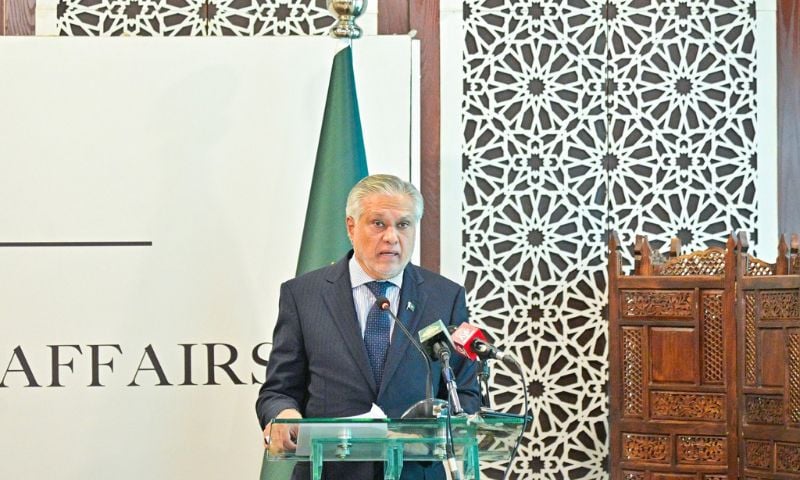
ISLAMABAD: Pakistan’s Deputy Prime Minister and Foreign Minister Ishaq Dar on Tuesday warned that any attempt to weaponise water against Pakistan would be considered as an act of war.
Addressing ambassadors and members of the diplomatic corps, he said that Islamabad reserves the right to defend its national interests in line with international law.
He said Pakistan is closely monitoring developments related to the Indus Waters Treaty, warning that any unilateral attempt to alter water flows would carry serious consequences.
Under the treaty, the western rivers — the Indus, Chenab and Jhelum — were allocated to Pakistan, while India was granted control over the eastern rivers of the Indus basin.
Ishaq Dar stressed that water is a vital lifeline for Pakistan, adding that any effort to obstruct or reduce its flow would cross a red line. Dar noted that recent fluctuations in the Chenab River’s flow have raised concerns, and Pakistan expects India to provide transparent and verifiable data on river waters.
Deputy Prime Minister/Foreign Minister Senator Ishaq Dar briefed the Diplomatic Corps on the first anniversary of #MarkaEHaq, describing it as a symbol of Pakistan’s unity, resilience, and the unwavering resolve of its Armed Forces to defend the country’s sovereignty and… pic.twitter.com/i5CaPGebh2
— Ministry of Foreign Affairs – Pakistan (@ForeignOfficePk) May 5, 2026
The foreign minister also said India has made allegations against Pakistan regarding the Pahalgam attack without presenting evidence, followed by aggressive actions. He added that Pakistan’s armed forces, under the leadership of Field Marshal Syed Asim Munir, responded effectively to any hostile moves.
The tensions between India and Pakistan escalated after a deadly attack in the Pahalgam area of Indian Illegally Occupied Jammu and Kashmir in April last year, which claimed the lives of 26 people.
India swiftly blamed Pakistan for the attack without presenting any credible evidence. Pakistan condemned the attack and strongly rejected the Indian government’s baseless accusations.
Pakistan also offered a neutral and transparent international investigation into the incident; however, India failed to respond to Islamabad’s offer and continued with its aggressive posture, jeopardising regional peace and security.
The four-day war between the two nuclear-armed neighbours began after India conducted missile strikes inside Pakistani territory, resulting in the deaths of multiple civilians and security personnel.
Pakistan gave a swift, strong, and decisive response to India. The Pakistan Air Force (PAF) shot down seven Indian aircraft, including Rafale jets, and successfully neutralised an S-400 air-defence system.
The conflict ended on May 10 when both countries agreed to a ceasefire mediated by the United States.
Ishaq Dar said Pakistan has previously demonstrated both military preparedness and diplomatic resilience during periods of escalation. Reiterating Islamabad’s long-standing stance, he emphasised that lasting peace in South Asia cannot be achieved without resolving the Kashmir dispute.
He said Pakistan continues to support peaceful dialogue but remains firmly committed to defending its sovereignty and national interests if challenged.
He further said that Islamabad played a facilitative role in encouraging diplomatic engagement between the United States and Iran, bringing both sides to the negotiating table after decades of strained relations.
The Deputy Prime Minister expressed gratitude to the countries that supported Pakistan during the US–Iran peace process, describing their engagement as a meaningful contribution to diplomacy and regional stability.
He also underscored Pakistan’s constructive involvement in the Shanghai Cooperation Organisation, its deepening partnership with China through the China–Pakistan Economic Corridor, and its ongoing engagement with the European Union.
He reaffirmed Pakistan’s longstanding position in support of Al-Quds Al-Sharif (Jerusalem) as the capital of a future Palestinian state.