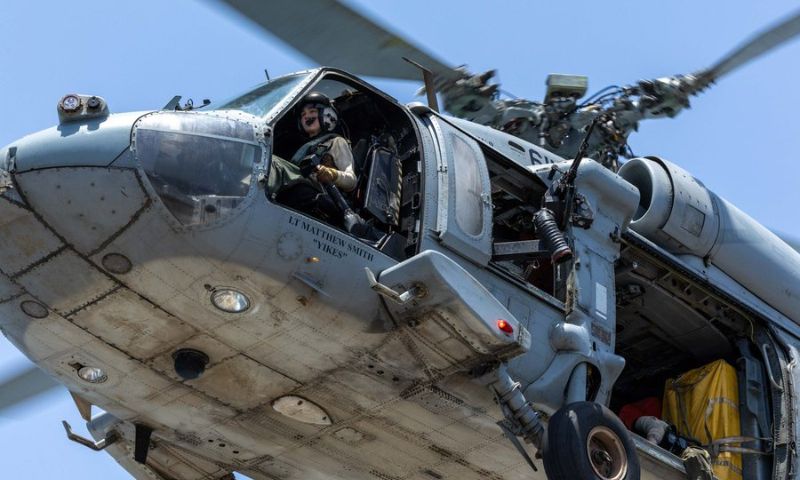



WASHINGTON: The United States Central Command (CENTCOM) has announced that U.S Navy MH-60 Sea Hawk helicopters are currently operating in and around the Strait of Hormuz as part of an initiative referred to as “Project Freedom”.
According to a statement shared by CENTCOM on X, the operation involves enhanced aerial support aimed at ensuring the security of commercial maritime traffic in one of the world’s most strategic and sensitive shipping lanes.
U.S. Navy MH-60 Sea Hawk helicopters are supporting Project Freedom in and near the Strait of Hormuz. Earlier today, Sea Hawk and U.S. Army AH-64 Apache helicopters were used to eliminate Iranian small boats threatening commercial shipping. pic.twitter.com/pt9eTWkhxZ
— U.S. Central Command (@CENTCOM) May 4, 2026
The CENTCOM further stated that, earlier on the same day, U.S. Navy MH-60 Sea Hawk helicopters, in coordination with U.S. Army AH-64 Apache attack helicopters, were deployed in response to what it described as Iranian small boats engaging in threatening behaviour against commercial vessels navigating through the region.
The command claimed that these combined air assets were used to neutralise the perceived threat posed to international shipping, though no additional operational details or independent verification of the incident were immediately provided.
The Strait of Hormuz remains a critical maritime corridor through which a significant proportion of global oil and fuel shipments pass, making it a frequent focal point for regional security tensions and naval activity involving multiple international actors.
Separately, CBS News reported that Apache helicopters and other military aircraft provided operational support during the transit of the destroyers, helping to ensure their safe passage through the contested maritime corridor.
However, Al Jazeera noted that the claims have not been independently verified, and details of the reported incident remain limited.
The Strait of Hormuz remains one of the world’s most critical shipping routes, regularly witnessing heightened military presence due to regional tensions and the movement of global energy supplies.